TDS under GST: the 2% rule, who deducts, a bill example and the new scrap rule
Section 51 explained with the Act’s own words: who must deduct, the 2% rate and the ₹2.5 lakh contract test, a bill worked through with both GST TDS and income-tax TDS, registration, GSTR-7 and GSTR-7A, late fees, how the supplier gets the credit back, and the extension to used cooking oil, plastic, tyre and e-waste scrap from 1 November 2026.
TDS under GST is a 2% deduction that government departments, local authorities, PSUs and other notified bodies make from payments to a supplier when the contract is worth more than ₹2.5 lakh, under section 51 of the CGST Act. The 2% is 1% CGST plus 1% SGST within a state, or 2% IGST across states, and it is worked out on the value excluding GST. The deductor deposits it and files GSTR-7 by the 10th of the next month; the supplier gets the amount back in its electronic cash ledger, not as input tax credit.
Since 10 October 2024 the same rule applies to any registered business buying metal scrap from a registered seller, and from 1 November 2026 it extends to used cooking oil, plastic scrap, tyre scrap and e-waste (Notification 07/2026-Central Tax of 27 October 2026). This guide quotes the section and the notifications, walks through a bill with the numbers, and covers registration, GSTR-7, late fees and how the supplier claims the credit. Everything was checked against the Act, the Gazette and the GST portal manuals on 31 October 2026.
- Law: section 51, CGST Act, 2017, in force since 1 October 2018
- Rate: 2% of the taxable value (1% CGST + 1% SGST, or 2% IGST); GST itself is excluded
- Threshold: contract value above ₹2.5 lakh, excluding GST
- Who deducts: government departments, local authorities, government agencies, PSUs and 51% government bodies; registered buyers of metal scrap; from 1 November 2026, registered buyers of used cooking oil, plastic scrap, tyre scrap and e-waste
- Deposit and return: by the 10th of the next month; GSTR-7, then the portal issues GSTR-7A
- Supplier: accepts the entry in “TDS and TCS Credit Received”; the amount lands in the electronic cash ledger
- Late fee: ₹50 a day (both Acts), capped at ₹2,000; nil for a month with no deduction
- Not the same as: income-tax TDS (sections 194C, 194J; section 393 of the 2025 Act), which is deducted on the same bill, also excluding GST
What is the TDS of GST?
The TDS of GST is tax deducted at source under section 51 of the CGST Act: a notified buyer deducts 2% from what it pays a supplier for taxable goods or services and deposits it with the government in the supplier’s name. The section’s own words:
— Section 51(1), CGST Act, 2017
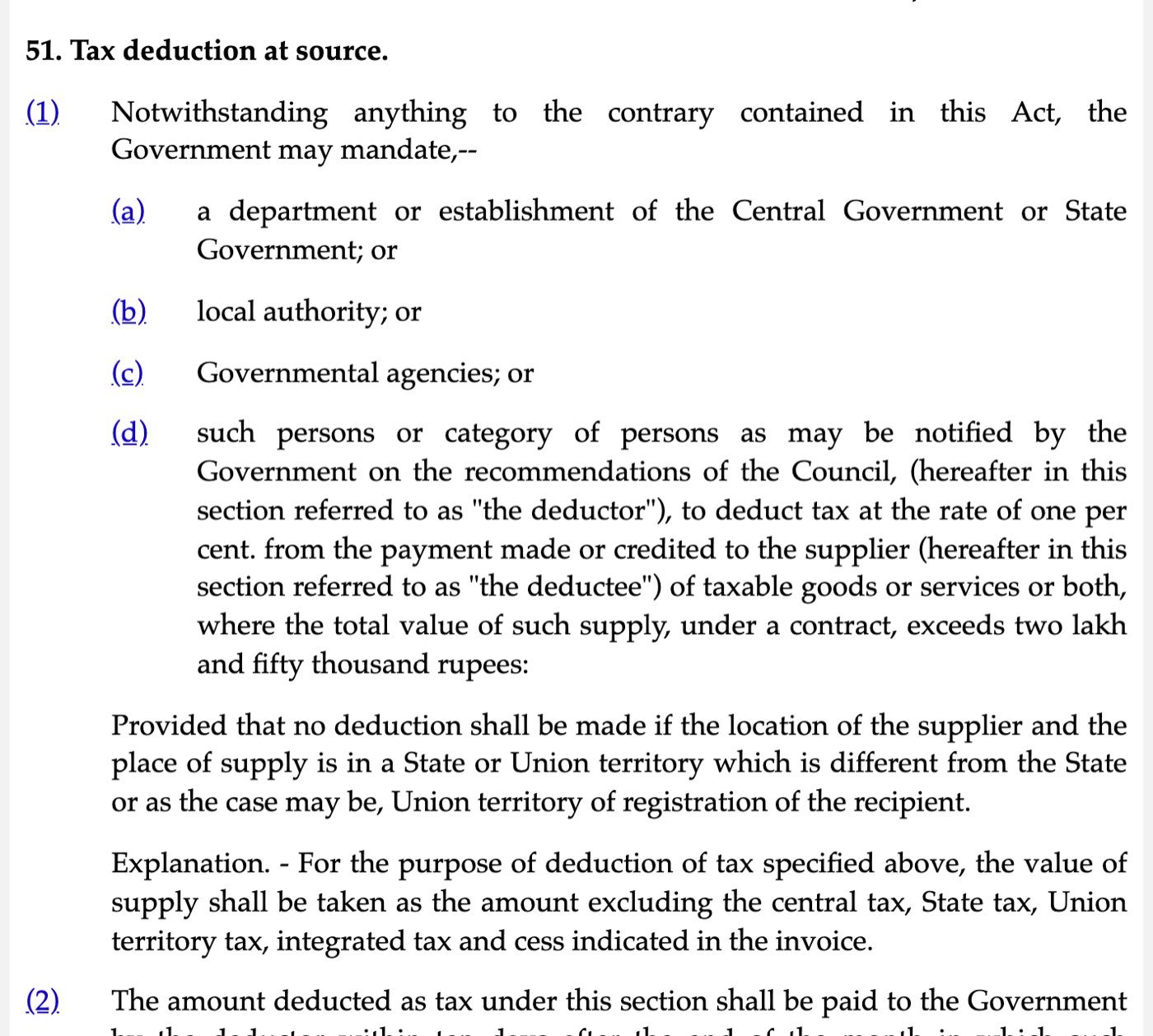
GST TDS is a cash-flow mechanism, not an extra tax. The deductee gets the full amount back as a credit in its electronic cash ledger once it accepts the deductor’s GSTR-7 entry, and uses it to pay its own GST. The government gains a trail of every large contract paid by public bodies and, since 2024, by scrap buyers.
Who has to deduct TDS under GST? (GST TDS applicability)
TDS under GST applies to the deductors named in section 51(1)(a) to (c) and to the persons the government has notified under clause (d), when they pay a supplier under a contract worth more than ₹2.5 lakh. The list on 31 October 2026:
| Clause | Deductor | Source |
|---|---|---|
| (a) | A department or establishment of the Central or a State Government | Section 51(1)(a); from 1 October 2018 |
| (b) | A local authority (municipality, panchayat, cantonment board) | Section 51(1)(b) |
| (c) | Governmental agencies | Section 51(1)(c) |
| (d) | An authority, board or body set up by an Act of Parliament or a State Legislature, or established by a Government, with 51% or more government equity or control | Notification 50/2018, clause (d)(a) |
| (d) | A society established by the Central or a State Government or a local authority under the Societies Registration Act, 1860 | Notification 50/2018, clause (d)(b) |
| (d) | Public sector undertakings | Notification 50/2018, clause (d)(c) |
| (d) | Any registered person buying metal scrap (Chapters 72 to 81) from another registered person | Notification 25/2024, from 10 October 2024 |
| (d) | Any registered person buying used cooking oil (1518), plastic waste and scrap (3915), tyre waste and scrap (4004), metal scrap (72 to 81) or electrical and electronic waste and scrap (8549) from another registered person | Notification 07/2026, from 1 November 2026 |
Three exclusions matter in practice. Notification 73/2018 removes supplies between deductors (a PSU paying a government department, a municipality paying a state board) from TDS. The proviso to section 51(1) removes supplies where both the supplier’s location and the place of supply are in another state. And the threshold is the contract value, so a ₹3 lakh contract paid in six ₹50,000 bills attracts TDS on every bill, while a ₹2.4 lakh contract paid in one go attracts none.
| Situation | Deduct TDS? |
|---|---|
| Contract for taxable goods or services worth more than ₹2.5 lakh (excluding GST), supplier and recipient in the same state | Yes: 1% CGST + 1% SGST |
| Same, but the supplier is in another state and the place of supply is the recipient’s state (IGST invoice) | Yes: 2% IGST |
| Supplier’s location and the place of supply are both in a state other than the recipient’s state of registration | No (proviso to section 51(1)) |
| Contract worth ₹2.5 lakh or less, even if a single payment is large | No |
| Exempt or nil-rated supply, or a supply on which the recipient pays GST under reverse charge | No (TDS applies to taxable supplies paid to the supplier) |
| Supply between two deductors: a department, local authority, government agency, PSU or notified body paying another | No (Notification 73/2018) |
| Payment made before 1 October 2018, or an advance for a contract below the threshold | No |
What is the rule for 2 GST TDS?
The “2% GST TDS” rule is section 51 read with the SGST Act: the CGST Act prescribes 1%, each State GST Act prescribes another 1%, so a supply within a state suffers 2% in two halves, and a supply across states suffers 2% IGST under section 20 of the IGST Act. The rate has not changed since 1 October 2018; what changed is who must deduct. The 2% is calculated on the taxable value in the invoice, before GST, and is deducted when the payment is made or credited, whichever comes first.
Do not confuse it with two other 2% deductions on the same bill. Income-tax TDS under section 194C (section 393 of the Income-tax Act, 2025) is 2% for a company contractor and 1% for an individual, deducted on the same GST-exclusive amount. And TCS under section 52 of the CGST Act, collected by e-commerce operators, is 0.5% since 10 July 2024, not 2%.
How to calculate GST TDS?
To calculate GST TDS, take the taxable value of the payment (the invoice amount minus the CGST, SGST, IGST and cess shown on it), check that the contract it belongs to is worth more than ₹2.5 lakh, and deduct 2%: 1% as CGST and 1% as SGST for a supply within the state, or 2% as IGST for a supply from another state. Steps:
- Identify the contract value excluding GST. Above ₹2.5 lakh, every payment under it is subject to TDS; at or below it, none is.
- Check the proviso. If the supplier’s location and the place of supply are both in a state other than yours, deduct nothing.
- Take the taxable value of this payment. Strip the GST and cess; include only what is paid to the supplier for the taxable supply.
- Apply 2%, split into CGST and SGST (same state) or as IGST (other state).
- Deduct income-tax TDS separately on the same GST-exclusive amount, if section 194C, 194J or another section applies.
How to deduct TDS on a GST bill: a worked example
Take a state PWD division paying a company contractor ₹5,00,000 plus 18% GST this month under a ₹20,00,000 road-repair contract, supplier and work both in the same state. The division deducts GST TDS and income-tax TDS on the same bill:
| Line | Amount |
|---|---|
| Taxable value of the works contract (payment this month) | ₹5,00,000 |
| GST at 18% shown on the invoice | ₹90,000 |
| Invoice total | ₹5,90,000 |
| GST TDS at 2% of ₹5,00,000 (CGST ₹5,000 + SGST ₹5,000) | ₹10,000 |
| Income-tax TDS at 2% (contractor is a company; also on ₹5,00,000, Circular 23/2017) | ₹10,000 |
| Paid to the contractor | ₹5,70,000 |
The division deposits ₹10,000 through its GST cash ledger and reports it in GSTR-7 by the 10th of next month, and deposits ₹10,000 with the Income Tax Department by the 7th. The contractor receives ₹5,70,000 in the bank, sees ₹10,000 in “TDS and TCS Credit Received” on the GST portal, accepts it, and uses it against its own output GST. The income-tax TDS shows in its Form 26AS.
Had the invoice been for a ₹2,40,000 contract, no GST TDS would apply, however large the single payment. Had the contractor been in another state doing work in that other state (an IGST invoice with the place of supply outside the division’s state), the proviso would switch GST TDS off too. The GST calculator separates the taxable value from the GST on any invoice.
What is the TDS on GST above 2.5 lakhs?
TDS on GST above 2.5 lakhs is 2% of the taxable value of every payment under a contract whose total value, excluding GST, exceeds ₹2,50,000. The ₹2.5 lakh test is applied to the contract, not to the invoice or the month. Once a contract crosses it, every payment under it attracts TDS, including the first one; a contract that never crosses it attracts none. The Karnataka Commercial Taxes Department’s FAQ puts it this way:
— FAQs on TDS under GST, Commercial Taxes Department, Karnataka
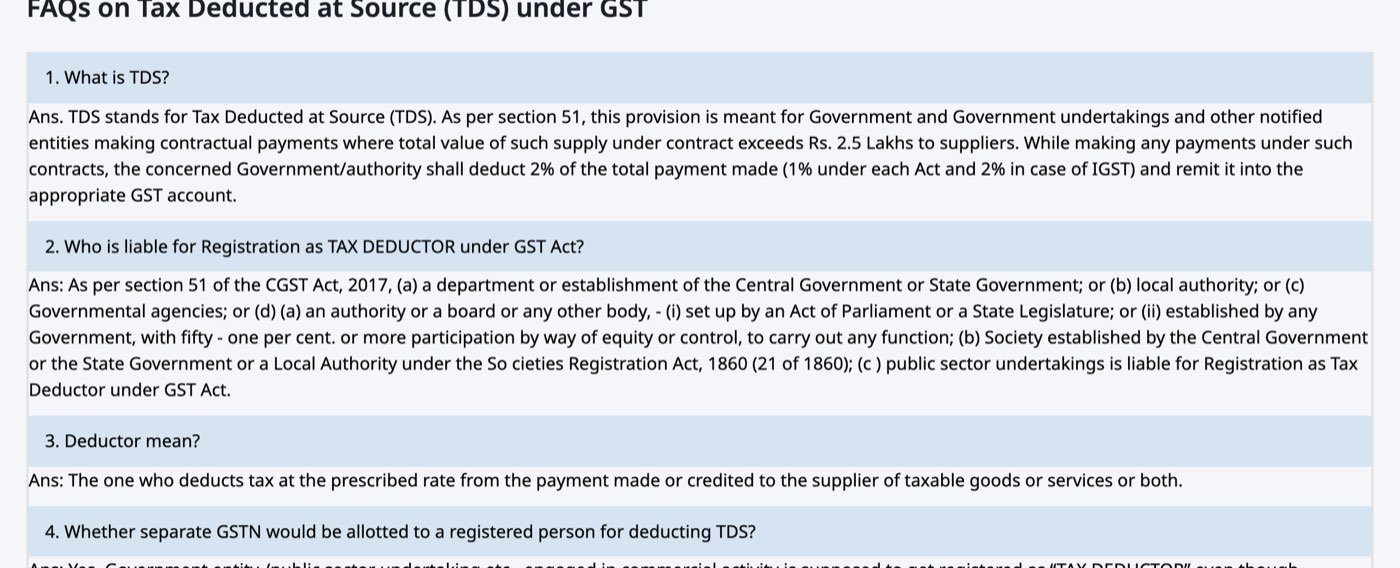
Two edge cases. A contract with a taxable part and an exempt part is tested on the taxable part only. And a contract amended upward past ₹2.5 lakh attracts TDS on payments made after the amendment, not retrospectively on the earlier ones.
How does a deductor register for TDS under GST?
A deductor registers for TDS under GST separately from any normal GSTIN, by filing Form GST REG-07 on the portal, and receives a TDS registration certificate in Form GST REG-06. Section 24(vi) makes this registration compulsory regardless of turnover. The GST portal’s own FAQ lists the preconditions:
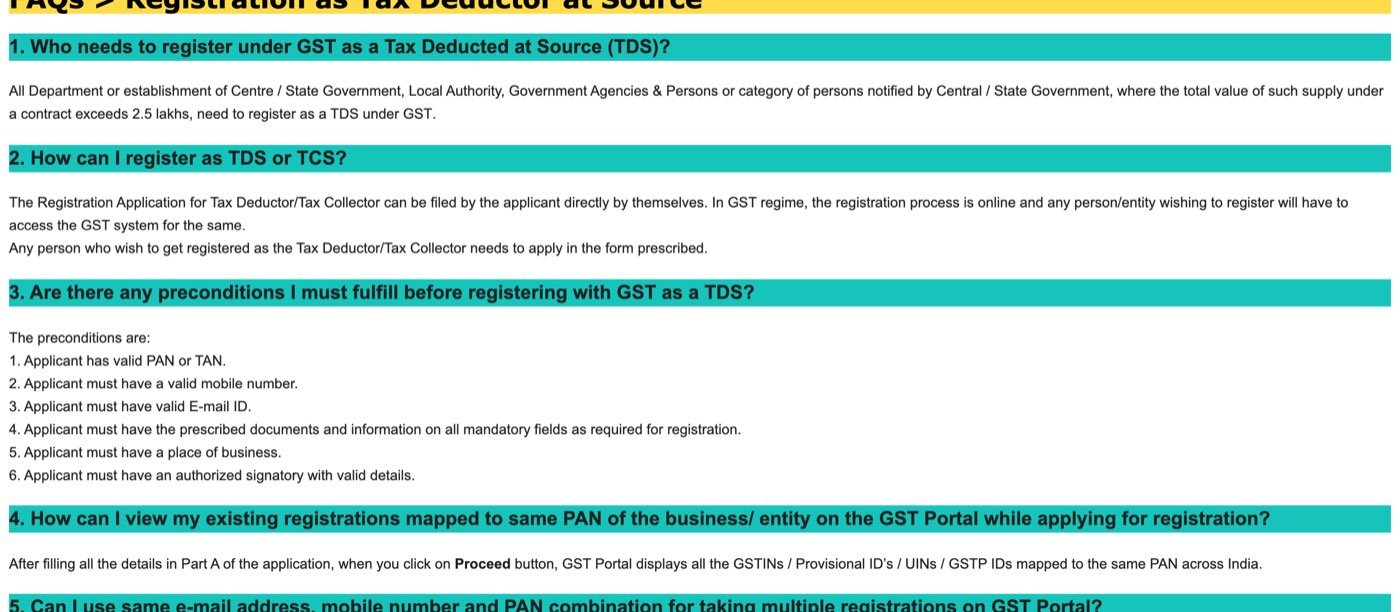
- Who signs: a DDO or an authorised signatory; government offices commonly register on the TAN.
- Timeline: the officer processes the application within 3 working days of first receipt, or within 7 working days after a reply to a query. Track it with the ARN; the GST ARN status guide decodes the number.
- Scrap and waste buyers: a trader already registered as a normal taxpayer still needs the separate TDS registration before deducting. Buyers of the four new categories must have it in place for payments from 1 November 2026.
- Cancellation: when the person stops being a deductor, the officer cancels the TDS registration in Form GST REG-08.
How is GST TDS deposited and reported? (GSTR-7 and GSTR-7A)
GST TDS is deposited and reported through Form GSTR-7, filed on the portal by the 10th of the month after the deduction, and the portal then generates the certificate, Form GSTR-7A, for each supplier. The timeline under section 51 and the rules:
| Step | When and how | Law |
|---|---|---|
| Deduct | On payment or credit to the supplier, whichever is earlier | Section 51(1) |
| Deposit | By the 10th of the next month, through the deductor’s cash ledger (PMT-06) | Section 51(2) |
| File GSTR-7 | By the 10th of the next month; a month with no deduction can be filed as nil | Section 39(3) |
| Certificate GSTR-7A | Generated by the portal from the filed GSTR-7; no signature needed | Section 51(3), rule 66 |
| Deductee accepts | In “TDS and TCS Credit Received” on the portal; the amount then sits in the electronic cash ledger | Section 51(5) |
Since the Finance Act, 2020 (in force 1 January 2021) the certificate is whatever the rules prescribe, and the old ₹100-a-day late fee for a late certificate in section 51(4) is gone: GSTR-7A is system-generated from the GSTR-7, so there is nothing for the deductor to issue by hand. The deductor downloads it from Services → User Services → View/Download Certificates; the deductee can download the same certificate.
What goes wrong, and what it costs:
| Failure | Consequence | Law |
|---|---|---|
| GSTR-7 filed late | ₹25 a day under the CGST Act plus ₹25 under the SGST Act (₹50 a day), capped at ₹1,000 + ₹1,000; nil for a month with no deduction | Section 47 read with Notification 23/2024 |
| TDS deducted but deposited late, or not deducted | Interest at 18% a year under section 50(1), plus the tax, recovered under sections 73 and 74 | Section 51(6), (7) |
| Excess or wrong deduction | Refund under section 54 to the deductor or the deductee; no refund to the deductor once the amount is in the deductee’s cash ledger | Section 51(8) |
How does the supplier claim GST TDS credit?
The supplier claims GST TDS credit by accepting the deductor’s entry in the “TDS and TCS Credit Received” statement on the GST portal (Services → Returns), after which the amount is credited to its electronic cash ledger, under section 51(5). It is not input tax credit and does not go through GSTR-3B’s ITC table; it sits in the cash ledger like a tax payment and can be used for output tax, interest or fees, or refunded under section 54. The portal’s manual:
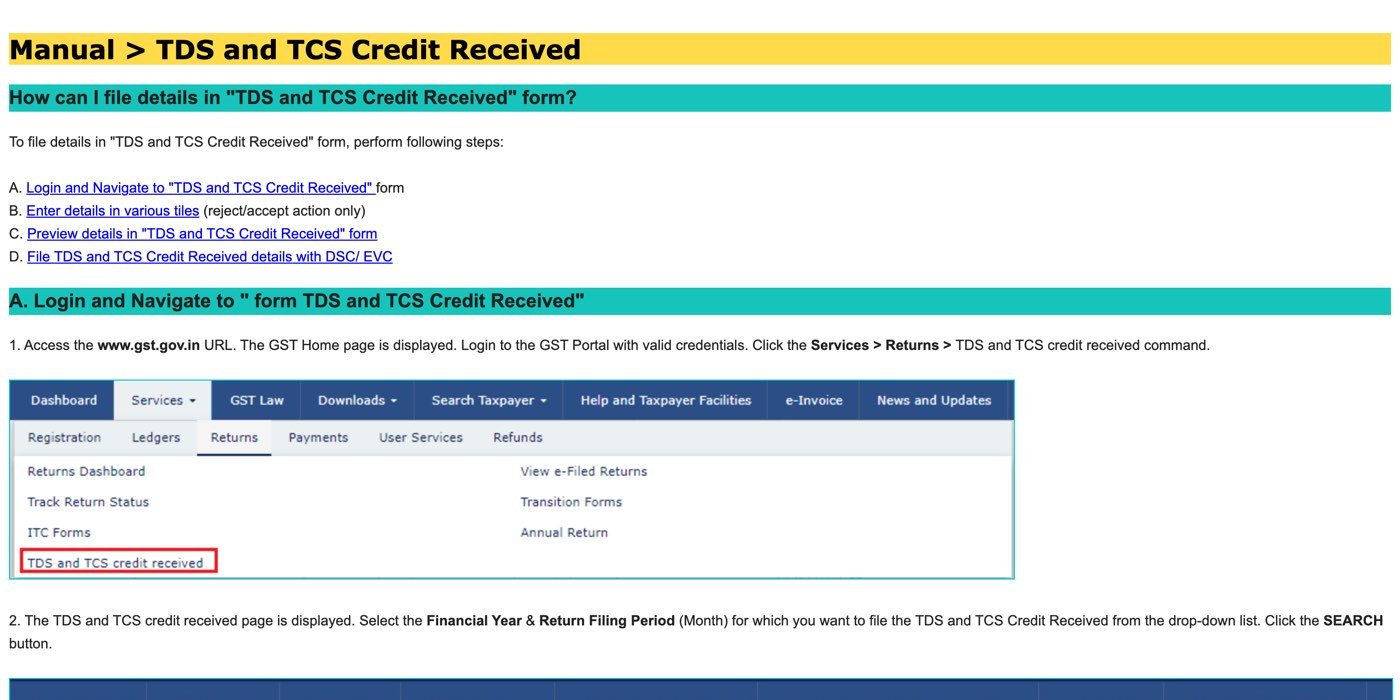
- Open Services → Returns → TDS and TCS credit received, choose the financial year and month, and click Search.
- Click Prepare Online. The rows auto-populated from every deductor’s GSTR-7 appear; accept the correct ones and reject the wrong ones. The statement cannot be filed until every row has an action.
- Click Generate Summary (from the September 2025 period this replaces the old Proceed to File button), preview, and file with DSC or EVC.
- Check the electronic cash ledger: the accepted amount appears under the CGST, SGST or IGST head in which it was deducted.
A rejected row goes back to the deductor to amend in its next GSTR-7. If the deductor never files GSTR-7, nothing appears, so chase the deductor rather than the portal: the credit depends on its return, not on the deduction.
What changes from 1 November 2026?
From 1 November 2026, any registered person buying used cooking oil, plastic scrap, tyre scrap, metal scrap or electrical and electronic waste from another registered person must deduct 2% GST TDS when the contract exceeds ₹2.5 lakh. Notification 07/2026-Central Tax, dated 27 October 2026, substitutes clause (d) of the 2018 notification; it follows the 57th GST Council meeting and copies the metal-scrap model of October 2024 to four more waste streams. The Gazette text:
— Notification 07/2026-Central Tax, G.S.R. 935(E), Gazette of India CG-DL-E-27102026-277454
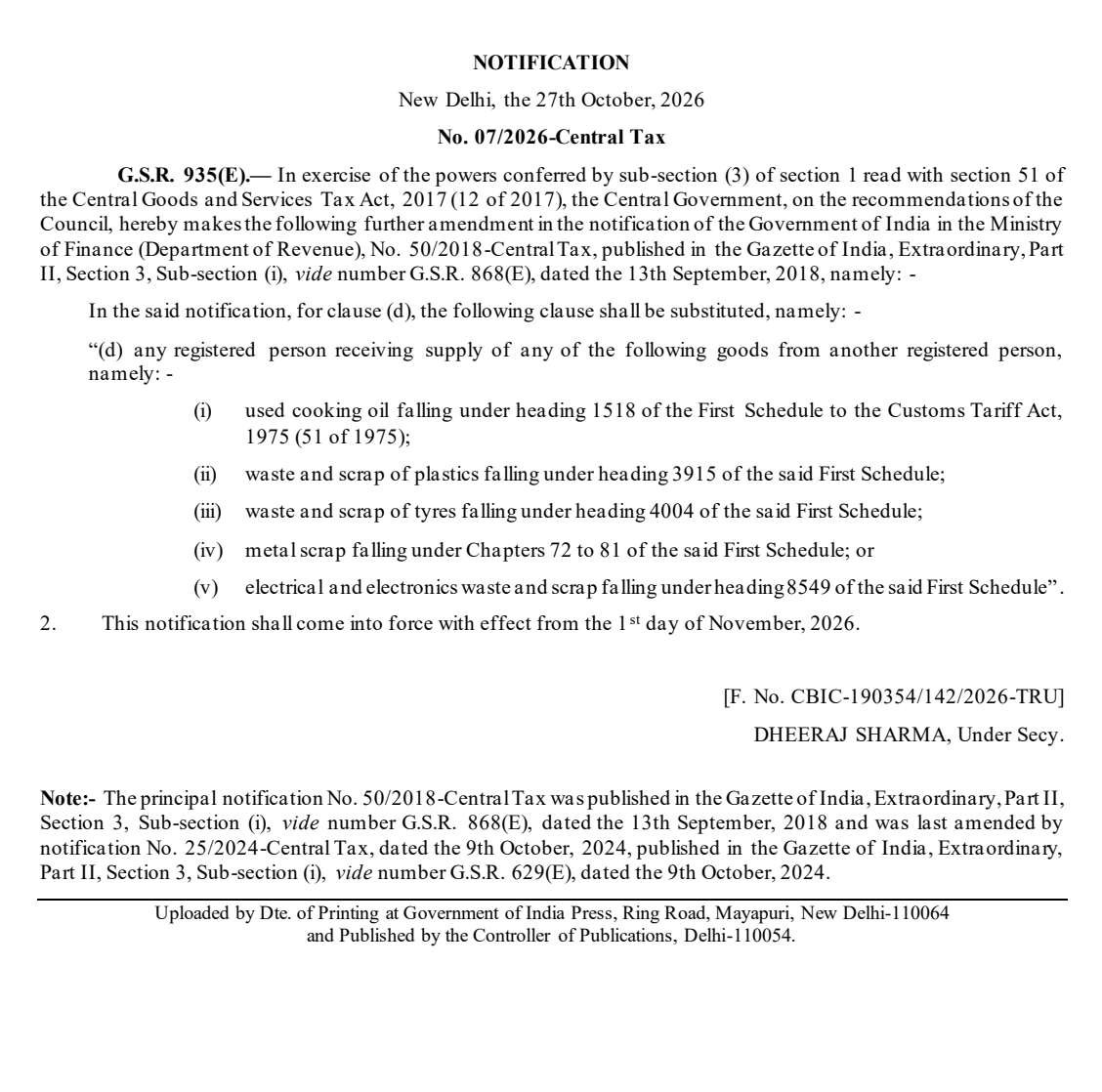
| Goods | Customs Tariff heading |
|---|---|
| Used cooking oil | Heading 1518 |
| Waste and scrap of plastics | Heading 3915 |
| Waste and scrap of tyres | Heading 4004 |
| Metal scrap (already covered since 10 October 2024) | Chapters 72 to 81 |
| Electrical and electronics waste and scrap | Heading 8549 |
Two companion notifications of the same date close the gaps. Notification 06/2026-Central Tax (G.S.R. 934(E)) withdraws the registration exemption of Notification 5/2017 for suppliers of these five goods, so a scrap or used-oil seller whose supplies are taxed under reverse charge must now register once it crosses the threshold. Notification 04/2026-Central Tax (Rate) (G.S.R. 927(E)) puts supplies of the same goods by an unregistered person to a registered person under reverse charge, so the buyer pays the GST itself in that case instead of deducting TDS. In short: registered seller, deduct 2% TDS; unregistered seller, pay the GST under reverse charge.
What a buyer in these trades should do before 1 November 2026: obtain the separate TDS registration (REG-07), list every supplier contract above ₹2.5 lakh, set the accounting system to deduct 2% on the taxable value of payments made on or after that date, and diarise GSTR-7 for the 10th. Payments for October supplies made in November are caught, because section 51 works on the payment or credit date.
Is income-tax TDS also deducted on a GST bill?
Yes. Income-tax TDS under sections 194C, 194J and the rest (section 393 of the Income-tax Act, 2025 from tax year 2026-27) is deducted on the same bill, separately from GST TDS, and CBDT Circular 23/2017 says it is calculated on the amount excluding GST when the GST is shown separately on the invoice. So a government department paying a contractor deducts both: 2% GST TDS to the GST account and 1% or 2% income-tax TDS to the Income Tax Department, each on the GST-exclusive value, as the worked example shows. The TDS rate chart has every income-tax section and rate, and the TDS payment guide the deposit steps.
The phrase “TDS on GST” is used for both, which causes most of the confusion. GST TDS is a GST-law deduction credited to the supplier’s GST cash ledger; income-tax TDS is an income-tax deduction credited to the supplier’s Form 26AS. One does not reduce the other.
TDS vs TCS under GST: what is the difference?
TDS under GST is deducted by a notified buyer under section 51; TCS under GST is collected by an e-commerce operator under section 52 from the sellers on its platform. Both end up in the supplier’s electronic cash ledger through the same “TDS and TCS Credit Received” statement, but the rates, returns and thresholds differ:
| TDS (section 51) | TCS (section 52) | |
|---|---|---|
| Who | The buyer (government, PSU, notified body, or a registered scrap buyer) | The e-commerce operator (Amazon, Flipkart, Swiggy and so on) |
| Section | 51 | 52 |
| Rate | 2% (1% + 1%, or 2% IGST) | 0.5% (0.25% + 0.25%, or 0.5% IGST) since 10 July 2024 |
| Threshold | Contract value above ₹2.5 lakh | None |
| Return | GSTR-7 by the 10th | GSTR-8 by the 10th |
| Certificate | GSTR-7A | None; the supplier sees it in GSTR-2A and the credit-received statement |
Marketplace sellers meet TCS, not TDS; the Amazon and Flipkart sellers’ guide covers it. Freelancers billing a government department or PSU meet GST TDS once a contract crosses ₹2.5 lakh, on top of the income-tax TDS described in the freelancing guide.
GST में TDS क्या है?
GST में TDS, CGST अधिनियम की धारा 51 के तहत 2% की कटौती है, जो सरकारी विभाग, स्थानीय निकाय, PSU और अधिसूचित संस्थाएँ किसी सप्लायर को भुगतान करते समय करती हैं, जब अनुबंध (कॉन्ट्रैक्ट) का मूल्य GST छोड़कर ₹2.5 लाख से अधिक हो। एक ही राज्य में 1% CGST + 1% SGST, और दूसरे राज्य से सप्लाई पर 2% IGST; गणना इनवॉइस की कर-योग्य राशि पर होती है, GST पर नहीं। कटौतीकर्ता अगले महीने की 10 तारीख तक राशि जमा करके GSTR-7 भरता है, पोर्टल GSTR-7A प्रमाणपत्र बनाता है, और सप्लायर “TDS and TCS Credit Received” में एंट्री स्वीकार करके राशि अपने इलेक्ट्रॉनिक कैश लेजर में पाता है। 10 अक्टूबर 2024 से रजिस्टर्ड मेटल स्क्रैप खरीदारों पर और 1 नवंबर 2026 से (अधिसूचना 07/2026-केंद्रीय कर) प्रयुक्त खाद्य तेल, प्लास्टिक स्क्रैप, टायर स्क्रैप और ई-वेस्ट के रजिस्टर्ड खरीदारों पर भी यही नियम लागू है। आयकर का TDS (धारा 194C आदि) इसी बिल पर अलग से, GST छोड़कर राशि पर कटता है।
Common questions
A 2% deduction under section 51 of the CGST Act that government departments, local authorities, government agencies, PSUs, 51% government bodies and notified registered buyers (metal scrap since October 2024; used cooking oil, plastic scrap, tyre scrap and e-waste from 1 November 2026) make from payments to a supplier when the contract is worth more than Rs 2.5 lakh excluding GST.
Tax deducted at source under the GST law: 2% of the taxable value (1% CGST plus 1% SGST, or 2% IGST), deducted by a notified buyer when it pays a supplier under a contract above Rs 2.5 lakh, deposited by the 10th of the next month and reported in GSTR-7.
Section 51 of the CGST Act prescribes 1% and each State GST Act another 1%, so the deduction is 2% within a state (1% + 1%) and 2% IGST across states. It is calculated on the invoice value excluding GST and applies only when the contract exceeds Rs 2.5 lakh.
Take the taxable value of the payment (invoice total minus the GST and cess shown), confirm the contract is above Rs 2.5 lakh excluding GST and that the supplier's location and place of supply are not both in another state, then deduct 2%: 1% CGST and 1% SGST, or 2% IGST. On a Rs 5,00,000 bill plus 18% GST, GST TDS is Rs 10,000.
2% of the taxable value of every payment under a contract whose total value, excluding GST, exceeds Rs 2,50,000. The threshold is tested on the contract, not on each invoice, so a Rs 3 lakh contract attracts TDS on every bill under it, while a Rs 2.4 lakh contract attracts none.
Departments and establishments of the Central and State Governments, local authorities, government agencies, authorities or bodies with 51% or more government equity or control, government societies and PSUs (Notification 50/2018), registered buyers of metal scrap from registered sellers (Notification 25/2024, from 10 October 2024) and, from 1 November 2026, registered buyers of used cooking oil, plastic scrap, tyre scrap, metal scrap and e-waste from registered sellers (Notification 07/2026).
No. The Explanation to section 51(1) says the value of supply for TDS is the amount excluding CGST, SGST, UTGST, IGST and cess shown in the invoice. GST TDS is 2% of the taxable value only.
Both fall on the 10th of the month following the month of deduction: the tax is deposited within ten days after the end of the month (section 51(2)) and GSTR-7 is filed by the 10th (section 39(3)). GSTR-7A is generated by the portal after the return is filed.
Rs 25 a day under the CGST Act plus Rs 25 under the SGST Act, Rs 50 a day in all, capped at Rs 1,000 plus Rs 1,000 (Notification 23/2024-Central Tax, in force from 1 November 2024). A month in which nothing was deducted carries no late fee. Tax deposited late attracts 18% interest under section 50(1).
By accepting the deductor's entry in the TDS and TCS Credit Received statement on the GST portal (Services, Returns). The amount is then credited to the electronic cash ledger under section 51(5) and can be used to pay output tax, interest or fees, or claimed as a refund under section 54. It is not input tax credit.
Yes, at 2% IGST, when the supplier is in another state and the place of supply is the recipient's state. It is not applicable when both the supplier's location and the place of supply are in a state other than the recipient's state of registration (proviso to section 51(1)).
No. Notification 73/2018-Central Tax excludes supplies between persons specified in clauses (a) to (d) of section 51(1), so a PSU paying a government department, or a municipality paying a state board, deducts no GST TDS.
Yes. Since 10 October 2024 (Notification 25/2024) any registered person buying metal scrap falling under Chapters 72 to 81 from another registered person must deduct 2% GST TDS when the contract exceeds Rs 2.5 lakh. From 1 November 2026 the same applies to used cooking oil, plastic scrap, tyre scrap and e-waste.
Notification 07/2026-Central Tax of 27 October 2026 extends section 51 TDS to registered buyers of used cooking oil (heading 1518), waste and scrap of plastics (3915), waste and scrap of tyres (4004), metal scrap (Chapters 72 to 81) and electrical and electronic waste and scrap (8549) bought from registered sellers. Notification 06/2026 withdraws the registration exemption for suppliers of those goods, and Notification 04/2026-Central Tax (Rate) puts supplies of them by unregistered persons under reverse charge.
No. CBDT Circular 23/2017 says income-tax TDS under sections 194C, 194J and the others is deducted on the amount excluding GST when the GST is indicated separately in the invoice or contract. GST TDS under section 51 is a separate deduction on the same GST-exclusive value.
TDS (section 51) is deducted at 2% by a notified buyer on contracts above Rs 2.5 lakh and reported in GSTR-7. TCS (section 52) is collected at 0.5% (0.25% CGST plus 0.25% SGST, or 0.5% IGST, since 10 July 2024) by e-commerce operators from the sellers on their platforms, with no threshold, and reported in GSTR-8. Both reach the supplier's electronic cash ledger.
- CGST Act, 2017, section 51 — Tax deduction at source (Indian Kanoon)
- Finance Act, 2020, section 124 — amendment of section 51 (Indian Kanoon)
- Notification 50/2018–Central Tax, 13 September 2018 — section 51 in force from 1 October 2018; clause (d) persons
- Notification 73/2018–Central Tax, 31 December 2018 — no TDS between deductors
- Notification 23/2024–Central Tax, 8 October 2024 — GSTR-7 late fee
- Notification 15/2024–Central Tax, 10 July 2024 — TCS at 0.5%
- Gazette of India Extraordinary No. 848, 27 October 2026 — Notifications 06/2026 and 07/2026–Central Tax and 04/2026–Central Tax (Rate)
- Commercial Taxes Department, Karnataka — FAQs on TDS under GST
- GST portal — FAQs: Registration as Tax Deductor at Source
- GST portal — Manual: TDS and TCS Credit Received
- CBDT Circular 23/2017, 19 July 2017 — income-tax TDS on the amount excluding GST (itatonline copy)
Section 51, the notifications and the Gazette of 27 October 2026 were read in full on 31 October 2026; the portal procedure follows the GST portal’s own manuals. The Karnataka FAQ predates the 2021 amendment and still describes the old certificate late fee, which no longer applies. The worked example assumes a company contractor and an intra-state supply. This is a guide, not advice on a specific contract.