Sukanya Samriddhi Yojana (SSY) calculator: maturity amount and yearly chart
See what your daughter’s Sukanya Samriddhi account will be worth at maturity, how it grows every year, and how much can be withdrawn for her education at 18, using the interest method in the scheme rules.
Checked 26 October 2026 · Sukanya Samriddhi Account Scheme, 2019 · matches SBI’s official calculator · your figures never leave your browser
Your deposits
At maturity
Deposits assumed on or before the 5th of the month; interest credited and compounded every 31 March, as the scheme rules say. The rate is fixed by the government each quarter, so the figure is an estimate at today’s 8.2%. Everything runs in your browser.
| Year | FY | Age | Deposited | Interest | Balance on 31 March |
|---|
A Sukanya Samriddhi Yojana account paying 8.2% turns ₹1,50,000 a year into ₹71,82,119 at maturity: ₹22,50,000 deposited over 15 years plus ₹49,32,119 of interest, paid out 21 years after the account opens. At ₹12,500 a month the figure is ₹69,32,648, at ₹3,000 a month ₹16,63,835, and at ₹1,000 a month ₹5,54,612. These match SBI’s own SSA calculator to the rupee.
Sukanya Samriddhi Yojana (SSY) is the government’s savings scheme for a girl child under 10, run under the Sukanya Samriddhi Account Scheme, 2019. Deposits run for 15 years, the account matures 21 years after opening, and the interest, 8.2% a year since 1 January 2024, is compounded yearly and is tax-free. This Sukanya Samriddhi Yojana calculator (SSY calculator) works the way the scheme rules say interest is calculated, shows the year-by-year balance, and tells you how much can be withdrawn for her education at 18. The figures are the same for an account at a post office or at a bank, so it serves as a post office Sukanya Samriddhi Yojana calculator and an SBI one alike. We read the scheme rules, the National Savings Institute’s rate table, India Post’s scheme guide and the Income-tax Act, 2025 on 26 October 2026; the screenshots are from that day.
- Interest rate: 8.2% a year, compounded yearly (since 1 January 2024; set every quarter)
- Who: one account per girl under 10, opened by a parent or guardian; two per family (more for twins or triplets)
- Deposits: ₹250 to ₹1,50,000 a financial year, in multiples of ₹50, for 15 years from opening
- Maturity: 21 years from opening, or on marriage after she turns 18
- Withdrawal: up to 50% of the previous year-end balance for education, once she is 18 or has passed class 10
- Tax: deposits count towards the ₹1.5 lakh deduction under section 123 (old regime); interest and maturity are exempt (Schedule II)
- Missed year: ₹50 penalty per year of default plus the ₹250 minimum
How much money will I get after 21 years of Sukanya Samriddhi Yojana?
After 21 years a Sukanya Samriddhi account returns everything deposited over its first 15 years plus the interest, which at 8.2% is roughly 2.2 times the deposits: ₹71,82,119 for ₹1,50,000 a year, ₹69,32,648 for ₹12,500 a month, ₹27,73,059 for ₹5,000 a month, ₹16,63,835 for ₹3,000 a month and ₹5,54,612 for ₹1,000 a month. The exact figure depends on the rate holding at 8.2% for all 21 years, which it will not, because the government resets it every quarter:
| You deposit | For 15 years, total | You get after 21 years |
|---|---|---|
| ₹1,000 a month | ₹1,80,000 | ₹5,54,612 |
| ₹3,000 a month | ₹5,40,000 | ₹16,63,835 |
| ₹5,000 a month | ₹9,00,000 | ₹27,73,059 |
| ₹12,500 a month (the maximum) | ₹22,50,000 | ₹69,32,648 |
| ₹1,50,000 a year (the maximum) | ₹22,50,000 | ₹71,82,119 |
The money is paid out 21 years after the account opened, not when the girl reaches a particular age: an account opened when she was 5 pays out when she is 26. The calculator above gives the figure for your own amount and frequency, with the balance for every year in between.
How is the Sukanya Samriddhi maturity amount calculated?
The Sukanya Samriddhi maturity amount is the sum of 15 years of deposits plus interest that is worked out every month on the balance and added to the account once a year, on 31 March, for the full 21 years. Paragraph 5(2) of the scheme rules fixes the method:

Three things follow from that rule, and the calculator applies all of them:
- Deposit by the 5th. A deposit on the 6th or later earns no interest for that month. Yearly depositors do best paying in the first week of April; monthly depositors should set the standing instruction for the 1st to the 5th.
- Yearly compounding, not monthly. Interest accrues month by month but joins the balance only on 31 March, so there is no interest on interest within a year. The yearly interest is therefore the balance each month multiplied by 8.2% ÷ 12, added up.
- Interest for six more years. Deposits stop after 15 years, but the balance keeps earning for years 16 to 21. For ₹1,50,000 a year, the balance at the end of year 15 is ₹44,75,989 and it grows to ₹71,82,119 by year 21 with no further deposits.
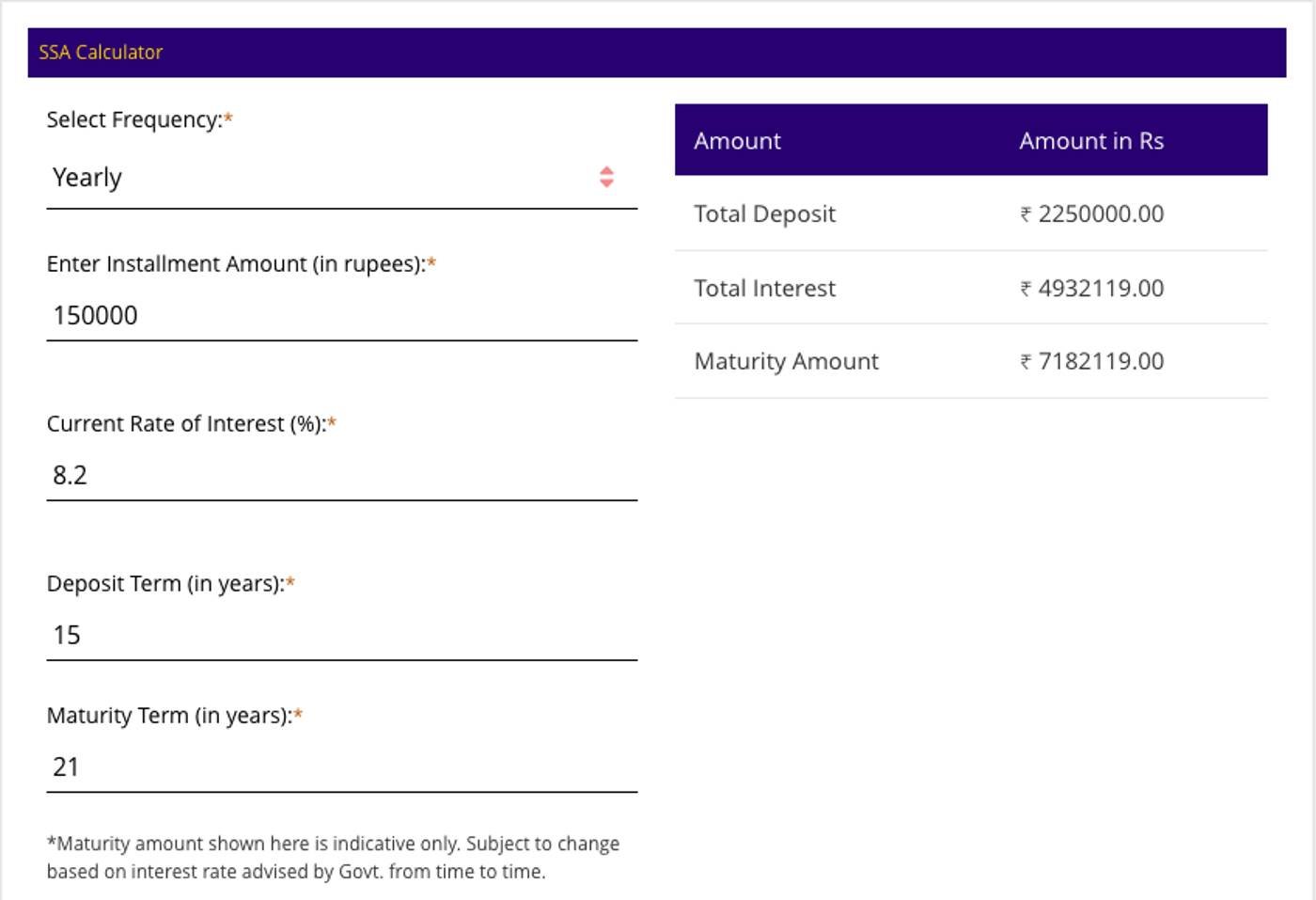
The formula for a yearly deposit A made at the start of each year is A × [(1 + r)15 − 1] ÷ r × (1 + r)7, which gives ₹71,82,119 for ₹1,50,000 at 8.2%. SBI’s official calculator, which uses the same method, returns the same figure:
What does the Sukanya Samriddhi Yojana chart show for ₹1,000 to ₹12,500 a month?
The Sukanya Samriddhi Yojana chart below gives the maturity amount at 8.2% for the common deposit sizes, assuming the deposit is made on time for all 15 years and the rate does not change. ₹12,500 a month and ₹1,50,000 a year both deposit the yearly maximum, but the yearly lump sum paid in April earns about ₹2,49,471 more by maturity, because the whole year’s money starts earning in April:
| Deposit | Total deposited | Total interest | Maturity amount |
|---|---|---|---|
| ₹1,000 a month | ₹1,80,000 | ₹3,74,612 | ₹5,54,612 |
| ₹2,000 a month | ₹3,60,000 | ₹7,49,224 | ₹11,09,224 |
| ₹3,000 a month | ₹5,40,000 | ₹11,23,835 | ₹16,63,835 |
| ₹5,000 a month | ₹9,00,000 | ₹18,73,059 | ₹27,73,059 |
| ₹8,000 a month | ₹14,40,000 | ₹29,96,895 | ₹44,36,895 |
| ₹10,000 a month | ₹18,00,000 | ₹37,46,118 | ₹55,46,118 |
| ₹12,500 a month | ₹22,50,000 | ₹46,82,648 | ₹69,32,648 |
| ₹12,000 a year | ₹1,80,000 | ₹3,94,570 | ₹5,74,570 |
| ₹24,000 a year | ₹3,60,000 | ₹7,89,139 | ₹11,49,139 |
| ₹50,000 a year | ₹7,50,000 | ₹16,44,040 | ₹23,94,040 |
| ₹1,00,000 a year | ₹15,00,000 | ₹32,88,079 | ₹47,88,079 |
| ₹1,50,000 a year | ₹22,50,000 | ₹49,32,119 | ₹71,82,119 |
So ₹1,000 a month, the figure most people search for, gives ₹5,54,612 after 21 years, of which ₹3,74,612 is interest on ₹1,80,000 deposited. ₹3,000 a month gives ₹16,63,835, and ₹5,000 a month ₹27,73,059. Any amount in multiples of ₹50 works, as long as the year’s total is between ₹250 and ₹1,50,000.
How does ₹1,50,000 a year grow year by year in Sukanya Samriddhi?
The year-by-year chart for the maximum deposit shows how the balance builds: slowly at first, then faster as the interest on a large balance outgrows the deposit itself. From year 9 the yearly interest exceeds the ₹1,50,000 deposit. For a daughter whose account opens at age 5 in 2026-27, the account matures in 2047-48 when she is 26:
| Year | Financial year | Her age | Deposited | Interest | Balance on 31 March |
|---|---|---|---|---|---|
| 1 | 2026-27 | 6 | ₹1,50,000 | ₹12,300 | ₹1,62,300 |
| 2 | 2027-28 | 7 | ₹1,50,000 | ₹25,609 | ₹3,37,909 |
| 3 | 2028-29 | 8 | ₹1,50,000 | ₹40,009 | ₹5,27,917 |
| 4 | 2029-30 | 9 | ₹1,50,000 | ₹55,589 | ₹7,33,506 |
| 5 | 2030-31 | 10 | ₹1,50,000 | ₹72,448 | ₹9,55,954 |
| 6 | 2031-32 | 11 | ₹1,50,000 | ₹90,688 | ₹11,96,642 |
| 7 | 2032-33 | 12 | ₹1,50,000 | ₹1,10,425 | ₹14,57,067 |
| 8 | 2033-34 | 13 | ₹1,50,000 | ₹1,31,779 | ₹17,38,846 |
| 9 | 2034-35 | 14 | ₹1,50,000 | ₹1,54,885 | ₹20,43,732 |
| 10 | 2035-36 | 15 | ₹1,50,000 | ₹1,79,886 | ₹23,73,618 |
| 11 | 2036-37 | 16 | ₹1,50,000 | ₹2,06,937 | ₹27,30,554 |
| 12 | 2037-38 | 17 | ₹1,50,000 | ₹2,36,205 | ₹31,16,760 |
| 13 | 2038-39 | 18 | ₹1,50,000 | ₹2,67,874 | ₹35,34,634 |
| 14 | 2039-40 | 19 | ₹1,50,000 | ₹3,02,140 | ₹39,86,774 |
| 15 | 2040-41 | 20 | ₹1,50,000 | ₹3,39,215 | ₹44,75,989 |
| 16 | 2041-42 | 21 | – | ₹3,67,031 | ₹48,43,020 |
| 17 | 2042-43 | 22 | – | ₹3,97,128 | ₹52,40,148 |
| 18 | 2043-44 | 23 | – | ₹4,29,692 | ₹56,69,840 |
| 19 | 2044-45 | 24 | – | ₹4,64,927 | ₹61,34,767 |
| 20 | 2045-46 | 25 | – | ₹5,03,051 | ₹66,37,818 |
| 21 | 2046-47 | 26 | – | ₹5,44,301 | ₹71,82,119 |
The calculator at the top prints this table for your own amount, frequency and opening year.
What is the Sukanya Samriddhi interest rate now?
The Sukanya Samriddhi Yojana interest rate is 8.2% a year, the highest rate among the post office small savings schemes, shared only with the Senior Citizen Savings Scheme. The rate has been 8.2% since 1 January 2024. NSI’s official table runs to 30 September 2026, and the Finance Ministry’s quarterly revision of 30 September 2026 kept it at 8.2% for October to December 2026. The next revision is due at the end of December 2026. The rate applies to the whole balance, not just new deposits, so every change moves the maturity amount; the calculator lets you test a different rate. The rates since the scheme began on 3 December 2014:
| Period | Rate (% a year) |
|---|---|
| 3 Dec 2014 – 31 Mar 2015 | 9.1 |
| 1 Apr 2015 – 31 Mar 2016 | 9.2 |
| 1 Apr 2016 – 30 Sep 2016 | 8.6 |
| 1 Oct 2016 – 31 Mar 2017 | 8.5 |
| 1 Apr 2017 – 30 Jun 2017 | 8.4 |
| 1 Jul 2017 – 31 Dec 2017 | 8.3 |
| 1 Jan 2018 – 30 Sep 2018 | 8.1 |
| 1 Oct 2018 – 30 Jun 2019 | 8.5 |
| 1 Jul 2019 – 31 Mar 2020 | 8.4 |
| 1 Apr 2020 – 31 Mar 2023 | 7.6 |
| 1 Apr 2023 – 31 Dec 2023 | 8.0 |
| 1 Jan 2024 – 30 Sep 2026 (NSI table), unchanged for Oct–Dec 2026 | 8.2 |
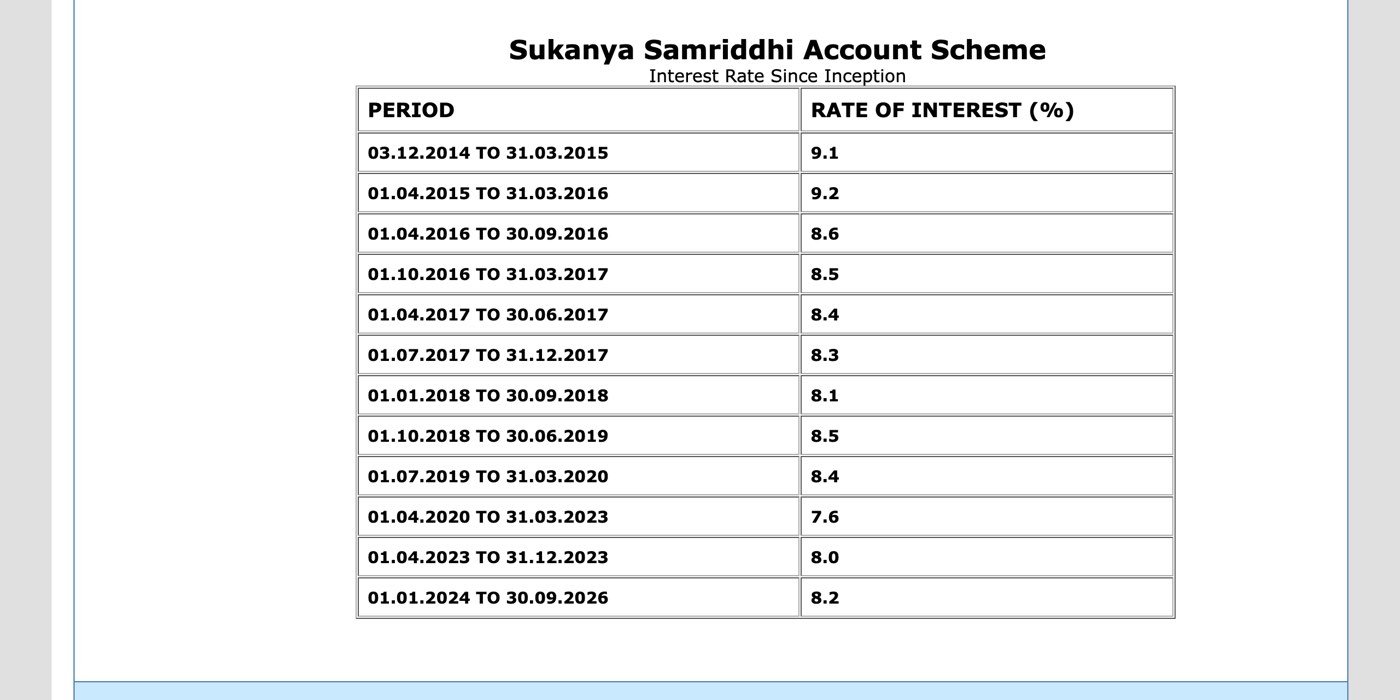
Across 21 years a rate change of even half a percentage point matters: at 7.6%, the 2020 to 2023 rate, ₹1,50,000 a year would mature at ₹65,93,071 instead of ₹71,82,119.
Who can open an SSY account, and how much can be deposited?
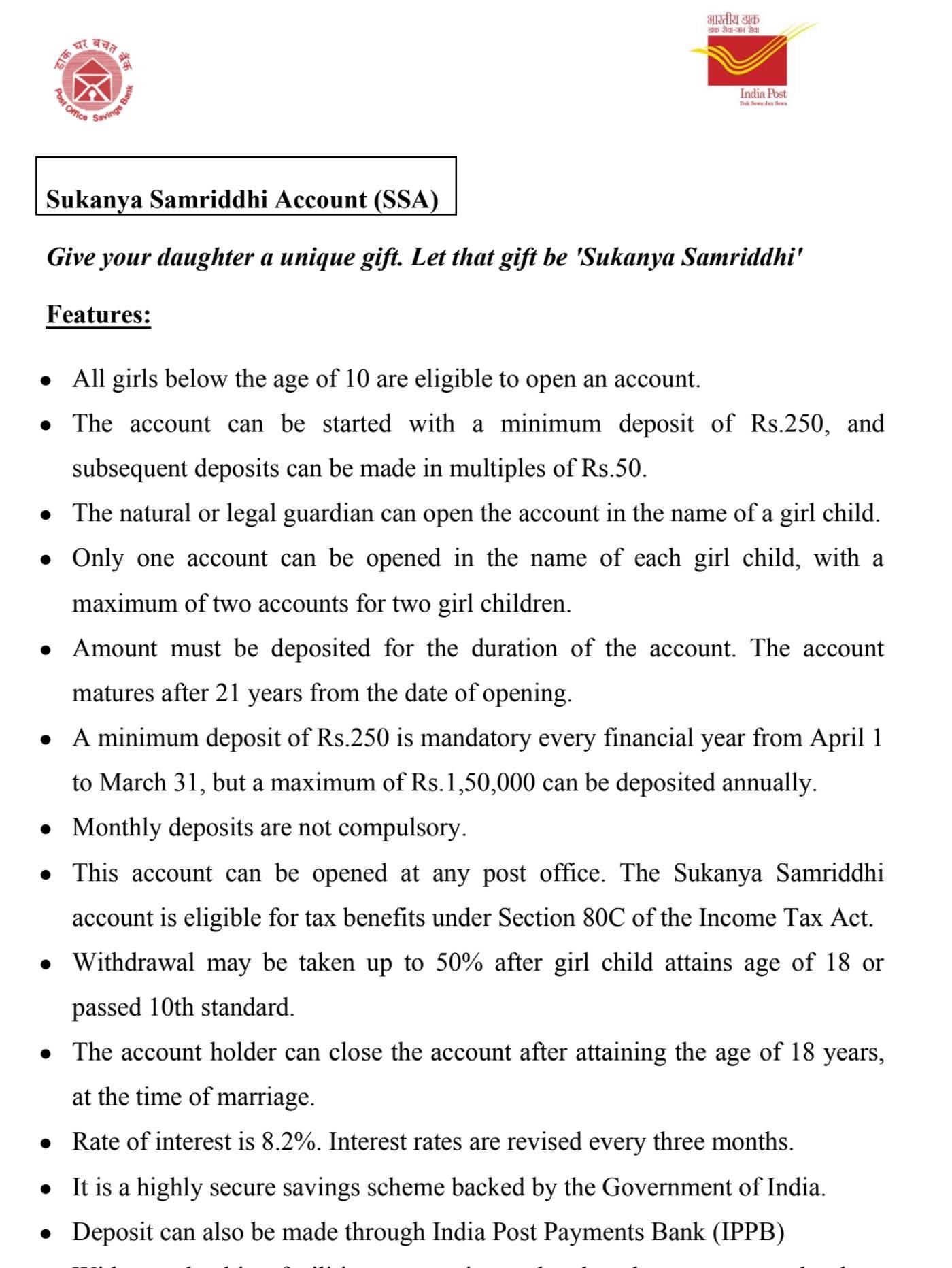
A Sukanya Samriddhi account can be opened by a parent or legal guardian for a girl who is under 10 on the day of opening, at any post office or an authorised bank. The scheme rules set the limits:
- One account per girl, two per family (para 3). A third is allowed for twins or triplets, with an affidavit and the birth certificates.
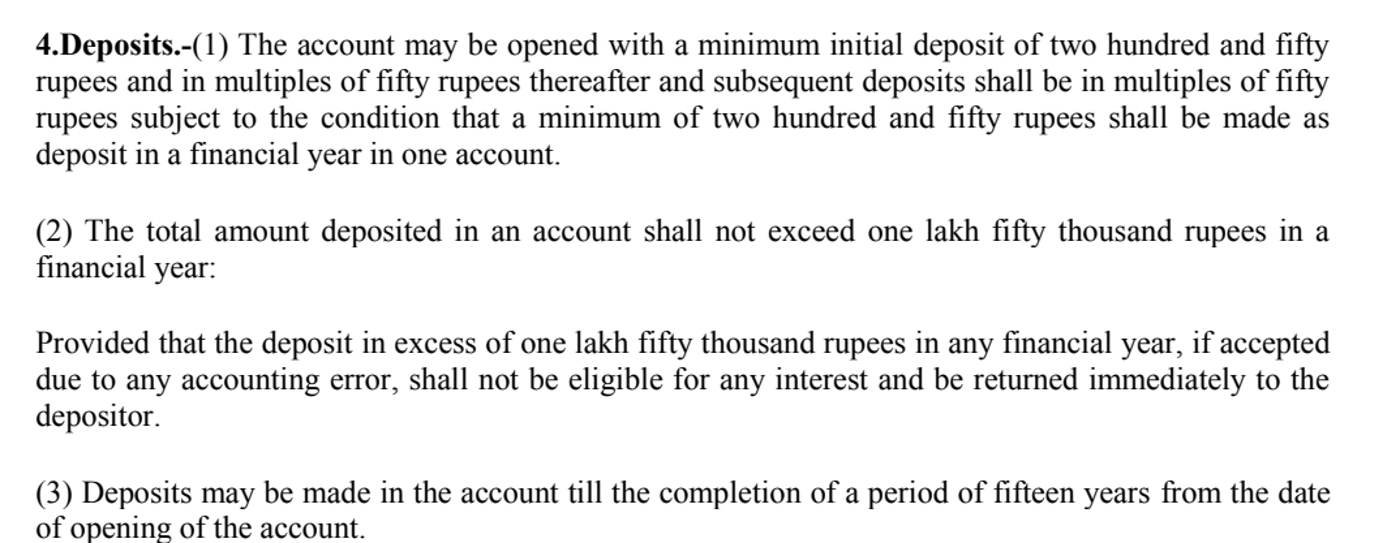
- ₹250 to open, then multiples of ₹50. At least ₹250 must go in every financial year, and no more than ₹1,50,000. Anything above the cap earns no interest and is returned (para 4(1), (2)).
- Deposits for 15 years from the date of opening, after which the account only earns interest until maturity (para 4(3)).
- Missed years. An account with less than ₹250 in a year is “in default”. It can be regularised any time within the 15 years by paying ₹50 for each defaulted year plus the ₹250 minimum for those years (para 4(4)). Even an unregularised account keeps earning the scheme rate on what was deposited (para 4(5)).
- Documents. The girl’s birth certificate and the guardian’s identity and address proof, with Form 1.
When can the money be withdrawn?
Money can be withdrawn from a Sukanya Samriddhi account in three situations before maturity, and the account pays out in full at maturity:
- Education, up to 50% at 18 or after class 10. Once the girl is 18 or has passed class 10, whichever is earlier, up to half of the balance at the end of the previous financial year can be withdrawn for her education, against an admission offer or fee slip, in one lump sum or in up to five yearly instalments (para 8). The calculator shows this figure for the year she turns 18.
- Marriage, after 18. The account can be closed for her marriage once she is 18, between one month before and three months after the wedding, on a declaration of age (para 9(2)).
- Hardship, after 5 years. Premature closure is allowed on compassionate grounds, such as a life-threatening illness of the girl or the death of the guardian, but not within five years of opening (para 7(3)). If the girl dies, the account is closed and paid to the guardian with interest to the date of death (para 7(1)).
- Maturity, 21 years after opening. The balance with interest is paid to the account holder on Form 4 (para 9). Her age at maturity is her age at opening plus 21, so an account opened at birth matures when she is 21 and one opened at 10 when she is 31.

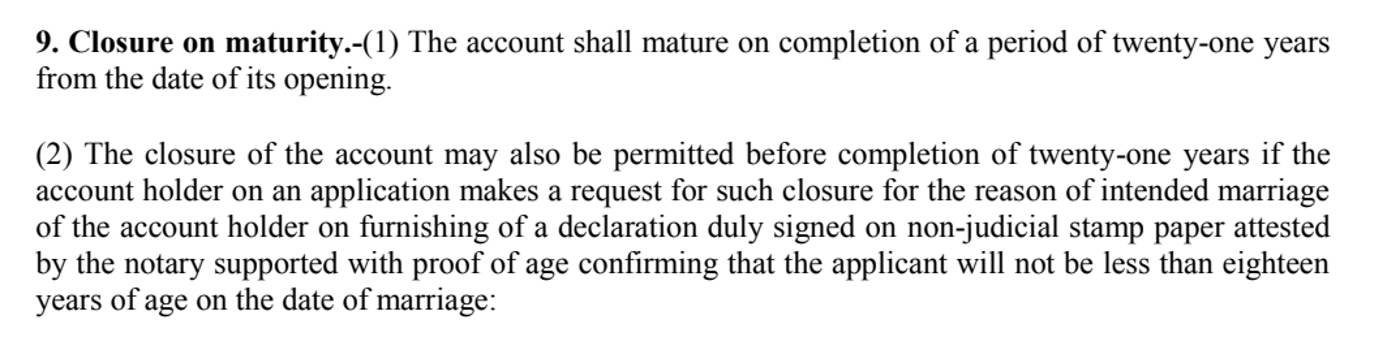
From 18 the girl operates the account herself; until then the guardian does (para 6). An account left open after maturity earns only the Post Office Savings Account rate, as the Finance Ministry’s January 2026 note on the scheme says, so there is no reason to leave the money in it.
How do I get the maturity amount from a Sukanya Samriddhi account?
The maturity amount of a Sukanya Samriddhi account is paid to the girl herself, on her application in Form 4 at the post office or bank, once 21 years have passed since the account opened (para 9(3)). The steps:
- Check the maturity date. It is 21 years from the date of opening, shown in the passbook, whatever the girl's age then. Closure for her marriage is possible earlier, once she is 18.
- She applies, not the guardian. From 18 the account holder operates the account herself, so she signs Form 4 and submits it with the passbook and her identity proof.
- The balance is paid with interest. The office pays the balance and the interest due up to closure to the account holder (para 9(3)); ask for it to be credited to her savings account.
- Do not leave it open. After maturity the balance earns only the Post Office Savings Account rate, not the scheme rate.
Nothing is deducted: the payout is exempt under Schedule II of the Income-tax Act, 2025 and carries no TDS. The SWP calculator shows how a lump sum of this size can be drawn down monthly if it is not needed at once.
Is Sukanya Samriddhi Yojana tax-free?
Sukanya Samriddhi Yojana is tax-free at every stage under the Income-tax Act, 2025, which applies from the tax year 2026-27: the deposit can be deducted, the interest is not taxed as it accrues, and the maturity or withdrawal is not taxed either.
- Deposits: section 123 allows an individual a deduction for the sums in Schedule XV, up to ₹1,50,000 a year in total. Item (h) of the Schedule covers a “deposit scheme notified by the Central Government in the name of an individual or any girl child of that individual, or any girl child for whom such person is the legal guardian”. The deduction is available only under the old regime: section 202(2) computes new-regime income without the Chapter VIII deductions, section 123 among them. The next two benefits apply under both regimes.
- Interest and payout: Schedule II (Sl. No. 5) keeps out of total income “any payment from any account opened as per the Sukanya Samriddhi Account Scheme, 2019”, with no condition attached. The yearly interest credit and the maturity amount are both such payments.
- No TDS is deducted on the interest or at maturity, since nothing is taxable.
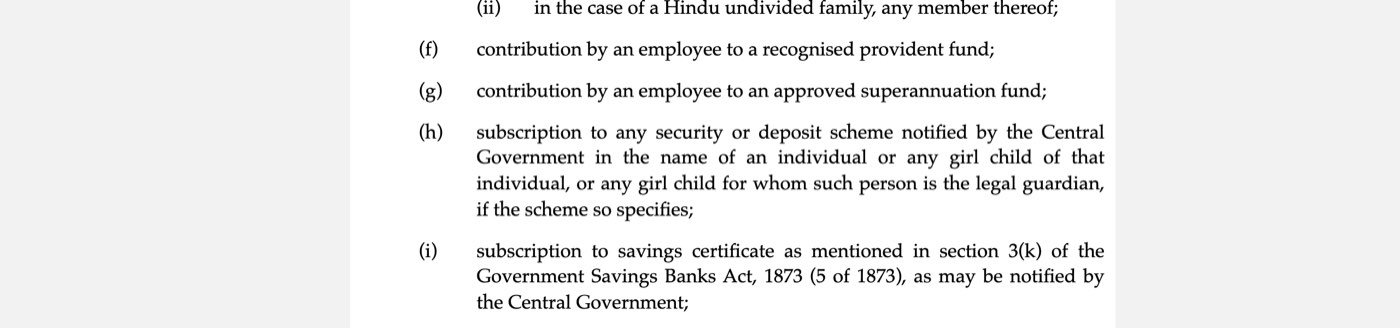
Whether the deduction is worth switching regimes for depends on your other deductions; the income tax calculator compares the two. The deposit is deductible in the hands of the parent who makes it, and because the interest is exempt, the rule that clubs a minor’s income with a parent’s has nothing to tax.
SSY or PPF: which is better for a daughter?
SSY pays more than PPF (8.2% against 7.1%) with the same tax treatment, but it can be opened only for a girl under 10, locks the money until she is 18 and matures at 21 years, so most parents who can afford both use SSY first and PPF for the rest:
| Sukanya Samriddhi (SSY) | Public Provident Fund (PPF) | |
|---|---|---|
| Rate (Oct 2026) | 8.2% | 7.1% |
| Who can open | A girl under 10, through a guardian | Anyone, including for a minor |
| Yearly deposit | ₹250 to ₹1,50,000 | ₹500 to ₹1,50,000 |
| Deposit period | 15 years | 15 years, then extendable |
| Maturity | 21 years from opening (or marriage after 18) | 15 years |
| Early access | 50% for education at 18 or after class 10 | Partial withdrawals from the 7th year; loans from the 3rd financial year |
| Tax | Deduction under s.123 (old regime); interest and payout exempt | Same |
The ₹1,50,000 limit under section 123 is shared across SSY, PPF, EPF, life insurance and the other Schedule XV items, so putting the maximum into SSY leaves no deduction for PPF; the two accounts still earn their tax-free interest. The PF calculator covers EPF, and the SWP calculator shows how a lump sum, such as an SSY maturity, can be drawn down.
How do I open a Sukanya Samriddhi account?
A Sukanya Samriddhi account is opened at a post office or an authorised bank branch by the girl’s parent or legal guardian, in four steps:
- Choose the branch. Any post office, or a bank branch authorised for small savings; the account can be moved later.
- Fill in Form 1. The guardian applies in the girl's name. She must be under 10 on the day of opening, and each girl can have only one account.
- Attach the documents. Her birth certificate, the guardian's identity and address proof, and a photograph; a family's third account needs the twins' or triplets' birth certificates and an affidavit.
- Make the first deposit. At least Rs 250, in cash, by cheque or through India Post Payments Bank. The passbook records every later deposit and the interest credited each 31 March.
Later deposits can be made in cash, by cheque or online: India Post accepts them through the India Post Payments Bank app, and with core banking the account can be operated at any post office in India. The rules also provide for transferring the account to another post office or bank when the family moves; interest is credited for the year regardless of the transfer (para 5(3)).
सुकन्या समृद्धि योजना कैलकुलेटर: 21 साल में कितना मिलेगा?
सुकन्या समृद्धि योजना (SSY) में 8.2% ब्याज मिलता है, जो हर साल 31 मार्च को खाते में जुड़ता है। 15 साल तक जमा करना होता है और खाता खुलने के 21 साल बाद परिपक्व होता है। हर साल ₹1,50,000 जमा करने पर परिपक्वता राशि लगभग ₹71,82,119 होती है (जमा ₹22,50,000, ब्याज ₹49,32,119); हर महीने ₹1,000 जमा करने पर ₹5,54,612, ₹3,000 पर ₹16,63,835 और ₹5,000 पर ₹27,73,059। खाता 10 साल से कम उम्र की बेटी के नाम माता-पिता या अभिभावक खोल सकते हैं, एक परिवार में दो बेटियों के लिए। साल में कम से कम ₹250 और ज़्यादा से ज़्यादा ₹1,50,000 जमा हो सकते हैं। बेटी के 18 साल की होने या 10वीं पास करने पर पढ़ाई के लिए पिछले साल के बैलेंस का 50% निकाला जा सकता है। जमा राशि पर पुरानी कर व्यवस्था में धारा 123 के तहत ₹1.5 लाख तक की कटौती मिलती है, और ब्याज तथा परिपक्वता राशि पूरी तरह कर-मुक्त है। महीने की 5 तारीख तक जमा करें, तभी उस महीने का ब्याज मिलता है।
Common questions
At 8.2%, ₹1,50,000 a year for 15 years gives ₹71,82,119 at maturity (₹22,50,000 deposited plus ₹49,32,119 interest). ₹12,500 a month gives ₹69,32,648, ₹3,000 a month ₹16,63,835 and ₹1,000 a month ₹5,54,612. The amount depends on the rate staying at 8.2%, which the government revises every quarter.
About ₹5,54,612. ₹1,000 a month for 15 years deposits ₹1,80,000, which earns ₹3,74,612 of interest at 8.2% by the time the account matures 21 years after opening.
Interest is worked out for each calendar month on the lowest balance between the close of the 5th and the end of the month, and credited to the account at the end of the financial year, where it compounds. A deposit made after the 5th earns nothing for that month, so deposit by the 5th, or in the first week of April for a yearly deposit.
8.2% a year, compounded yearly. It has been 8.2% since 1 January 2024 and was kept at 8.2% for October to December 2026. The government sets the small savings rates every quarter.
At least ₹250 and at most ₹1,50,000 in a financial year, in multiples of ₹50, for 15 years from the date of opening. Deposits above ₹1,50,000 earn no interest and are returned. Monthly deposits are not compulsory; one yearly deposit is fine.
A parent or legal guardian, for a girl who is under 10 on the date of opening. Each girl can have one account and a family can have two, or more for twins or triplets. The account is opened at a post office or an authorised bank with the girl's birth certificate and the guardian's identity and address proof.
21 years after the account is opened, whatever the girl's age then. It can also be closed for her marriage once she is 18, between one month before and three months after the wedding. Deposits stop after 15 years, but the balance earns interest for the full 21.
Yes, for her education: up to 50% of the balance at the end of the previous financial year, once she is 18 or has passed class 10, against an admission offer or fee slip, in one sum or in up to five yearly instalments. Premature closure is allowed only on compassionate grounds after five years, or if the account holder dies.
Yes, at all three stages. Deposits qualify for the ₹1,50,000 deduction under section 123 of the Income-tax Act, 2025 (Schedule XV, item (h)), available in the old regime. The interest and the maturity amount are not included in total income under Schedule II, so there is no tax and no TDS.
The account goes into default but is not closed. It can be regularised any time within the 15-year deposit period by paying ₹50 for each missed year plus the ₹250 minimum for those years. Even if it is never regularised, the money already deposited keeps earning the scheme rate until closure.
Yearly, paid in the first week of April, earns the most: the whole year's money is in the account from April. At the ₹1,50,000 maximum, a yearly deposit matures at about ₹2,49,471 more than ₹12,500 a month. Monthly deposits are easier to budget and lose little if they go in by the 5th.
Yes for two daughters in a family. A third account is allowed only when twins or triplets are born in the first or second birth order, with an affidavit and birth certificates. Each girl can have only one account.
- Sukanya Samriddhi Account Scheme, 2019 (G.S.R. 914(E), as amended by G.S.R. 288(E)) — National Savings Institute copy
- National Savings Institute — Sukanya Samriddhi Account Scheme: interest rate since inception
- India Post — features of savings schemes at post offices (e-book, 7 October 2024)
- Department of Economic Affairs — small savings notifications, including the quarterly rate revisions
- State Bank of India — Sukanya Samriddhi Account interest / maturity calculator
- Press Information Bureau, 21 January 2026 — From Savings to Strength: Empowering India’s Girls Through Sukanya Samriddhi Yojana (interest after maturity at the savings-account rate)
- Income-tax Act, 2025 — section 123 and Schedule XV (Indian Kanoon)
- Income-tax Act, 2025 — Schedule II, income not to be included in total income (Income Tax Department)
- Business Standard, 30 September 2026 — small savings rates unchanged for October to December 2026 (quoting the Finance Ministry’s notification)
Checked on 26 October 2026. The rules are quoted from the scheme as notified, the rate from NSI’s table and India Post’s guide, and the tax treatment from the Income-tax Act, 2025. The October to December 2026 rate is taken from press reports of the Finance Ministry’s memorandum of 30 September 2026, because the file linked for it on the Department of Economic Affairs site is the separate GPF resolution. The calculator reproduces the scheme’s interest method and matches SBI’s official calculator; it assumes deposits on time and a constant rate, which the government revises every quarter, so the maturity amount is an estimate. This is general information, not investment or tax advice.