Cost inflation index table 2001-02 to 2026-27, with indexation calculator
Look up the CII for any financial year since 2001-02, index what you paid for a property to the year you sell it, and see whether 20% with indexation or 12.5% without gives the lower tax.
Updated 19 October 2026 · S.O. 3889(E) · Income-tax Act, 2025 · your figures never leave your browser
Your property
Indexed cost
CII as notified by the CBDT for 2001-02 to 2026-27. Tax is for a resident individual or HUF selling land or a building, before exemptions, the basic exemption limit and surcharge; the LTCG calculator includes those. Everything runs in your browser.
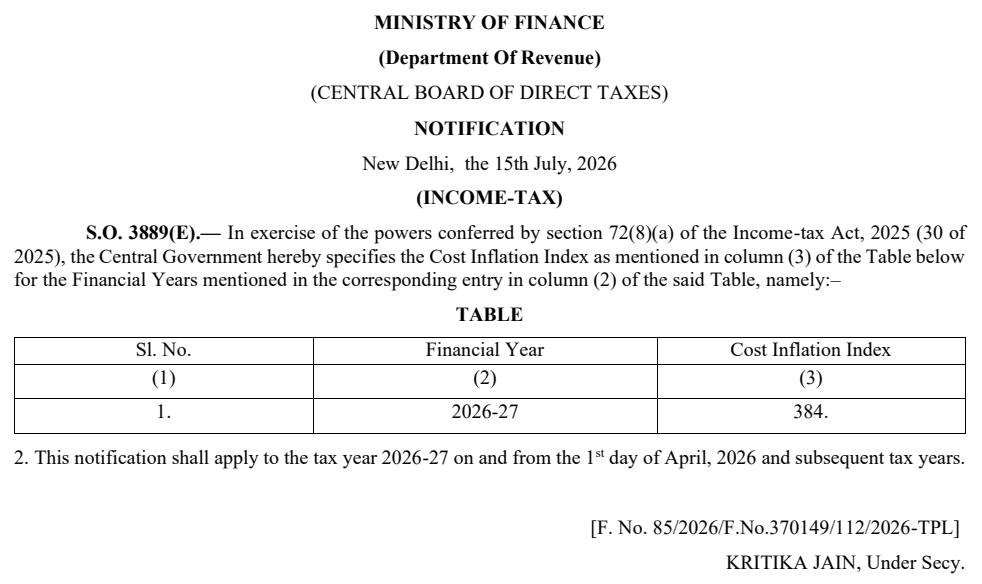
The Cost Inflation Index (CII) for FY 2026-27 is 384. The Central Board of Direct Taxes notified it on 15 July 2026 (S.O. 3889(E)) under section 72(8)(a) of the Income-tax Act, 2025, and it applies to sales made in the tax year 2026-27, from 1 April 2026 to 31 March 2027. For FY 2025-26 (assessment year 2026-27) the CII is 376, and the base year is 2001-02, with an index of 100. To index a cost, multiply it by the CII of the year of sale and divide by the CII of the year of purchase: ₹30 lakh paid in 2010-11 becomes ₹30,00,000 × 384 ÷ 167 = ₹68,98,204. Since 23 July 2024, indexation is available only to resident individuals and HUFs selling land or buildings bought before that date, as an alternative to 12.5% without indexation.
- FY 2026-27: 384 (S.O. 3889(E), 15 July 2026)
- FY 2025-26 (AY 2026-27): 376
- Base year: 2001-02 = 100, used since FY 2017-18; the base before that was 1981-82
- Formula: indexed cost = cost × CII of the year of sale ÷ CII of the year of purchase (or of 2001-02, if later)
- Who can still use it: resident individuals and HUFs selling land or buildings bought before 23 July 2024 (s.197(3))
- Not for: shares, mutual funds, gold, bonds, property bought from 23 July 2024, non-residents or companies
Cost inflation index table: 2001-02 to 2026-27
The CII, sometimes called the capital gain index, for every financial year since the base year, with the assessment year each belonged to under the Income-tax Act, 1961. Under the 2025 Act, which applies from 1 April 2026, the financial year is simply the tax year, so 2026-27 has no separate assessment year.
| Financial year | Assessment year | CII |
|---|---|---|
| 2026-27 | Tax year 2026-27 | 384 |
| 2025-26 | AY 2026-27 | 376 |
| 2024-25 | AY 2025-26 | 363 |
| 2023-24 | AY 2024-25 | 348 |
| 2022-23 | AY 2023-24 | 331 |
| 2021-22 | AY 2022-23 | 317 |
| 2020-21 | AY 2021-22 | 301 |
| 2019-20 | AY 2020-21 | 289 |
| 2018-19 | AY 2019-20 | 280 |
| 2017-18 | AY 2018-19 | 272 |
| 2016-17 | AY 2017-18 | 264 |
| 2015-16 | AY 2016-17 | 254 |
| 2014-15 | AY 2015-16 | 240 |
| 2013-14 | AY 2014-15 | 220 |
| 2012-13 | AY 2013-14 | 200 |
| 2011-12 | AY 2012-13 | 184 |
| 2010-11 | AY 2011-12 | 167 |
| 2009-10 | AY 2010-11 | 148 |
| 2008-09 | AY 2009-10 | 137 |
| 2007-08 | AY 2008-09 | 129 |
| 2006-07 | AY 2007-08 | 122 |
| 2005-06 | AY 2006-07 | 117 |
| 2004-05 | AY 2005-06 | 113 |
| 2003-04 | AY 2004-05 | 109 |
| 2002-03 | AY 2003-04 | 105 |
| 2001-02 | AY 2002-03 | 100 |
Use the CII of the year you bought the asset (or of 2001-02, if you bought it earlier) and the CII of the year you sold it. The figures up to 2025-26 were notified under the 1961 Act; section 536(2) of the 2025 Act keeps notifications issued under the old Act in force. The figure for 2026-27 is the first notified under the new Act:
Indexation chart: ₹1 lakh indexed to 2026-27
What ₹1 lakh of cost becomes after indexation, by the year you bought, for a sale in 2026-27 (CII 384) and for a sale in 2025-26 (CII 376). The last column is the break-even explained below: with no improvement costs, 20% with indexation gives the lower tax when the sale price is below the cost multiplied by this figure.
| Bought in | CII | Indexed to 2026-27 | Indexed to 2025-26 | Indexation wins below |
|---|---|---|---|---|
| 2001-02 | 100 | ₹3,84,000 | ₹3,76,000 | 8.57× |
| 2002-03 | 105 | ₹3,65,714 | ₹3,58,095 | 8.09× |
| 2003-04 | 109 | ₹3,52,294 | ₹3,44,954 | 7.73× |
| 2004-05 | 113 | ₹3,39,823 | ₹3,32,743 | 7.40× |
| 2005-06 | 117 | ₹3,28,205 | ₹3,21,368 | 7.09× |
| 2006-07 | 122 | ₹3,14,754 | ₹3,08,197 | 6.73× |
| 2007-08 | 129 | ₹2,97,674 | ₹2,91,473 | 6.27× |
| 2008-09 | 137 | ₹2,80,292 | ₹2,74,453 | 5.81× |
| 2009-10 | 148 | ₹2,59,459 | ₹2,54,054 | 5.25× |
| 2010-11 | 167 | ₹2,29,940 | ₹2,25,150 | 4.47× |
| 2011-12 | 184 | ₹2,08,696 | ₹2,04,348 | 3.90× |
| 2012-13 | 200 | ₹1,92,000 | ₹1,88,000 | 3.45× |
| 2013-14 | 220 | ₹1,74,545 | ₹1,70,909 | 2.99× |
| 2014-15 | 240 | ₹1,60,000 | ₹1,56,667 | 2.60× |
| 2015-16 | 254 | ₹1,51,181 | ₹1,48,031 | 2.36× |
| 2016-17 | 264 | ₹1,45,455 | ₹1,42,424 | 2.21× |
| 2017-18 | 272 | ₹1,41,176 | ₹1,38,235 | 2.10× |
| 2018-19 | 280 | ₹1,37,143 | ₹1,34,286 | 1.99× |
| 2019-20 | 289 | ₹1,32,872 | ₹1,30,104 | 1.88× |
| 2020-21 | 301 | ₹1,27,575 | ₹1,24,917 | 1.74× |
| 2021-22 | 317 | ₹1,21,136 | ₹1,18,612 | 1.56× |
| 2022-23 | 331 | ₹1,16,012 | ₹1,13,595 | 1.43× |
| 2023-24 | 348 | ₹1,10,345 | ₹1,08,046 | 1.28× |
| 2024-25 (to 22 Jul) | 363 | ₹1,05,785 | ₹1,03,581 | 1.15× |
Property bought from 23 July 2024 onwards gets no indexation, which is why the chart stops at July 2024.
How to calculate indexed cost of acquisition
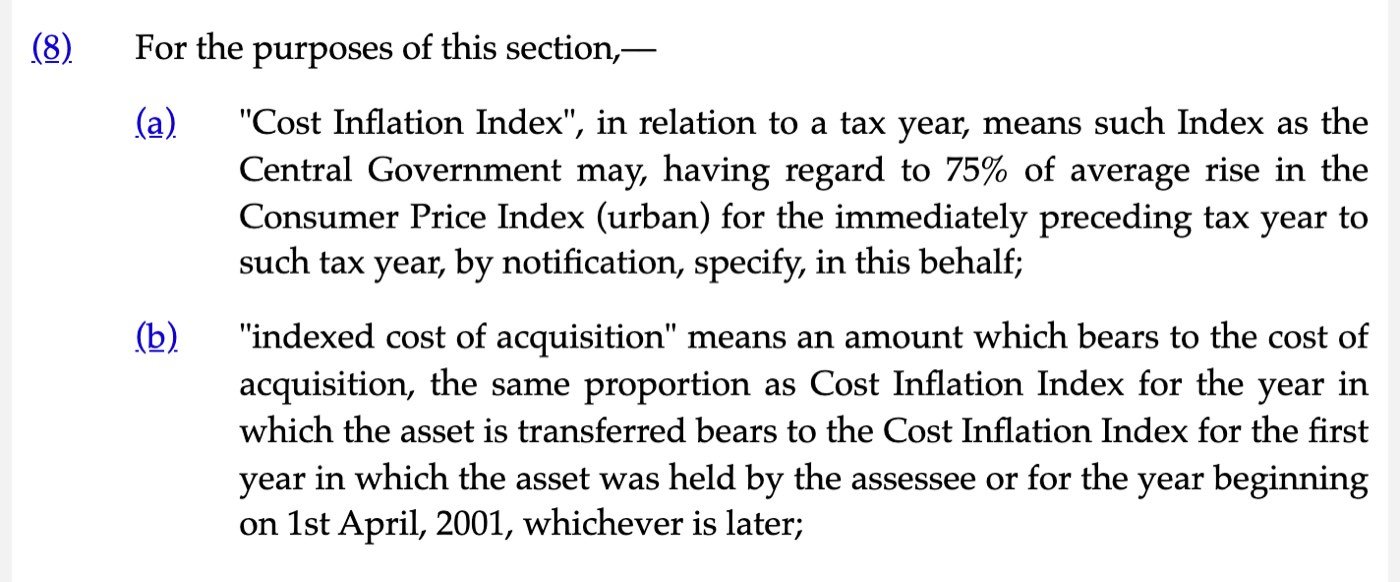
- Indexed cost of acquisition = cost of acquisition × CII of the year of sale ÷ CII of the year of purchase, or of 2001-02 if that is later.
- Indexed cost of improvement = cost of the improvement × CII of the year of sale ÷ CII of the year the improvement was made.
- Long-term capital gain with indexation = sale price − selling costs − indexed cost of acquisition − indexed cost of improvement.
These are the definitions in section 72(8) of the Income-tax Act, 2025, which also says how the government sets the index:
Worked example. A flat bought in 2010-11 for ₹30 lakh, with ₹5 lakh spent on an extension in 2015-16, is sold in 2026-27 for ₹1.2 crore after brokerage. The indexed cost of acquisition is ₹30,00,000 × 384 ÷ 167 = ₹68,98,204. The indexed cost of the improvement is ₹5,00,000 × 384 ÷ 254 = ₹7,55,906. The gain with indexation is ₹43,45,891, and 20% of it is ₹8,69,178 (₹9,03,945 with 4% cess). Without indexation the gain is ₹85,00,000 and the tax at 12.5% is ₹10,62,500 (₹11,05,000 with cess). Indexation saves ₹2,01,055, so the seller pays the 20% figure. These are the calculator’s default inputs.
Who can claim indexation in 2026-27
Section 72(2) of the 2025 Act uses the indexed cost for one purpose only: item B of the formula in section 197(3). That sub-section lets a resident individual or HUF who sells land, a building or both, acquired before 23 July 2024, work out the tax at 20% on the indexed gain as well as at 12.5% without indexation, and ignore any excess of the second over the first. In effect they pay the lower of the two.
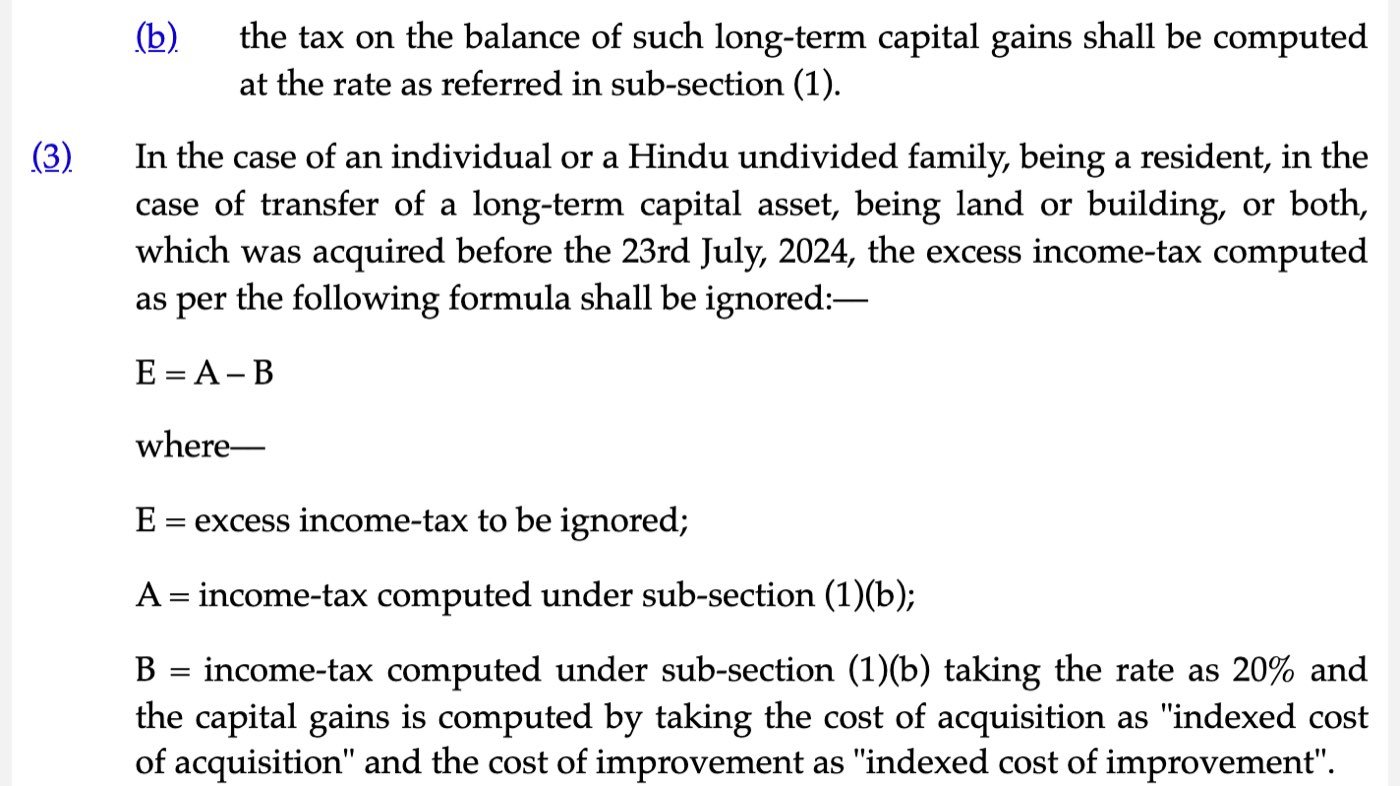
- Can use indexation: resident individuals and HUFs, on land, a house, a flat or a commercial building bought before 23 July 2024 and held for more than 24 months.
- Cannot: non-residents, companies, firms and LLPs; property bought on or after 23 July 2024; and every other asset. Listed shares and equity funds pay 12.5% on gains above ₹1.25 lakh. Gold, unlisted shares, listed bonds and debt funds bought before 1 April 2023 pay 12.5% without indexation. Debt funds bought from 1 April 2023, and unlisted bonds, are taxed at slab rates.
Until 22 July 2024, 20% with indexation was the normal rate for long-term gains on most assets other than listed equity. The Finance (No. 2) Act, 2024 replaced it with 12.5% without indexation for transfers from 23 July 2024, and kept indexation only as this option for property. The LTCG calculator runs the full computation, with exemptions and the basic exemption limit.
12.5% without or 20% with indexation: which is lower?
The two taxes are equal when 12.5% of (sale price − cost) equals 20% of (sale price − cost × r), where r is the CII of the year of sale divided by the CII of the year of purchase. That gives a break-even sale price of cost × (8r − 5) ÷ 3. Below it, 20% with indexation is lower; above it, the flat 12.5% is.
- Bought in 2005-06 (r = 3.28): indexation is lower unless the property sells for more than 7.09 times what it cost. The older the purchase, the higher the multiple a sale must reach before 12.5% wins.
- Bought in 2010-11 (r = 2.30): the break-even is 4.47 times the cost. The worked example above sells for 3.43 times the ₹35 lakh spent; with the extension indexed only from 2015-16 its line is lower, at 4.17 times, and the sale is still below it, so indexation wins.
- Bought in 2020-21 (r = 1.28): the break-even is 1.74 times. A flat bought for ₹50 lakh and sold for ₹1 crore has doubled, which is above the line: 12.5% of the ₹50 lakh gain is ₹6,25,000, against ₹7,24,252 at 20% on the indexed gain of ₹36,21,262.
Improvement costs move the line, so for a real sale use the calculator rather than the chart.
Which year’s CII: FY, AY or tax year
The CII is fixed by financial year (April to March), for both the purchase and the sale, never by assessment year. Under the 1961 Act a sale in FY 2025-26 is reported for assessment year 2026-27, so “CII for AY 2026-27” means 376, the figure for FY 2025-26. The 2025 Act drops the assessment year: a sale between 1 April 2026 and 31 March 2027 falls in the tax year 2026-27 and uses 384.
| Sale made between | Financial year | Return | CII |
|---|---|---|---|
| 1 Apr 2026 – 31 Mar 2027 | 2026-27 | Tax year 2026-27 (Income-tax Act, 2025) | 384 |
| 1 Apr 2025 – 31 Mar 2026 | 2025-26 | AY 2026-27 | 376 |
| 1 Apr 2024 – 31 Mar 2025 | 2024-25 | AY 2025-26 | 363 |
| 1 Apr 2023 – 31 Mar 2024 | 2023-24 | AY 2024-25 | 348 |
Property bought before 2001, inherited or gifted
- Bought before 1 April 2001: you may take the fair market value on 1 April 2001 as the cost instead of the price paid (s.90(9)(a)). For land or a building it cannot exceed the stamp duty value on that date (s.90(10)). Index it from 2001-02, whose CII is 100. Improvements made before 1 April 2001 are ignored (s.90(1)(b)(i)).
- Inherited or gifted: the cost is what the previous owner paid, plus improvements by either of you (s.73(1), Table item 1). If the previous owner acquired the asset before 1 April 2001, you may use its value on that date instead (s.90(9)(b)). The holding period includes the previous owner’s (s.2(101)). For the purchase-year CII, the Bombay High Court held in CIT v. Manjula J. Shah (2011) that indexation runs from the year the previous owner first held the asset, not the year you received it. Tribunals have followed it, and the 2025 Act keeps the same words (“the first year in which the asset was held by the assessee”).
- Improvements: each one is indexed from its own year. Additions and construction count; repairs and maintenance do not.
How the government sets the CII
Section 72(8)(a) asks the Central Government to fix each year’s index having regard to 75% of the average rise in the Consumer Price Index (urban) for the preceding year. The CII therefore rises more slowly than prices: 384 is 2.1% above 2025-26’s 376. It is not the inflation rate; for actual consumer price inflation by year, see the inflation calculator.
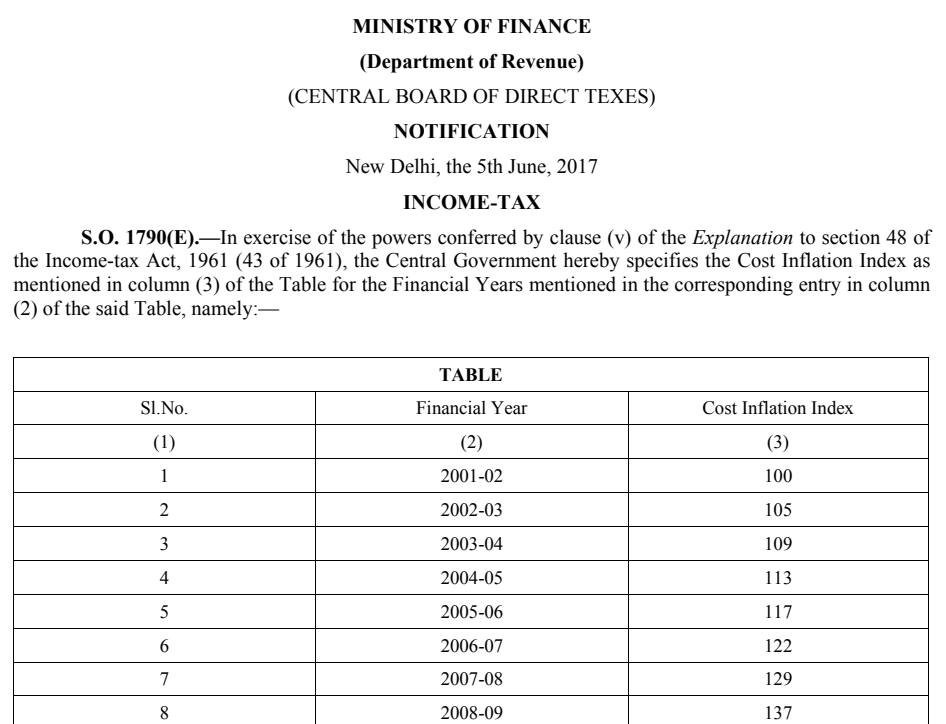
The series was rebased in 2017. Until 2016-17 it ran from 1981-82 = 100, ending at 1,125. The Finance Act, 2017 moved the base to 2001-02, and the CBDT notified the new series, from 100 for 2001-02 to 272 for 2017-18, on 5 June 2017. It has applied from assessment year 2018-19:
The index for 2027-28 has not been notified yet. The 2026-27 figure came on 15 July 2026, three and a half months into the year.
कॉस्ट इन्फ्लेशन इंडेक्स (CII) 2026-27 कितना है?
वित्त वर्ष 2026-27 के लिए कॉस्ट इन्फ्लेशन इंडेक्स (CII) 384 है, जिसे CBDT ने 15 जुलाई 2026 को अधिसूचित किया (S.O. 3889(E))। वित्त वर्ष 2025-26 (आकलन वर्ष 2026-27) के लिए यह 376 है, और आधार वर्ष 2001-02 है, जिसका इंडेक्स 100 है। इंडेक्स्ड लागत = खरीद मूल्य × बिक्री वाले वर्ष का CII ÷ खरीद वाले वर्ष का CII। 23 जुलाई 2024 के बाद इंडेक्सेशन केवल निवासी व्यक्तियों और HUF को मिलता है, जब वे 23 जुलाई 2024 से पहले खरीदी गई ज़मीन या मकान बेचते हैं। वे 20% (इंडेक्सेशन के साथ) और 12.5% (बिना इंडेक्सेशन) में से कम वाला टैक्स दे सकते हैं।
Common questions
384. The CBDT notified it on 15 July 2026 by notification S.O. 3889(E) under section 72(8)(a) of the Income-tax Act, 2025. It applies to the tax year 2026-27, that is, to sales from 1 April 2026 to 31 March 2027.
376. Use it for sales between 1 April 2025 and 31 March 2026, reported in the return for assessment year 2026-27. For FY 2024-25 (AY 2025-26) the CII is 363.
2001-02, with an index of 100. The Finance Act, 2017 moved the base from 1981-82 to 2001-02, and the new series has applied from assessment year 2018-19. For an asset bought before 1 April 2001 you can take its fair market value on that date as the cost and index it from 2001-02.
Multiply the cost by the CII of the year of sale and divide by the CII of the year of purchase. For a flat bought for ₹30 lakh in 2010-11 (CII 167) and sold in 2026-27 (CII 384): 30,00,000 × 384 ÷ 167 = ₹68,98,204.
Only for land and buildings acquired before 23 July 2024 and sold by a resident individual or HUF. They can compute the tax at 20 percent on the indexed gain and pay that if it is lower than 12.5 percent without indexation (section 197(3)). All other long-term gains are taxed without indexation.
No, not for sales made on or after 23 July 2024. Listed shares and equity funds pay 12.5 percent on gains above ₹1.25 lakh. Gold, unlisted shares and debt funds bought before 1 April 2023 pay 12.5 percent without indexation. Debt funds bought from 1 April 2023 are taxed at slab rates.
It depends on how fast the price rose compared with the CII. With no improvement costs, 20 percent with indexation is lower when the sale price is below the cost times (8r - 5) ÷ 3, where r is the CII of the year of sale divided by the CII of the year of purchase. For a property bought in 2010-11 and sold in 2026-27, r is 2.30, so indexation is lower unless it sells for more than 4.47 times its cost.
The cost is what the previous owner paid, or its value on 1 April 2001 if they acquired it before then. The Bombay High Court held in CIT v. Manjula J. Shah (2011) that indexation starts from the year the previous owner first held the asset, not the year you inherited it, and the Income-tax Act, 2025 keeps the same wording.
The government notifies it each year having regard to 75 percent of the average rise in the Consumer Price Index (urban) for the previous year, under section 72(8)(a) of the Income-tax Act, 2025. That is why it rises more slowly than retail inflation: 384 for 2026-27 is 2.1 percent above 376 for 2025-26.
It has not been notified yet. The 2026-27 figure was notified on 15 July 2026, three and a half months into the year it applies to.
- CBDT — Notification S.O. 3889(E), No. 85/2026, Cost Inflation Index for 2026-27 (15 July 2026)
- Income-tax Act, 2025 — section 72, including 72(2) and 72(8) (Indian Kanoon)
- Income-tax Act, 2025 — section 197, tax on long-term capital gains (Indian Kanoon)
- Income-tax Act, 2025 — full text, including sections 2(101), 73, 90 and 536 (Indian Kanoon)
- Gazette of India — S.O. 1790(E), Cost Inflation Index with base year 2001-02 (5 June 2017)
- Income Tax Department — Cost Inflation Index
- ITATonline — CIT v. Manjula J. Shah (Bombay High Court): indexed cost of gifted assets
Checked on 19 October 2026. The CII for 2026-27 was read from the Gazette text of S.O. 3889(E), and 2001-02 to 2017-18 from S.O. 1790(E); the later years match the department’s published series. The legal rules were checked against the text of the Income-tax Act, 2025. The calculator gives an estimate for one sale by a resident individual or HUF, before exemptions and surcharge, so it is not a computation for your return. This is general information, not tax advice.