Salary hike calculator: your hike percentage, the new CTC, and what reaches your bank
Turn a hike percentage into the new CTC, or two salaries into the percentage. Then see the part most calculators skip: the in-hand pay per month before and after on FY 2026-27 slabs, how much of the raise PF and tax absorb, and whether it beats inflation.
FY 2026-27 · CPI 4.82% (August 2026) · runs entirely in your browser, your figures never leave your browser
What do you know?
For the in-hand estimate
Standard assumptions, the same ones the salary calculator uses: basic is 45% of CTC, PF on basic capped at ₹15,000 a month, Maharashtra professional tax, no variable pay.
Your hike
Hike % = (new − old) ÷ old × 100. In-hand figures use FY 2026-27 slabs and the standard CTC structure; your own structure will differ.
A salary hike percentage is the increase divided by the old salary: (new − old) ÷ old × 100. A 12% hike on an ₹8 lakh CTC makes it ₹8,96,000, an extra ₹8,000 a month on paper and about ₹7,827 a month in hand, because PF and income tax take their share of every raise. The calculator above does both sums at once: it turns a percentage into the new CTC, or two salaries into the percentage, and then runs the new figure through the same in-hand formula as the salary calculator on FY 2026-27 slabs, so you see the raise the way your bank will. It also checks the hike against inflation, which was 4.82% in August 2026.
- Formula: hike % = (new − old) ÷ old × 100; new salary = old × (1 + hike%)
- Example: ₹8,00,000 CTC with a 12% hike becomes ₹8,96,000; ₹8,000 more a month on CTC, about ₹7,827 more in hand
- Average hike in India, 2026: 9.1% projected by Aon’s survey of 1,400+ companies, up from 8.9% in 2025
- Inflation: CPI 4.82% in August 2026; a hike below that is a pay cut in real terms
- Why in hand lags: every rupee of raise above the PF ceiling is taxed at your marginal slab, 5% to 30% plus cess, and the ₹12 lakh rebate ends abruptly
- 8th Pay Commission: constituted 3 November 2025, report due around mid-2027; the fitment factor is not decided
How the hike calculator works
Choose what you know. With the hike percentage, enter your current CTC and the percentage, and the calculator gives the new CTC and the increase per year and per month. With old and new salary, enter both and it gives the percentage, which is what you need when an offer letter quotes a number rather than a rate. Both modes accept a monthly figure instead of an annual one; the maths is the same, only the labels change.
The second half is what other hike calculators leave out. The new CTC is run through the standard cost-to-company structure, basic at 45%, employer PF and gratuity taken off to reach gross, then your PF, professional tax and income tax on this year’s slabs, to give in-hand pay per month before and after. The gap between the raise on paper and the raise in hand is shown as a percentage, and the hike is compared with inflation to give the real raise. Change the regime toggle if you file under the old regime with deductions.
How to calculate salary hike percentage
Two formulas cover every case.
- From two salaries to a percentage: hike % = (new salary − old salary) ÷ old salary × 100. From ₹6,00,000 to ₹7,20,000: (7,20,000 − 6,00,000) ÷ 6,00,000 × 100 = 20%.
- From a percentage to the new salary: new salary = old salary × (1 + hike ÷ 100). A 15% hike on ₹9,00,000 is 9,00,000 × 1.15 = ₹10,35,000.
Use the same period on both sides, annual with annual or monthly with monthly, and compare like with like: a hike quoted on fixed pay is not a hike on CTC if the variable component or the employer’s PF changed too. The table gives the new CTC for the hikes most offers fall into.
| Current CTC | 10% hike | 15% hike | 20% hike | 30% hike |
|---|---|---|---|---|
| ₹4,00,000 | ₹4,40,000 | ₹4,60,000 | ₹4,80,000 | ₹5,20,000 |
| ₹6,00,000 | ₹6,60,000 | ₹6,90,000 | ₹7,20,000 | ₹7,80,000 |
| ₹8,00,000 | ₹8,80,000 | ₹9,20,000 | ₹9,60,000 | ₹10,40,000 |
| ₹10,00,000 | ₹11,00,000 | ₹11,50,000 | ₹12,00,000 | ₹13,00,000 |
| ₹12,00,000 | ₹13,20,000 | ₹13,80,000 | ₹14,40,000 | ₹15,60,000 |
| ₹15,00,000 | ₹16,50,000 | ₹17,25,000 | ₹18,00,000 | ₹19,50,000 |
| ₹20,00,000 | ₹22,00,000 | ₹23,00,000 | ₹24,00,000 | ₹26,00,000 |
Why a 10% hike is not 10% more in hand
Three deductions grow with the raise. Your PF contribution rises with basic until basic reaches ₹15,000 a month, after which it is fixed at ₹1,800 and the raise flows straight to gross. Professional tax is flat. Income tax is the big one: every extra rupee of taxable income is taxed at your top slab, 5%, 10%, 15%, 20%, 25% or 30% plus 4% cess, so the share of a raise that reaches you falls as your salary rises. The example in the calculator, ₹8,00,000 with a 12% hike, keeps about 98% of the raise in hand because the rebate still cancels the tax at that level.
The sharpest drop is at the rebate limit. Up to ₹12 lakh of taxable income the new regime charges nothing, with marginal relief just above it; a hike that carries you across that line is taxed on the whole slab structure from ₹4 lakh up. On a ₹13,00,000 CTC, a 10% hike to ₹14,30,000 adds ₹10,833 a month on paper but only ₹4,100 in hand, about 38% of the raise, because income tax starts. Here is the same 15% hike at seven salary levels:
| Current CTC | In hand now (per month) | In hand after 15% (per month) | Share of the raise kept |
|---|---|---|---|
| ₹4,00,000 | ₹28,804 | ₹33,695 | 98% |
| ₹6,00,000 | ₹45,109 | ₹52,447 | 98% |
| ₹8,00,000 | ₹61,415 | ₹71,199 | 98% |
| ₹10,00,000 | ₹77,721 | ₹89,951 | 98% |
| ₹12,00,000 | ₹94,027 | ₹1,04,280 | 68% |
| ₹15,00,000 | ₹1,11,096 | ₹1,26,579 | 83% |
| ₹20,00,000 | ₹1,44,386 | ₹1,63,102 | 75% |
None of this is a reason to refuse a raise. It is a reason to negotiate on the number that matters: ask what the offer does to monthly in-hand, not only to CTC, and run the new figure through the LPA to in-hand table or the salary calculator before you sign.
The real raise: your hike against inflation
A hike only improves your standard of living by the amount it beats price rises. Retail inflation measured by the Consumer Price Index was 4.82% in August 2026, against the Reserve Bank’s 4% target. The real raise is (1 + hike) ÷ (1 + inflation) − 1: a 12% hike against 4.82% inflation is a real raise of about 6.8%, and a 4% hike is a real cut. The calculator uses the latest CPI print as its default; overwrite it with your own estimate, or with the inflation of the city you live in, which is often higher for rent.
What is a good hike? The 2026 averages
Aon’s Annual Salary Increase and Turnover Survey, now in its 32nd edition and covering more than 1,400 companies across 45 industries, projects an average increase of 9.1% for 2026, up from 8.9% in 2025. Real estate, infrastructure and non-banking financial companies lead; banking sits near 8.8%. Those are company-wide budgets: a top performer gets more than the average and a weak year gets less, and the figure is for people who stay. Raises on switching jobs are generally larger, which is why the two salaries mode of the calculator is useful for comparing an offer with a counter-offer.
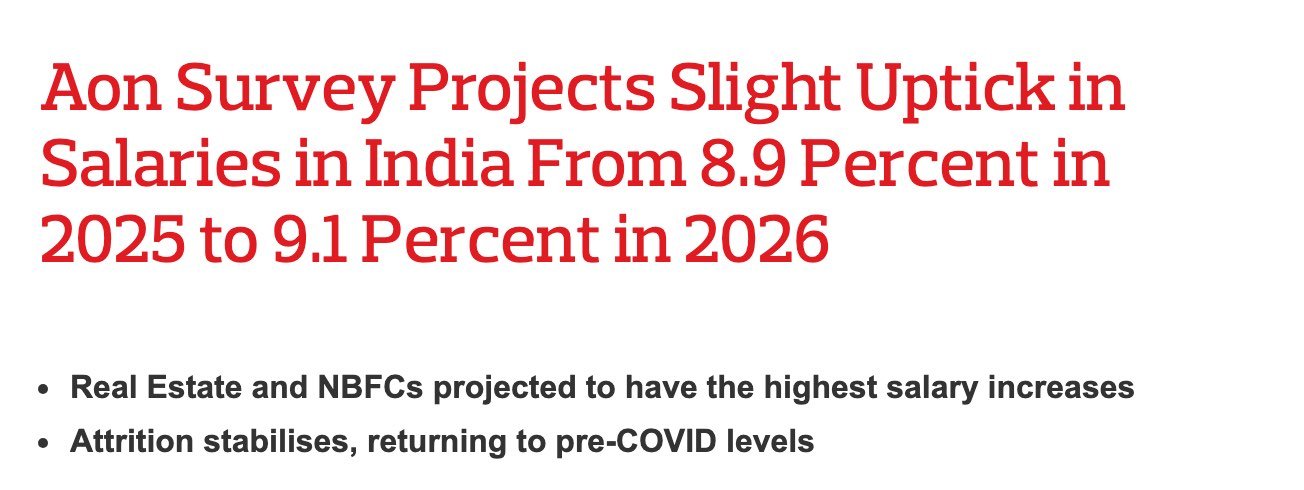
Measured against inflation of 4.82%, the average 2026 hike is a real raise of about 4.1%. A hike at or below inflation is worth questioning; one in double digits is above the market.
Hike on CTC, fixed pay or basic: read the letter carefully
Employers quote hikes on different bases, and the base changes what you get. A hike on CTC includes the employer’s PF and gratuity provision, so part of the number never reaches you. A hike on fixed pay excludes variable pay and is usually the honest comparison between two offers. A hike on basic alone, common in government and public-sector pay and in some older private structures, lifts every allowance that is a percentage of basic, HRA and DA included, so a small basic hike can be a larger total hike. Since the Labour Codes took effect on 21 November 2025, basic plus DA must be at least half of total pay, which has pushed many employers to restructure; a hike that comes with a restructure can raise your PF and lower your take-home even as CTC goes up, so check the salary slip components, not just the headline.
8th Pay Commission salary hike calculator
Central government employees search for an 8th Pay Commission hike calculator, and the honest answer is that the input it needs does not exist yet. The 8th CPC was constituted on 3 November 2025 with an 18-month mandate, so its report is expected around mid-2027, and the fitment factor, the multiplier applied to today’s basic to get the new basic, is not decided. What the arithmetic does say is that the factor overstates the raise: dearness allowance, 60% of basic from January 2026, is merged into the new basic and reset to zero, so the real rise is the factor divided by 1.60.
Illustration only. The 8th CPC has published nothing; allowances and the pay matrix will be reset when it does.
| Fitment factor | Rise over basic + DA at 60% |
|---|---|
| 1.92 | 20% |
| 2.28 | 42% |
| 2.57 | 61% |
| 2.86 | 79% |
For what a given pay level is worth today, in hand, see the salaries by job pages, which price each post from the 7th CPC matrix with current DA.
Salary hike kaise calculate karein (hike percentage in Hindi)
हाइक प्रतिशत = (नई सैलरी − पुरानी सैलरी) ÷ पुरानी सैलरी × 100। जैसे ₹6,00,000 से ₹7,20,000 होने पर हाइक 20% है। और अगर हाइक प्रतिशत पता है तो नई सैलरी = पुरानी सैलरी × (1 + हाइक ÷ 100)। ध्यान रखें कि CTC पर मिली हाइक पूरी हाथ में नहीं आती: PF और इनकम टैक्स बढ़ने से इन-हैंड बढ़ोतरी कम होती है। ऊपर का कैलकुलेटर दोनों हिसाब दिखाता है।
Common questions
Subtract the old salary from the new one, divide by the old salary and multiply by 100. From ₹6,00,000 to ₹7,20,000 the hike is (7,20,000 minus 6,00,000) divided by 6,00,000 times 100, which is 20 percent. Use the same period for both figures, annual or monthly.
New CTC equals old CTC multiplied by one plus the hike percentage divided by 100. A 12 percent hike on ₹8,00,000 gives 8,00,000 times 1.12, or ₹8,96,000. Because CTC includes the employer's PF and gratuity, the increase in your monthly in-hand pay is smaller than the increase in CTC divided by twelve.
Aon's 2026 survey of more than 1,400 companies projects an average increase of 9.1 percent, up from 8.9 percent in 2025, so a double-digit hike is above the market for someone staying in their job. Retail inflation was 4.82 percent in August 2026, so anything below that is a cut in real terms. Hikes on switching jobs are usually larger.
₹6.5 lakh: 5,00,000 times 1.30. That is ₹12,500 a month more on CTC. In hand, on the standard structure and the new regime, it is about ₹12,229 a month more, because the extra basic raises your PF contribution; income tax stays nil at this level.
No. Your PF contribution rises with basic up to the ₹15,000 ceiling, and income tax takes your top slab rate plus cess from every rupee above the rebate limit. On a ₹13 lakh CTC a 10 percent hike adds about ₹10,833 a month to CTC but only about ₹4,100 to in-hand pay, because the raise carries taxable income past ₹12 lakh and tax starts.
It depends on the employer. Private companies usually quote the hike on CTC or on fixed pay; government and public-sector pay revises basic, and allowances that are a percentage of basic rise with it. Ask which base the percentage applies to, and compare offers on fixed pay and on monthly in-hand, not on CTC alone.
Divide the difference by the old salary and multiply by 100. If the old salary was ₹45,000 a month and the new one is ₹52,000, the hike is 7,000 divided by 45,000 times 100, about 15.6 percent. The calculator's old-and-new-salary mode does this and also shows the change in hand.
Not a reliable one yet. The 8th Central Pay Commission was constituted on 3 November 2025 with an 18-month mandate, and its fitment factor is not decided. Any calculator that shows a figure is multiplying today's basic by a guessed factor. Remember that dearness allowance, 60 percent of basic from January 2026, is merged and reset when a new matrix starts, so a factor of 2.57 is a rise of about 61 percent over today's basic plus DA, not 157 percent.
The hike adjusted for price rises: (1 plus hike) divided by (1 plus inflation) minus 1. With inflation at 4.82 percent, a 12 percent hike is a real raise of about 6.8 percent and a 4 percent hike is a real cut of about 0.8 percent.
- Aon — Annual Salary Increase and Turnover Survey 2025-26: salaries in India projected to rise 9.1% in 2026
- Ministry of Statistics and Programme Implementation — CPI press release for August 2026: all-India inflation 4.82% (provisional), released 14 September 2026
- Press Information Bureau — Consumer Price Index on base 2024=100 for August 2026
- Reserve Bank of India — inflation target of 4% under the monetary policy framework
- Income Tax Department — slab rates and rebate for FY 2026-27
- Department of Expenditure — 8th Central Pay Commission constituted 3 November 2025
Survey and inflation figures checked on 7 October 2026; the CPI default will be out of date once the next monthly print is published. In-hand estimates use the standard assumptions of the salary calculator and FY 2026-27 slabs. General information, not tax or career advice. Reviewed for technical accuracy by CA Amit Tripathi.