Long-term capital gains tax: LTCG calculator for shares, mutual funds and property
Enter the dates and prices. The calculator decides whether the gain is long-term, applies the ₹1.25 lakh equity exemption, the 31 January 2018 grandfathering, the 12.5% rate and, for property bought before 23 July 2024, the 20%-with-indexation alternative, and shows the tax with cess.
Updated 13 October 2026 · Income-tax Act, 2025 · CII 2026-27: 384 · your figures never leave your browser
What did you sell?
Your other income
Residents only: if your other income is below the basic exemption limit, the unused part of the limit is taken off the gain first. Leave it high if you have a salary above the limit.
Tax on this sale
Rates under the Income-tax Act, 2025 for sales from 1 April 2026 (the same rates applied from 23 July 2024 under the old Act). Surcharge, which applies when total income exceeds ₹50 lakh, is not added. Everything runs in your browser.
Long-term capital gains tax in India is 12.5% for sales made in the tax year 2026-27. On listed shares and equity mutual funds held for more than 12 months, the first ₹1.25 lakh of gains each year is tax-free and the rest is taxed at 12.5% (section 198 of the Income-tax Act, 2025). Land, buildings, gold, unlisted shares and most other assets become long-term after 24 months and pay 12.5% without indexation (section 197). Resident individuals who sell a property bought before 23 July 2024 can instead pay 20% with indexation if that works out lower. Add 4% cess to all of these. The calculator above applies each rule to your own dates and prices. The sections below explain the rules and show worked examples.
- Equity LTCG: 12.5% above ₹1,25,000 a year; long-term after 12 months; STT must have been paid (s.198).
- Equity STCG: 20% on shares and equity funds sold within 12 months (s.196).
- Property and other assets: 12.5% without indexation after 24 months (s.197).
- Property bought before 23 July 2024: resident individuals and HUFs pay the lower of 12.5% flat and 20% with indexation (s.197(3)); CII for 2026-27 is 384.
- Debt funds bought from 1 April 2023: never long-term; taxed at your slab rate (s.76).
- The ₹12 lakh rebate does not cover LTCG taxed at 12.5% (s.156(3), s.198(7)).
How the LTCG calculator works
Pick the type of asset, then enter the two dates and the prices. The calculator first works out how long you held the asset. If that is more than the holding period for its type (12 or 24 months), the gain is long-term. The capital gain is the sale price minus selling expenses and the cost. For shares bought before 1 February 2018, the cost is the grandfathered value explained below. For property, the cost also includes improvements. The calculator then takes off what is not taxed and applies the rate:
- for equity, the ₹1.25 lakh yearly exemption, less any equity gains you have already made this year;
- for any resident, the unused part of the basic exemption limit if your other income is below it;
- for property, the amount you put into a new house or capital gains bonds.
For a property bought before 23 July 2024 it computes both the 12.5% and the indexed 20% figure and charges the lower one, which is what section 197(3) allows. Short-term equity gains are taxed at 20%. Other short-term gains are added to your income at slab rates, so for those the calculator shows the gain and leaves the tax to the income tax calculator.
LTCG tax rates for 2026-27
Since 1 April 2026 capital gains are taxed under the Income-tax Act, 2025, which replaced the 1961 Act. The rates did not change with the new Act. They are the same rates the Finance (No. 2) Act, 2024 brought in from 23 July 2024, renumbered: old section 112A is now section 198, 112 is 197 and 111A is 196.
| Asset | Long-term after | Short-term rate | Long-term rate |
|---|---|---|---|
| Listed equity shares, equity mutual funds, business trust units (STT paid) | More than 12 months | 20% (s.196) | 12.5% on gains above ₹1.25 lakh a year (s.198) |
| Land, building or both | More than 24 months | Slab rate | 12.5% without indexation (s.197); if bought before 23 July 2024, resident individuals and HUFs pay the lower of that and 20% with indexation |
| Other listed securities: bonds, debentures, gold and silver ETFs | More than 12 months | Slab rate | 12.5% without indexation (s.197) |
| Physical gold, unlisted shares, non-equity mutual funds outside s.76, other assets | More than 24 months | Slab rate | 12.5% without indexation (s.197) |
| Debt mutual funds bought on or after 1 April 2023, market-linked debentures, unlisted bonds and debentures | Never long-term (s.76) | Slab rate | Not applicable: always short-term |
4% health and education cess is added to every figure in the table. Surcharge also applies when total income is above ₹50 lakh, and the calculator does not add it.
When is a gain long-term: 12 months or 24 months?
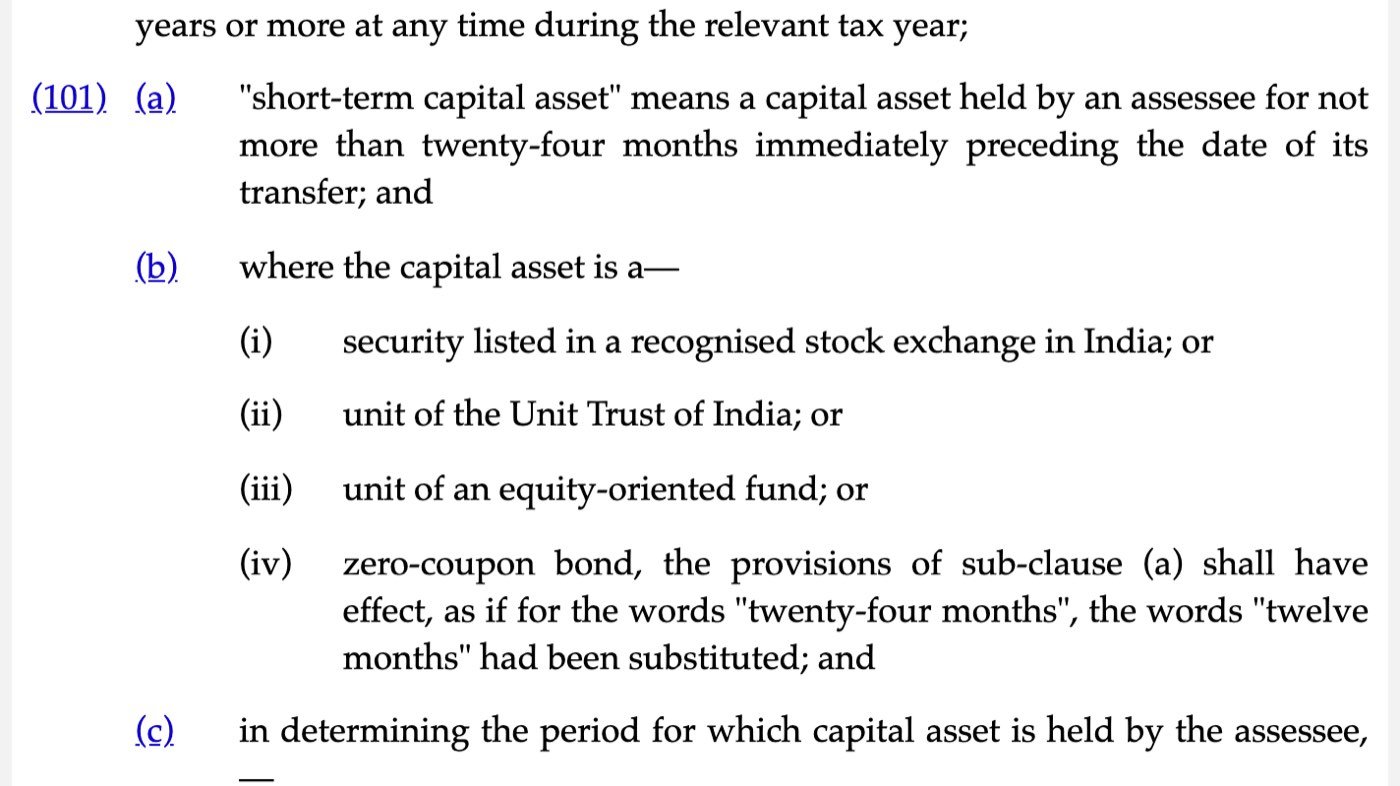
Section 2(101) of the new Act defines a short-term capital asset as one held for not more than 24 months before it is sold. For four kinds of asset the limit is 12 months instead: securities listed on a recognised stock exchange in India, units of the UTI, units of equity-oriented funds and zero-coupon bonds. So the answer to “is LTCG 24 months or 36 months?” is neither for shares (12 months) and 24 months for property. The 36-month rule for unlisted assets ended on 23 July 2024.
Count from the date of purchase to the date of sale. For shares bought in several lots, the oldest shares are treated as sold first (first-in, first-out, section 67(7)(c) for demat holdings). Some of your sale may therefore be long-term and some short-term. If you sell exactly on the anniversary, the holding is arguably not “more than” 12 months, so sell at least a day later to be safe. The calculator treats a sale on the anniversary as short-term.
LTCG on shares and equity mutual funds
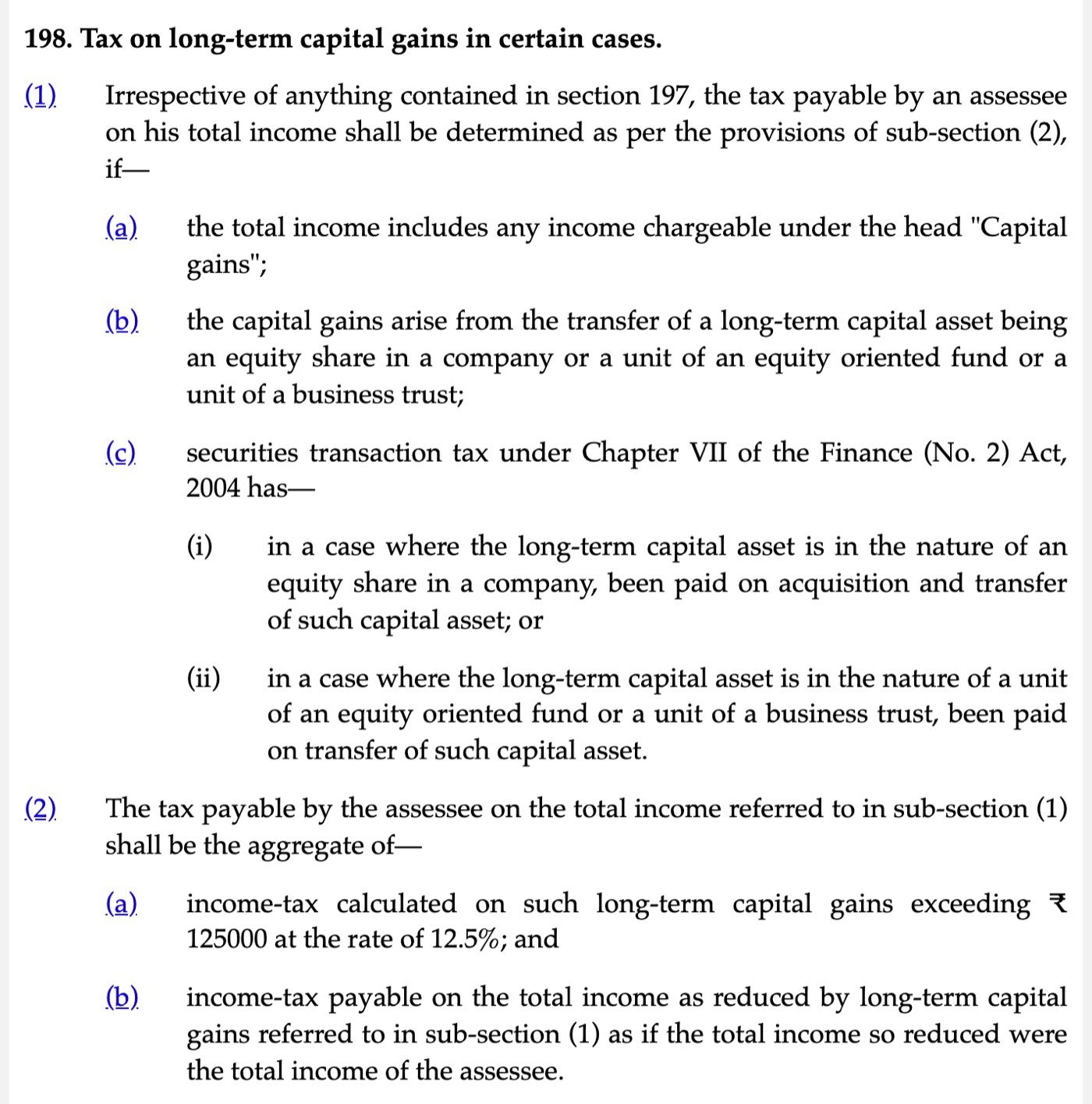
Section 198 applies when three conditions are met. The gain is long-term. The asset is an equity share, a unit of an equity-oriented fund or a unit of a business trust. Securities transaction tax was paid on both purchase and sale for shares, or on the sale for fund units. An equity-oriented fund is one that keeps at least 65% of its money in listed Indian equity, so most equity, ELSS, index and aggressive hybrid funds qualify. Gains up to ₹1,25,000 in a tax year are exempt. The limit is per person per year, across all your equity sales, not per stock or per fund. The rest is taxed at 12.5% with no indexation.
Worked example. You bought shares for ₹5,00,000 on 10 June 2023 and sold them for ₹8,00,000 on 15 September 2026, after 39 months, so the gain is long-term. The gain is ₹3,00,000. After the ₹1,25,000 exemption, ₹1,75,000 is taxed at 12.5%, which is ₹21,875. With 4% cess the total is ₹22,750. These are the calculator’s default inputs.
The basic exemption still helps. A resident whose other income is below the basic exemption limit can set the unused part against the gain (s.198(3)). Take a retiree with ₹2,00,000 of pension and interest under the new regime, where the limit is ₹4,00,000. If they sell the same shares for ₹10,00,000, the gain is ₹5,00,000. Taking off the ₹1,25,000 exemption and the unused ₹2,00,000 leaves ₹1,75,000 taxable, and the tax is ₹22,750 with cess.
Shares bought before 1 February 2018: the grandfathered cost
Long-term gains on listed equity were tax-free until 31 January 2018. To keep gains made before that date out of tax, section 90(7) sets the cost of shares and equity fund units bought before 1 February 2018 at the higher of two values. The first is what you actually paid. The second is the lower of their value on 31 January 2018 (the highest quoted price that day, or the NAV for funds) and the sale price. For example, a share bought in 2016 for ₹100, valued at ₹250 on 31 January 2018 and sold for ₹400, has a cost of ₹250 and a taxable gain of ₹150, not ₹300. Enter the 31 January 2018 value in the calculator’s extra field to apply this.
LTCG on property: 12.5% flat or 20% with indexation
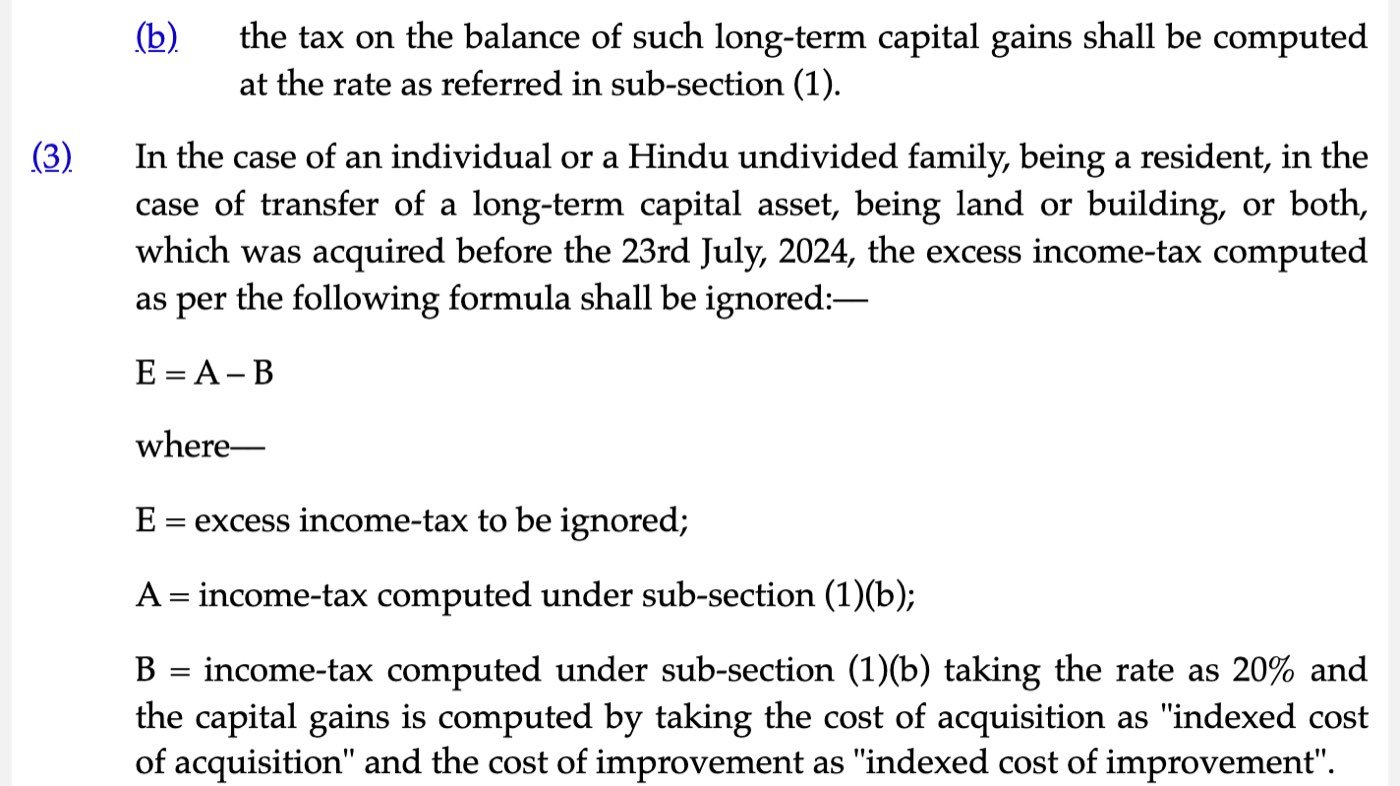
A house, flat, plot or commercial building held for more than 24 months is a long-term capital asset. The rate is 12.5% on the gain computed without indexation. Section 197(3) keeps the old choice for one group. A resident individual or HUF selling land or a building acquired before 23 July 2024 can compute the tax a second way: 20% on the gain after indexing the cost. They then pay whichever is lower. Legally, the “excess” of the 12.5% figure over the 20% figure is ignored, which comes to the same thing.
Indexation raises the cost in line with the Cost Inflation Index (CII). The indexed cost is the cost × CII of the year of sale ÷ CII of the year of purchase. For property bought before 1 April 2001, the cost may be taken as the fair market value on 1 April 2001, capped at the stamp duty value on that date (s.90(9) and (10)), and indexed from 2001-02. Improvements are indexed from the year they were made. Cost of improvement means additions and construction, not repairs or maintenance.
Example A: bought in 2015. A flat bought for ₹40 lakh in June 2015 is sold for ₹1 crore in October 2026, with ₹1 lakh of brokerage. Without indexation the gain is ₹59,00,000 and the tax at 12.5% is ₹7,37,500. With indexation the cost becomes ₹40 lakh × 384 ÷ 254 = ₹60,47,244, the gain ₹38,52,756 and the tax at 20% ₹7,70,551. The flat 12.5% is lower, so that applies: ₹7,67,000 with cess.
Example B: bought in 2005. A flat bought for ₹20 lakh in August 2005 and sold on the same terms has an unindexed gain of ₹79,00,000, which means ₹9,87,500 at 12.5%. Its indexed cost is ₹20 lakh × 384 ÷ 117 = ₹65,64,103, which leaves a gain of ₹33,35,897 and ₹6,67,179 at 20%. Indexation saves ₹3,20,321, and the total payable is ₹6,93,866.
Which one wins? The two taxes are equal when the net sale price is (8r − 5) ÷ 3 times the cost, where r is the CII ratio. Below that multiple, indexation gives the lower tax. Above it, the flat 12.5% does. For a sale in 2026-27:
| Bought in | CII then | CII ratio r (to 384) | Indexation wins if net sale price is below cost × |
|---|---|---|---|
| 2001-02 | 100 | 3.84 | 8.57× |
| 2005-06 | 117 | 3.28 | 7.09× |
| 2010-11 | 167 | 2.30 | 4.47× |
| 2013-14 | 220 | 1.75 | 2.99× |
| 2015-16 | 254 | 1.51 | 2.36× |
| 2018-19 | 280 | 1.37 | 1.99× |
| 2020-21 | 301 | 1.28 | 1.74× |
| 2023-24 | 348 | 1.10 | 1.28× |
A property that has merely kept up with inflation is better off indexed. One that has grown much faster than the index is better off at 12.5%. Improvement costs move the line, so use the calculator rather than the table for a real sale. The indexation choice is not available to non-residents, companies or firms, or for property bought on or after 23 July 2024.
Cost Inflation Index table
The Central Government notifies the CII each year at 75% of the average rise in the urban consumer price index (s.72(8)(a)). The figure for 2026-27 is 384, notified on 15 July 2026 (S.O. 3889(E)).
| Financial / tax year | CII | Financial / tax year | CII |
|---|---|---|---|
| 2001-02 | 100 | 2014-15 | 240 |
| 2002-03 | 105 | 2015-16 | 254 |
| 2003-04 | 109 | 2016-17 | 264 |
| 2004-05 | 113 | 2017-18 | 272 |
| 2005-06 | 117 | 2018-19 | 280 |
| 2006-07 | 122 | 2019-20 | 289 |
| 2007-08 | 129 | 2020-21 | 301 |
| 2008-09 | 137 | 2021-22 | 317 |
| 2009-10 | 148 | 2022-23 | 331 |
| 2010-11 | 167 | 2023-24 | 348 |
| 2011-12 | 184 | 2024-25 | 363 |
| 2012-13 | 200 | 2025-26 | 376 |
| 2013-14 | 220 | 2026-27 | 384 |
Mutual funds: which ones get 12.5%?
- Equity funds (65% or more in listed Indian equity): long-term after 12 months, 12.5% above ₹1.25 lakh under s.198. Short-term gains are taxed at 20%.
- Debt funds bought on or after 1 April 2023, defined as funds with more than 65% in debt and money-market instruments: section 76 treats every gain as short-term, whatever the holding period, and taxes it at your slab rate. Units bought before 1 April 2023 are outside section 76. They become long-term after 24 months and pay 12.5% without indexation.
- Everything in between: gold and silver funds, international funds, funds of funds and hybrids with 35–65% equity. These are neither equity-oriented nor “specified” under section 76, so they are long-term after 24 months (12 months if the units are listed, like an ETF) and taxed at 12.5% under s.197.
How to save LTCG tax: sections 82, 85 and 86
The reinvestment exemptions kept their substance in the new Act but changed numbers.
- Section 82 (old 54): sell a house, buy a house. The long-term gain on a residential house is exempt to the extent you buy one house in India within one year before or two years after the sale, or build one within three years. If the gain is ₹2 crore or less, you may buy two houses instead, once in a lifetime. Gains above ₹10 crore and house cost above ₹10 crore do not count.
- Section 85 (old 54EC): capital gains bonds. The long-term gain on land or a building is exempt to the extent you invest it within six months in bonds redeemable after five years, such as those issued by NHAI, REC and other notified issuers. The limit is ₹50 lakh across the year of sale and the next year. Selling or borrowing against the bonds within five years brings the exemption back to tax.
- Section 86 (old 54F): sell anything else, buy a house. Long-term gains on shares, gold or a plot are exempt in proportion to how much of the net sale price you put into one residential house: house cost ÷ net consideration × gain. You must not own more than one other house on the date of sale. The ₹10 crore cap applies here too.
Money not yet invested by the return due date must be parked in the Capital Gains Account Scheme with a bank to keep the s.82 and s.86 exemptions. In the calculator, the reinvestment field (shown for land or building) applies s.82 and s.85. For s.86, work out the proportional exemption first and reduce the sale price by it.
Why the ₹12 lakh rebate does not cover LTCG
In the new regime, section 156(2) wipes out tax up to ₹60,000 for a resident with total income up to ₹12 lakh. Section 156(3) caps that rebate at the tax computed at the normal slab rates of section 202(1). Section 198(7) then says the rebate comes off tax on income other than equity LTCG. So a person earning ₹8 lakh from salary who also makes ₹3 lakh of equity LTCG pays nothing on the salary, but does pay 12.5% on the gain above ₹1.25 lakh. The capital gain also counts towards the ₹12 lakh total income test. What does help, as shown above, is the unused basic exemption limit when other income is below ₹4 lakh (new regime) or ₹2.5 lakh (old regime; ₹3 lakh at 60 and ₹5 lakh at 80).
Capital losses: set-off and carry forward
A long-term capital loss can be set off only against long-term gains. A short-term loss can be set off against either kind. Neither can be set off against salary or other income. A loss you cannot use this year is carried forward for up to eight tax years, keeping the same restriction, but only if you file the return by the due date (s.108, s.111 and s.121). Booking losses in March against gains made earlier in the year (“tax-loss harvesting”) is legal. So is selling equity worth up to ₹1.25 lakh of gains each year and buying back, which uses the exemption that would otherwise lapse.
Old and new section numbers
Notices, AIS entries and older articles still quote the 1961 Act. Each pair below is linked in the 2025 Act’s own cross-reference notes.
| Rule | Income-tax Act, 1961 | Income-tax Act, 2025 |
|---|---|---|
| Holding period, short-term capital asset | 2(42A) | 2(101) |
| Capital gains charged | 45 | 67 |
| Mode of computation, indexation, CII | 48 | 72 |
| Debt funds and market-linked debentures | 50AA | 76 |
| Exemption: sale of a house, new house | 54 | 82 |
| Exemption: agricultural land | 54B | 83 |
| Exemption: capital gains bonds | 54EC | 85 |
| Exemption: any other asset, new house | 54F | 86 |
| Cost of acquisition, 2001 and 2018 values | 55 | 90 |
| Set-off within the head | 70 | 108 |
| Carry forward of capital loss | 74 | 111 |
| Rebate (₹60,000 in the new regime) | 87A | 156 |
| Short-term gains on equity at 20% | 111A | 196 |
| Long-term gains at 12.5% | 112 | 197 |
| Long-term gains on equity at 12.5% above ₹1.25 lakh | 112A | 198 |
Reporting LTCG and paying the tax
Capital gains go in the capital gains schedule of the return for the tax year of sale. Equity sales are listed scrip by scrip for gains above the exemption. Brokers’ capital gains statements and the AIS give the figures. There is no TDS on a resident’s share sale, so a large gain may require advance tax in the instalment after the sale. Missed advance tax is charged interest, the same mechanism explained on the tax calendar. When you sell immovable property for ₹50 lakh or more, the buyer deducts TDS of 1% of the price or the stamp duty value, whichever is higher (s.393). You claim it back in the return. See the TDS rate chart.
LTCG टैक्स कितना लगता है?
टैक्स वर्ष 2026-27 में लिस्टेड शेयर और इक्विटी म्यूचुअल फंड को 12 महीने से ज़्यादा रखने पर हुए मुनाफ़े (LTCG) पर साल में ₹1.25 लाख तक कोई टैक्स नहीं है। इससे ऊपर के मुनाफ़े पर 12.5% टैक्स और 4% सेस लगता है (आयकर अधिनियम 2025 की धारा 198)। ज़मीन, मकान, सोना और दूसरी संपत्तियाँ 24 महीने बाद लॉन्ग-टर्म होती हैं और उन पर 12.5% टैक्स बिना इंडेक्सेशन के लगता है। 23 जुलाई 2024 से पहले खरीदी गई प्रॉपर्टी बेचने वाले निवासी व्यक्ति 20% इंडेक्सेशन के साथ वाला विकल्प भी देख सकते हैं, जो कम हो वही देना होगा। ऊपर दिया कैलकुलेटर आपकी तारीख़ों और कीमतों से टैक्स निकालता है।
Common questions
12.5 percent plus 4 percent cess. For listed shares and equity mutual funds held over 12 months, it applies only to gains above ₹1.25 lakh in the tax year (section 198 of the Income-tax Act, 2025). For property, gold, unlisted shares and other assets held over 24 months, it applies to the whole gain without indexation (section 197).
₹1,25,000 a year of long-term gains on listed equity shares, equity mutual funds and business trust units on which STT was paid. The limit is per person across all such sales in the tax year. There is no equivalent exemption for property or gold, but a resident whose other income is below the basic exemption limit can set the unused part of the limit against any long-term gain.
Long-term gains are taxed at 12.5 percent and short-term gains on listed equity at 20 percent. The 20 percent long-term rate survives only as an option: a resident individual or HUF selling land or a building bought before 23 July 2024 can compute tax at 20 percent with indexation and pay that if it is lower than 12.5 percent without indexation.
Neither for shares: listed securities and equity fund units become long-term after 12 months. Land, buildings, gold, unlisted shares and other assets become long-term after 24 months. The 36-month period for unlisted assets was removed from 23 July 2024 and is not in the Income-tax Act, 2025.
Sale price minus selling expenses, cost of acquisition and cost of improvement, taxed at 12.5 percent. If the property was bought before 23 July 2024 and the seller is a resident individual or HUF, also index the cost and improvements with the Cost Inflation Index (384 for 2026-27) and compute 20 percent of that gain; the lower of the two is payable. Add 4 percent cess.
Only for land and buildings acquired before 23 July 2024 and sold by resident individuals or HUFs, and only as the alternative computation under section 197(3). Shares, mutual funds, gold and property bought on or after 23 July 2024 get no indexation.
No. The new-regime rebate of up to ₹60,000 under section 156 is limited to tax at the normal slab rates and, under section 198(7), is given only against tax on income other than equity LTCG. A person with ₹8 lakh of salary and ₹3 lakh of equity LTCG still pays 12.5 percent on ₹1.75 lakh.
Equity-oriented funds: 12.5 percent above ₹1.25 lakh after 12 months. Debt funds bought on or after 1 April 2023: always short-term, taxed at slab rates. Gold, international and hybrid funds with 35 to 65 percent equity: 12.5 percent without indexation after 24 months, or after 12 months if listed.
Reinvest: buy or build a residential house within the time limits (section 82 for gains on a house, section 86 for gains on other assets), or invest up to ₹50 lakh of a land or building gain in five-year capital gains bonds within six months (section 85). For equity, use the ₹1.25 lakh exemption every year and set off losses; capital losses carry forward for eight years.
Under the Income-tax Act, 2025, which applies from 1 April 2026: 112A is section 198, 112 is section 197, 111A is section 196, 54 is section 82, 54EC is section 85, 54F is section 86, and the holding-period definition in 2(42A) is section 2(101).
- Income-tax Act, 2025 — section 198, tax on long-term capital gains in certain cases (Indian Kanoon)
- Income-tax Act, 2025 — section 197, tax on long-term capital gains (Indian Kanoon)
- Income-tax Act, 2025 — section 2, definitions, clause (101) short-term capital asset (Indian Kanoon)
- Income-tax Act, 2025 — full text, including sections 72, 76, 82, 85, 86, 90, 111, 156 and 196 (Indian Kanoon)
- Income Tax Department — Tax on long-term capital gains
- Income Tax Department — Capital gain
- Income Tax Department — Cost Inflation Index
- Business Today — CBDT notifies Cost Inflation Index of 384 for FY27 (16 July 2026)
Rates, holding periods, indexation, grandfathering, exemptions and the rebate rule were checked against the text of the Income-tax Act, 2025 on 13 October 2026. The CII for 2026-27 (384) was checked against reports of notification S.O. 3889(E) of 15 July 2026, and earlier CII values against the department’s notified series. The calculator gives an estimate for one sale by a resident individual. It leaves out surcharge and treats every input as given, so it is not a computation for your return. This is general information, not tax or investment advice.