Systematic withdrawal plan (SWP) calculator: monthly income from your mutual fund, after inflation and tax
Enter the amount invested, the monthly withdrawal and the return you expect. The calculator shows how long the money lasts, what is left, the withdrawal raised each year for inflation, and the tax on every payout under the Income-tax Act, 2025.
Updated 18 October 2026 · equity, hybrid and debt funds · your figures never leave your browser
Your investment
For the tax
Your SWP
Returns compound monthly at the rate that gives your yearly figure exactly (10% a year is 0.797% a month); each withdrawal comes at the end of a month. Tax uses the Income-tax Act, 2025 rates for residents, without surcharge or exit loads. Returns are your assumption, not a promise.
Year by year (financial years)
| Year | Withdrawn | Gains | Tax | Value at end |
|---|
An SWP (systematic withdrawal plan) pays you a fixed amount from a mutual fund every month by selling just enough units on a set date, and the rest of the money stays invested. With ₹50 lakh earning 10% a year, a withdrawal of ₹30,000 a month can run for 20 years and still leave about ₹1.21 crore in the fund. Raise the withdrawal 6% a year to keep pace with inflation and the same money runs out after 20 years 6 months. Each payout is taxed only on the gain inside it, so the tax is small, especially in an equity fund: ₹2,24,695 over the whole 20 years in this example. The calculator above runs these numbers on your own inputs, including the tax under the Income-tax Act, 2025.
- Full form: Systematic Withdrawal Plan
- How it pays: units worth your fixed amount are redeemed on a chosen date each month (or quarter)
- Interest rate: none; what the fund earns depends on the market
- Tax: only the gain inside each withdrawal is taxed; equity funds 12.5% above ₹1.25 lakh a year after 12 months, 20% before; debt funds bought from April 2023 at your slab rate
- TDS: none on SWP redemptions for resident investors
- Lasts forever if: you withdraw less each year than the fund earns
How the SWP calculator works
Enter the amount invested, the monthly withdrawal, the return you expect and the number of years. Each month the calculator grows the fund at your return, then sells units worth one withdrawal. Two details make its results more accurate than most:
- True monthly compounding. A 10% yearly return is applied as 0.797% a month, which compounds to exactly 10% over a year. Calculators that use 10 ÷ 12 = 0.833% a month quietly assume about 10.5% a year.
- Tax on each withdrawal. A withdrawal is a sale of units, and only the gain in those units is taxable. The calculator tracks that gain unit by unit, sorts it into short- and long-term by how long you have held the fund, groups it by financial year so the ₹1.25 lakh exemption applies each year, and adds 4% cess.
Use “Raise the withdrawal every year by” to keep your income in step with inflation. If you are starting the SWP from money you invested years ago, enter what you paid and how long you have held it: the gain inside each withdrawal is then larger, and long-term from the first month.
What is an SWP in mutual funds?
SWP stands for Systematic Withdrawal Plan. The Association of Mutual Funds in India explains it this way:

Three things follow from that. The money you have not withdrawn keeps earning whatever the fund earns. Your payout is fixed in rupees, so the number of units sold each month changes with the price: fewer when markets are up, more when they are down. And an SWP has no interest rate. What people search for as “SWP interest rate” is really the fund’s return, which the calculator asks you to assume.
SWP example: ₹50 lakh, ₹30,000 a month
The calculator’s default plan: ₹50 lakh in an equity fund returning 10% a year, ₹30,000 a month for 20 years, with the first withdrawal in November 2026.
- You receive ₹72,00,000 over 20 years, ₹72 lakh in all.
- The fund still holds ₹1,20,89,723 at the end, because ₹3.6 lakh a year is 7.2% of the starting amount and the fund earns more than that.
- The gains inside all those withdrawals add up to ₹39,97,060, and the tax on them, after the ₹1.25 lakh yearly exemption, is ₹2,24,695.
- In today’s money, at 6% inflation, the last ₹30,000 is worth about ₹9,354. That is the case for raising the withdrawal each year.
How long will your money last?
How long ₹1 crore lasts at different withdrawals and returns, with the withdrawal kept flat. “40+ years” means the fund is still growing:
| Withdrawal | At 8% a year | At 10% | At 12% |
|---|---|---|---|
| ₹7.2 lakh a year (₹60,000/month) | 40+ years | 40+ years | 40+ years |
| ₹9 lakh a year (₹75,000/month) | 25 yr 5 mo | 40+ years | 40+ years |
| ₹10.8 lakh a year (₹90,000/month) | 16 yr 4 mo | 22 yr 10 mo | 40+ years |
| ₹12 lakh a year (₹1,00,000/month) | 13 yr 5 mo | 16 yr 10 mo | 26 yr 3 mo |
| ₹15 lakh a year (₹1,25,000/month) | 9 yr 5 mo | 10 yr 8 mo | 12 yr 7 mo |
And with the withdrawal raised 5% every year, which is what most retirees actually need:
| Withdrawal | At 8% a year | At 10% | At 12% |
|---|---|---|---|
| ₹40,000/month, +5% a year | 32 yr 10 mo | 40+ years | 40+ years |
| ₹50,000/month, +5% a year | 23 yr 5 mo | 34 yr 4 mo | 40+ years |
| ₹60,000/month, +5% a year | 18 yr 4 mo | 23 yr 6 mo | 39 yr 8 mo |
The rule of thumb in both tables: if you withdraw less each year than the fund earns, the corpus grows; once you withdraw more, it starts to shrink, slowly at first and then fast.
SWP with inflation: raising the withdrawal every year
A flat ₹30,000 a month buys less every year. Raising it 6% a year keeps its value, but the corpus has to work much harder. In the same ₹50 lakh, 10% example, the withdrawal climbs to ₹90,768 a month by the 20th year and the money runs out after 20 years 6 months; kept flat, the same withdrawal still leaves ₹1.21 crore after 20 years. Use the “raise every year” field to find the starting withdrawal that lasts as long as you need.
How much corpus do you need for a monthly income?
The lump sum needed today to pay a monthly income for 25 years, with the payment raised 6% a year and the fund fully used up at the end:
| Monthly income to start | At 8% a year | At 10% a year |
|---|---|---|
| ₹25,000 a month | ₹58 lakh | ₹47.3 lakh |
| ₹50,000 a month | ₹1.16 crore | ₹94.7 lakh |
| ₹1,00,000 a month | ₹2.32 crore | ₹1.89 crore |
The calculator gives the same figure for your own plan as “Lump sum that funds exactly this plan”.
SWP tax: why it is so low
Each withdrawal is a sale of units, so it is taxed as a capital gain, not as income. Only the gain inside the units you sell is taxable, and in the early years most of each withdrawal is your own money coming back. On ₹1 crore in an equity fund paying ₹50,000 a month at 10%, starting in April 2027, the first three financial years look like this:
| Financial year | Withdrawn | Gains in it | Tax |
|---|---|---|---|
| 2027-28 | ₹6,00,000 | ₹29,976 | ₹6,235 |
| 2028-29 | ₹6,00,000 | ₹81,796 | ₹0 |
| 2029-30 | ₹6,00,000 | ₹1,28,905 | ₹508 |
The first withdrawals are short-term (taxed at 20%), but the gain in them is tiny. From the 13th month they are long-term, and the first ₹1.25 lakh of long-term equity gains each financial year is tax-free, so the tax stays at or near zero for years. The same ₹6 lakh a year as bank interest would be taxed in full at your slab rate. The rules by fund type:
| Fund type | Long-term after | Short-term rate | Long-term rate |
|---|---|---|---|
| Equity funds (65%+ in Indian shares) | More than 12 months | 20% (s.196) | 12.5% above ₹1.25 lakh a year (s.198) |
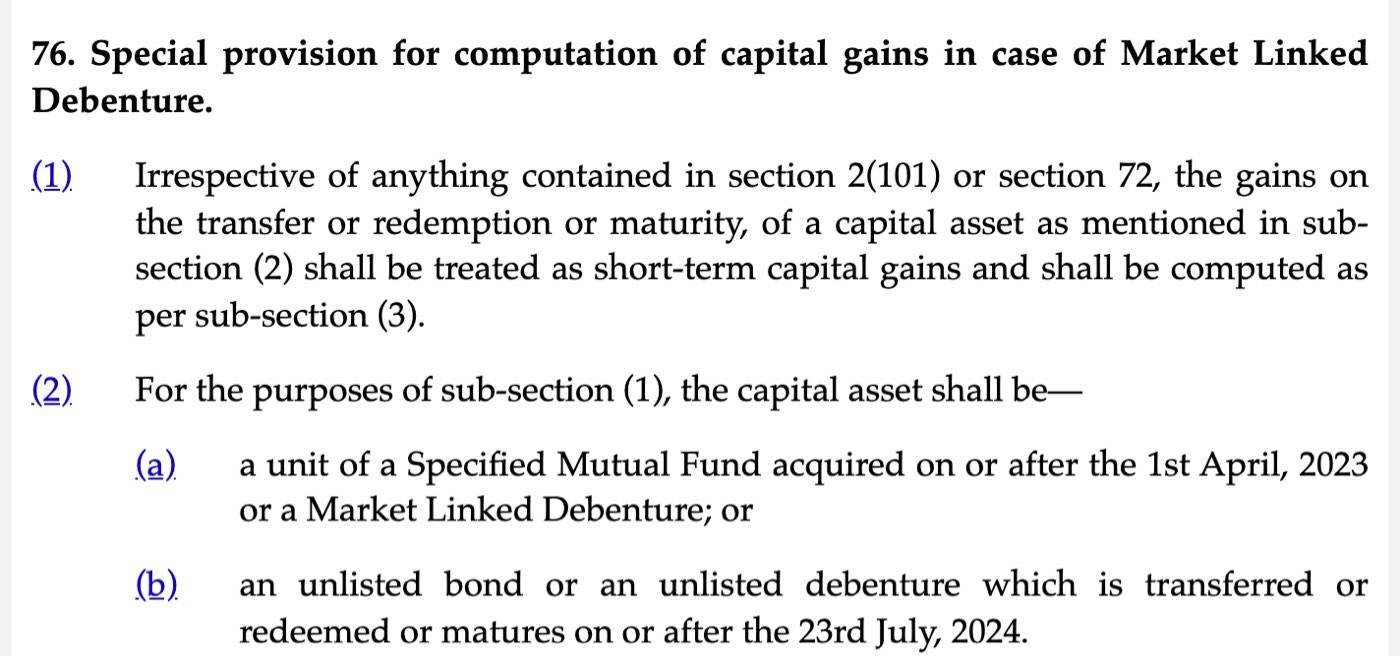
| Debt funds (over 65% in debt) bought on or after 1 April 2023 | Never | Your slab rate (s.76) | — |
| Hybrid funds with 35–65% equity, gold, international and other funds; debt funds bought before 1 April 2023 | More than 24 months (12 if listed, like an ETF) | Your slab rate | 12.5% (s.197) |
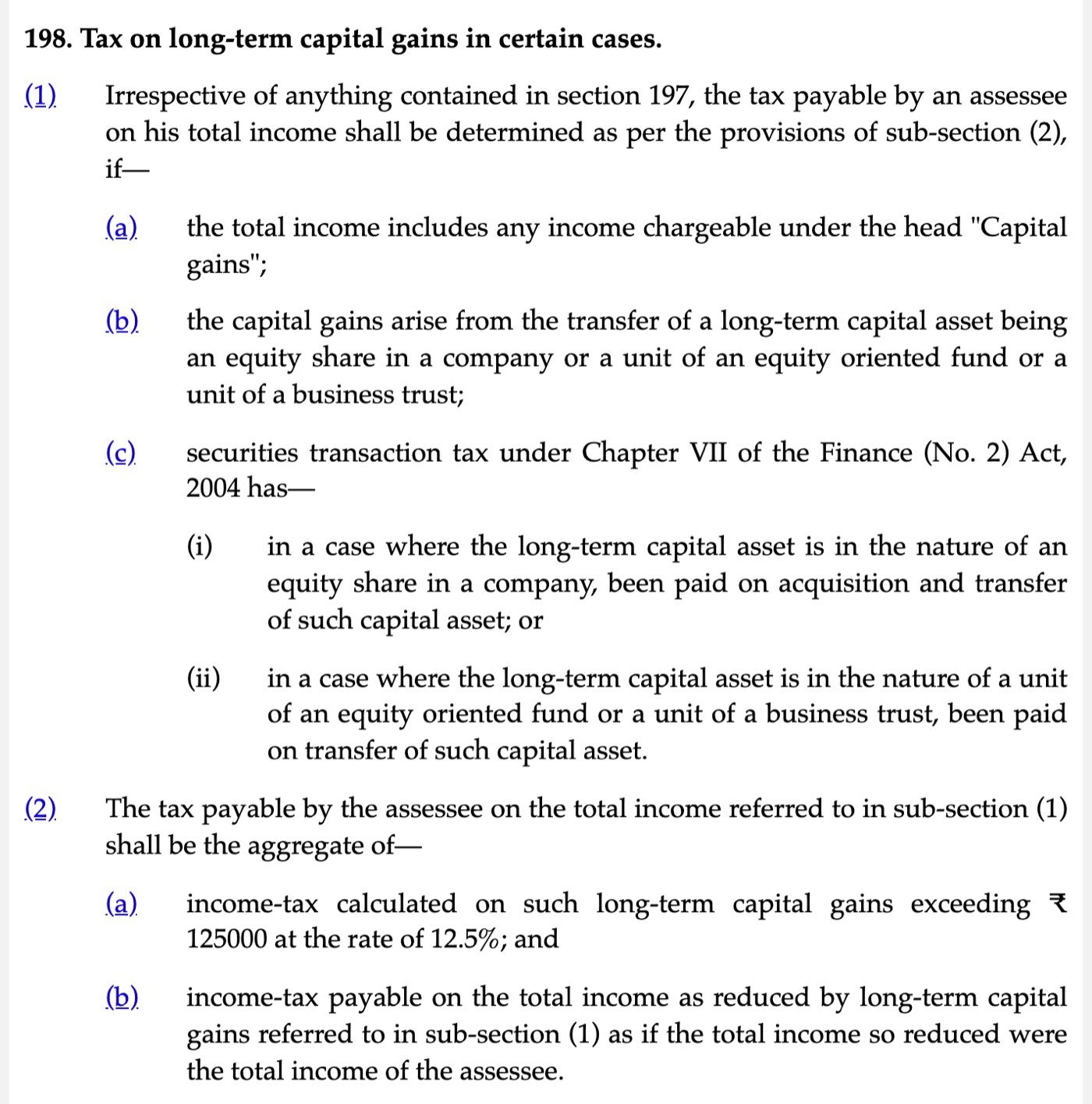
Debt funds are different. Under section 76, every gain on units of a “specified mutual fund”, one with more than 65% in debt and money-market instruments, bought on or after 1 April 2023 is short-term, however long you hold it, and is taxed at your slab rate:
Two more points. If your other income is below the basic exemption limit (₹4 lakh in the new regime), the unused part is set against these gains first; the calculator assumes your other income is above it. And the new-regime rebate that makes income up to ₹12 lakh tax-free does not cover capital gains taxed at these special rates, as the LTCG tax page explains.
Is there TDS on SWP?
Not for resident investors. Mutual funds deduct tax on redemptions only for non-residents; a resident pays the capital-gains tax when filing the return, and as advance tax if it is large. Sundaram Mutual Fund’s tax reckoner for 2026-27, written for the new Act, puts it plainly:

TDS does apply to the other way of drawing income from a fund, the IDCW (dividend) option: 10% on income from mutual-fund units above ₹10,000 in a financial year, under section 393(1) of the new Act. A resident whose total tax will be nil can file Form 121, the new Act’s replacement for Forms 15G and 15H, to stop it.

SWP vs dividend (IDCW) vs FD interest
- SWP: you choose the amount and the date; only the gain inside each payout is taxed, at capital-gains rates; no TDS for residents.
- IDCW (dividend) option: the fund decides whether and how much to pay; the whole payout is added to your income and taxed at your slab rate, with 10% TDS above ₹10,000 a year. AMFI’s own note is that these payouts are “in no way guaranteed”.
- Fixed deposit: the interest is guaranteed, but all of it is taxed at your slab rate every year.
The trade-off is risk. An FD’s interest is fixed; an SWP from an equity fund depends on markets, and a fall in the first few years, while you keep selling units, does lasting damage. Many people keep one to two years of withdrawals in a debt or liquid fund and run the SWP from there, topping it up from the equity fund in good years.
SIP vs SWP (and STP)
They are mirror images. A SIP (systematic investment plan) puts a fixed amount into a fund every month while you are earning; an SWP takes a fixed amount out when you need income. An STP (systematic transfer plan) moves a fixed amount every month from one fund to another, for example from a debt fund into an equity fund to invest a lump sum gradually. Each sale under an STP or SWP is taxed as a capital gain.
Choosing a fund for an SWP
We do not recommend schemes, but the choice comes down to three questions:
- How long must the money last? For 10 years or more, some equity exposure is usually needed to keep up with inflation; for 3 to 5 years, the swings of a pure equity fund are hard to live with while you are selling units every month.
- How much are you withdrawing? Keep the first year’s withdrawal comfortably below the return you can reasonably expect. The tables above show what happens when you do not.
- What does the tax look like? Equity and older debt funds get long-term rates; debt funds bought from April 2023 are taxed at your slab rate on every gain.
Whatever the fund, use its growth option for an SWP, not IDCW, and check its exit load: many equity funds charge one if units are redeemed within a set period after purchase, often a year.
How to start an SWP
- Invest a lump sum in the growth option of the fund, or use money you already hold there.
- Register the SWP on the fund house’s website or app, or through the platform or distributor you invested with: choose the scheme, the amount, monthly or quarterly, the date and the bank account.
- Check the scheme’s SWP form for its minimum amount and the dates on offer; these differ from scheme to scheme.
- You can change or stop the SWP with a fresh request, made before the next SWP date, and you can still redeem the rest of the investment whenever you want.
The calculator works for a plan with any fund house, SBI Mutual Fund’s included; only the fund’s return and its scheme rules differ.
SWP क्या होता है?
SWP का मतलब है सिस्टमैटिक विड्रॉल प्लान। इसमें आप म्यूचुअल फंड के ग्रोथ विकल्प में एक बार पैसा लगाते हैं और हर महीने एक तय रकम निकालते हैं; फंड उतने यूनिट बेचकर पैसा आपके बैंक खाते में भेज देता है और बाकी पैसा निवेश में बढ़ता रहता है। जैसे ₹50 लाख पर 10% सालाना रिटर्न मानें तो ₹30,000 महीना 20 साल तक निकल सकता है। टैक्स सिर्फ़ हर निकासी में मौजूद मुनाफ़े पर लगता है: इक्विटी फंड में 12 महीने बाद ₹1.25 लाख सालाना मुनाफ़े तक कोई टैक्स नहीं और उसके ऊपर 12.5%; रेज़िडेंट निवेशकों पर SWP में TDS नहीं कटता। SWP पर कोई तय ब्याज दर नहीं होती, कमाई बाज़ार पर निर्भर है।
Common questions
SWP means Systematic Withdrawal Plan: you invest in the growth option of a mutual fund and choose a fixed amount to be paid to your bank account on a set date every month or quarter. The fund sells units worth that amount each time, and the rest of the money stays invested.
Systematic Withdrawal Plan. It is the opposite of a SIP (Systematic Investment Plan): a SIP puts a fixed amount into a fund regularly, an SWP takes a fixed amount out.
Yes, but only the gain inside each withdrawal, as a capital gain. In an equity fund, gains are taxed at 20% if the units sold were held 12 months or less, and at 12.5% above ₹1.25 lakh a year after that. Debt-fund units bought on or after 1 April 2023 are taxed at your slab rate. Because early withdrawals are mostly your own money, the tax is usually small.
Not for resident investors. Mutual funds deduct tax on redemptions only for non-residents. TDS of 10 percent applies to dividend (IDCW) payouts above ₹10,000 a year, not to SWP redemptions.
At a 10 percent yearly return and a flat withdrawal, ₹75,000 a month (9 percent a year) lasts more than 40 years; ₹90,000 a month lasts 22 years 10 months and ₹1 lakh a month 16 years 10 months. Raising the withdrawal 5 percent a year, ₹50,000 a month lasts 34 years 4 months.
An SWP has no interest rate. Your money stays in the mutual fund and earns whatever the fund earns, which changes with the market. The calculator asks you to assume a yearly return.
A SIP invests a fixed amount in a fund at regular intervals to build wealth; an SWP withdraws a fixed amount at regular intervals to provide income. Many people use a SIP while working and an SWP after retiring.
There is no single best fund. For income needed over 10 years or more, some equity exposure helps keep up with inflation; for a few years, steadier debt or hybrid funds suit better. Keep the first year's withdrawal below the return you can reasonably expect, and use the fund's growth option, not IDCW.
Yes. You can change the amount or date, or stop the SWP, by submitting a new request to the fund house or through your platform before the next SWP date, and you can redeem the rest of the investment whenever you want.
This calculator works for an SWP in any mutual fund, including SBI Mutual Fund's schemes. Enter your investment, withdrawal and expected return; the minimum SWP amount and dates for a particular SBI scheme are in that scheme's SWP form.
- AMFI, Mutual Funds Sahi Hai — What is Systematic Withdrawal Plan (SWP)?
- Income-tax Act, 2025 — section 76, specified mutual funds (Indian Kanoon)
- Income-tax Act, 2025 — section 198, long-term gains on equity funds (Indian Kanoon)
- Income-tax Act, 2025 — full text, including sections 2(101), 156, 196, 197 and 393 (Indian Kanoon)
- Sundaram Mutual Fund — Tax Reckoner 2026-27
Tax rules checked against the text of the Income-tax Act, 2025 and a fund house’s 2026-27 tax reckoner on 18 October 2026. The calculator is a projection: mutual-fund returns are not guaranteed, and real returns arrive unevenly, which matters more when you are withdrawing. It leaves out surcharge, exit loads and STT (0.001% on selling equity-fund units). General information, not investment or tax advice.