What is TDS? Full form, meaning, and how tax deducted at source works in India (FY 2026-27)
The full form, the mechanism in four steps with a worked example, every common payment with its threshold and rate, TDS on salary month by month, how to check Form 26AS, refunds, Forms 15G and 15H — and what changed under the Income-tax Act, 2025.
TDS stands for Tax Deducted at Source. It is income tax that the person paying you — your employer, your bank, a client, a tenant — deducts from the payment at a rate fixed for that kind of payment, deposits with the government against your PAN, and reports so that it appears in your Form 26AS. When you file your return the deducted amount is set off against your final tax; if it is more than you owe, the difference comes back as a refund. In FY 2026-27 the common triggers are salary above the exemption limit, bank interest above ₹50,000 a year (₹1,00,000 for senior citizens), rent above ₹50,000 a month, and professional fees above ₹50,000 a year. In Hindi, TDS is स्रोत पर कर कटौती.
- Full form: Tax Deducted at Source — स्रोत पर कर कटौती
- What it is: your own income tax, deducted by the payer at a fixed rate and credited to your PAN
- Bank interest: 10% above ₹50,000 a year (₹1,00,000 for senior citizens)
- Rent: 10% above ₹50,000 a month · Professional fees: 10% above ₹50,000 a year
- Salary: slab rates spread over 12 months; nil up to about ₹1 lakh a month under the new regime
- No PAN: 20% · Non-filer higher rate: scrapped from 1 April 2025
- Check it: Form 26AS and AIS on the e-filing portal; Form 16 / 16A from the deductor
- Law: Sections 392 and 393 of the Income-tax Act, 2025 (was 192 to 196 of the 1961 Act)
TDS full form and meaning
The full form of TDS is Tax Deducted at Source. “Source” is the point where the income arises — the salary desk, the bank paying interest, the company paying a dividend, the client paying a fee. Instead of waiting for you to declare that income and pay tax on it a year later, the law makes the payer deduct a slice of tax before the money reaches you and hand it to the government on your behalf. The payer is called the deductor; you are the deductee.
Three things follow from that definition. TDS is not a separate tax: it is your own income tax, collected early and in pieces. It is deducted at a flat rate for the type of payment, not at your personal slab rate, so it can be more or less than what you finally owe. And it is credited to you personally, through your PAN, which is why a wrong or missing PAN is the most common reason TDS goes astray.
How TDS works: deduct, deposit, report, credit
Take a freelancer who invoices a company ₹1,00,000 for design work. Professional fees carry 10% TDS once they cross ₹50,000 in a year, so the company pays ₹90,000 and deducts ₹10,000. That ₹10,000 then travels through four steps.
- Deduct. The company deducts the tax at the moment it credits the invoice or pays it, whichever comes first. The deduction is on the full ₹1,00,000, not on the amount above the threshold.
- Deposit. By the 7th of the following month the company deposits the ₹10,000 with the government through a challan on the e-filing portal, quoting its TAN. The TDS payment guide shows every screen of that.
- Report. Every quarter the company files a TDS statement listing each deductee’s PAN, the amount paid and the tax deducted. TDS-CPC processes it and posts the ₹10,000 against the freelancer’s PAN.
- Credit. The freelancer sees the entry in Form 26AS and receives Form 16A from the company. At return time the whole ₹1,00,000 is income, the tax on it is worked out at slab rates, and the ₹10,000 already deducted is subtracted. If her total tax for the year is ₹4,000, the ₹6,000 excess is refunded; if it is ₹25,000, she pays the ₹15,000 balance.
The same mechanism runs for salary, except that the employer estimates the whole year’s tax in April and deducts one-twelfth every month, adjusting as the year goes on. That is why the TDS on a salary tracks your real liability far more closely than the flat 10% on a fee does.
Where TDS applies in FY 2026-27: the common payments
Every payment type has its own section, threshold and rate. The thresholds below are the ones in force for FY 2026-27; most of them were raised on 1 April 2025 and the Income-tax Act, 2025 carried them forward unchanged. The full list of 32 sections, with the changes marked, is on the TDS rate chart.
| Payment | Section | TDS applies above | Rate |
|---|---|---|---|
| Salary | 192 (now 392) | Basic exemption limit under the regime you chose | Slab rates, spread over the year |
| Bank, post-office and co-operative bank interest | 194A | ₹50,000 a year; ₹1,00,000 for senior citizens | 10% |
| Rent | 194-I | ₹50,000 a month | 10% land, building, furniture · 2% plant and machinery |
| Rent paid by an individual not under tax audit | 194-IB | ₹50,000 a month | 2%, once a year |
| Professional fees, royalty | 194J(b) | ₹50,000 a year | 10% |
| Technical services, call-centre work | 194J(a) | ₹50,000 a year | 2% |
| Contractors and sub-contractors | 194C | ₹30,000 per payment or ₹1,00,000 a year | 1% individual or HUF · 2% others |
| Commission or brokerage | 194H | ₹20,000 a year | 2% |
| Dividend | 194 | ₹10,000 a year | 10% |
| Purchase of property (not agricultural land) | 194-IA | ₹50 lakh | 1%, deducted by the buyer |
| Lottery, game-show and online-game winnings | 194B, 194BA | ₹10,000 per win; nil for online games | 30% |
| Cash withdrawn from a bank in a year | 194N | ₹1 crore (₹20 lakh if you have not filed returns) | 2%; 5% above ₹1 crore for non-filers |
| Purchase of goods by a large buyer | 194Q | ₹50 lakh from one seller | 0.1% |
| Payments by a firm to its partners | 194T | ₹20,000 a year | 10% (new from April 2025) |
Two rules sit on top of every row. If you do not give the payer your PAN, tax is deducted at 20% or the section’s rate, whichever is higher, and the credit may never reach you. And the higher rate that used to apply to people who had not filed their returns (old Sections 206AB and 206CCA) was scrapped from 1 April 2025, so filing history no longer changes the rate — except for cash withdrawals under 194N, which keeps its own non-filer test.
TDS on salary: how your employer works it out
Salary is the one payment where TDS is not a flat percentage. Under Section 192 (now 392) the employer estimates your income for the whole year, applies the slab rates of the regime you have chosen, and deducts the resulting tax in equal monthly instalments. For FY 2026-27 the new regime is the default: a ₹75,000 standard deduction, slabs starting at 5% above ₹4 lakh, and a rebate that wipes out tax on taxable income up to ₹12 lakh. The table shows what that means month by month for a salary with no other income and no declared deductions.
| Monthly salary | Annual | Tax for the year (new regime) | TDS per month |
|---|---|---|---|
| ₹50,000 | ₹6,00,000 | Nil | Nil |
| ₹75,000 | ₹9,00,000 | Nil | Nil |
| ₹1,00,000 | ₹12,00,000 | Nil | Nil |
| ₹1,25,000 | ₹15,00,000 | ₹97,500 | ₹8,125 |
| ₹1,50,000 | ₹18,00,000 | ₹1,50,800 | ₹12,567 |
| ₹2,00,000 | ₹24,00,000 | ₹2,92,500 | ₹24,375 |
So the answer to the question people ask most — what is the TDS on a ₹50,000 salary — is nil: ₹6 lakh a year less the standard deduction is ₹5.25 lakh of taxable income, the tax on it is ₹6,250, and the rebate cancels it. TDS on salary starts a little above ₹1 lakh a month under the new regime. If you opt for the old regime and declare rent, insurance or home-loan interest on Form 12BB, the employer recomputes with those; the income tax calculator runs both regimes on your own numbers, and the HRA calculator handles the rent exemption. The monthly deduction appears as a line on your salary slip, and the annual total on Form 16.
Why is 2% TDS deducted? The rates explained
The rate tells you what kind of payment the payer thinks it is. 2% is the rate for contractors that are companies or firms, for commission and brokerage, for technical services, for rent paid by an individual, for insurance commission and for plant-and-machinery rent — the low rate the law uses where the margin on the payment is thin. 1% applies to individual contractors and to property purchases. 10% is the standard rate for income that is mostly profit: professional fees, rent of buildings, interest, dividends, mutual-fund income and payments to partners. 30% is reserved for winnings, and 0.1% for bulk purchases of goods. If a client has deducted 2% from your invoice and you are a professional, they have treated you as a contractor or as technical services; the difference is worth raising before the quarter closes, because the statement is what fixes the credit.
TDS vs TCS vs advance tax vs self-assessment tax
All four are ways of paying the same income tax; they differ in who pays and when.
| TDS | TCS | Advance tax | Self-assessment tax | |
|---|---|---|---|---|
| Who pays it to the government | The payer (employer, bank, client) deducts it from your money | The seller collects it on top of the price | You, in four instalments | You, when you file the return |
| Trigger | A payment above the section’s threshold | Specified sales: cars above ₹10 lakh, foreign remittances above ₹10 lakh, tour packages | Tax after TDS of more than ₹10,000 in the year | Tax still due after TDS, TCS and advance tax |
| When | At credit or payment, whichever is earlier | At sale or receipt | 15 June, 15 September, 15 December, 15 March | Before filing, by 31 July for most individuals |
| Where you see it | Form 26AS, Form 16 or 16A | Form 26AS, Form 27D | Challan receipt, Form 26AS | Challan receipt |
TCS — tax collected at source — is the mirror image of TDS: the seller adds it to what you pay and deposits it, and it shows up as your credit in the same Form 26AS. Advance tax is what you pay yourself when TDS has not covered your liability, typically on business income, capital gains or interest; the four instalment dates are on the tax calendar.
How to check your TDS: Form 26AS, AIS, Form 16 and Form 16A
Log in to the e-filing portal, open e-File → Income Tax Returns → View Form 26AS, and the portal hands you over to TRACES to display the statement. Form 26AS lists every deductor that has reported tax against your PAN, quarter by quarter, with the amount paid and the tax deducted. Since assessment year 2023-24 that is all it lists; interest, dividends, share sales and other reported transactions moved to the Annual Information Statement under the AIS menu.

The deductor’s side of the same record is the certificate: Form 16 from an employer, issued by 15 June for the previous year, and Form 16A from anyone else, issued every quarter. Both are generated from TRACES, so they should agree with 26AS to the rupee. When they do not, the deductor has either not deposited the tax or has quoted the wrong PAN in the statement; either way the fix is on their side, through a corrected statement. Chasing that before you file is worth it, because the return-processing system gives credit only for what 26AS shows.
TDS refund: how to get excess TDS back
There is no separate refund form. You file your income tax return, declare the income the TDS related to, claim the TDS shown in 26AS, and the return-processing centre refunds the excess to the bank account validated on the portal — with interest at 0.5% a month from 1 April if the return was filed on time. A bank that deducted 10% on your fixed-deposit interest when your total income is below the exemption limit is the classic case: the ₹5,000 comes back only if you file, and a return filed after the due date still gets the refund but loses part of the interest. The tax on the same income at your slab rate is worked out on the income tax calculator.
How to stop or reduce TDS: Form 15G, 15H and lower-deduction certificates
If your total income is below the taxable limit you can ask the payer not to deduct at all. Form 15G is the declaration for anyone under 60 whose tax on total income is nil; Form 15H is the version for senior citizens, and the rebate counts, so a senior with pension and interest up to the rebate limit can file it. Banks accept both at the start of each year, and most let you submit them in net banking. Give one bank the form and forget the second bank, and the second bank still deducts.
If your income is taxable but the flat rate is far above your real liability — a consultant paying rent to a landlord whose only income is that rent, a contractor with thin margins — apply to your assessing officer for a certificate for lower or nil deduction through TRACES. The certificate names the deductor and the rate, and the deductor must follow it. It is the right tool where large refunds pile up year after year.
If you are the one deducting: TAN, deposit and statements
The obligations flip when you are paying. A business that crosses a threshold needs a TAN (tax deduction account number), must deduct at the section’s rate, deposit it by the 7th of the following month (30 April for March), file the quarterly statement by 31 July, 31 October, 31 January and 31 May, and issue certificates. Late deposit costs 1.5% a month counted from the date of deduction, and a late statement ₹200 a day. Individuals paying rent above ₹50,000 a month or buying property of ₹50 lakh or more deduct with their PAN through a single challan-cum-statement, now called Form 141. The payment guide covers the portal step by step and the rate chart the sections; the freelancing guide shows how TDS and GST sit together on the same invoice.
TDS in the Income-tax Act, 2025: Sections 392 and 393
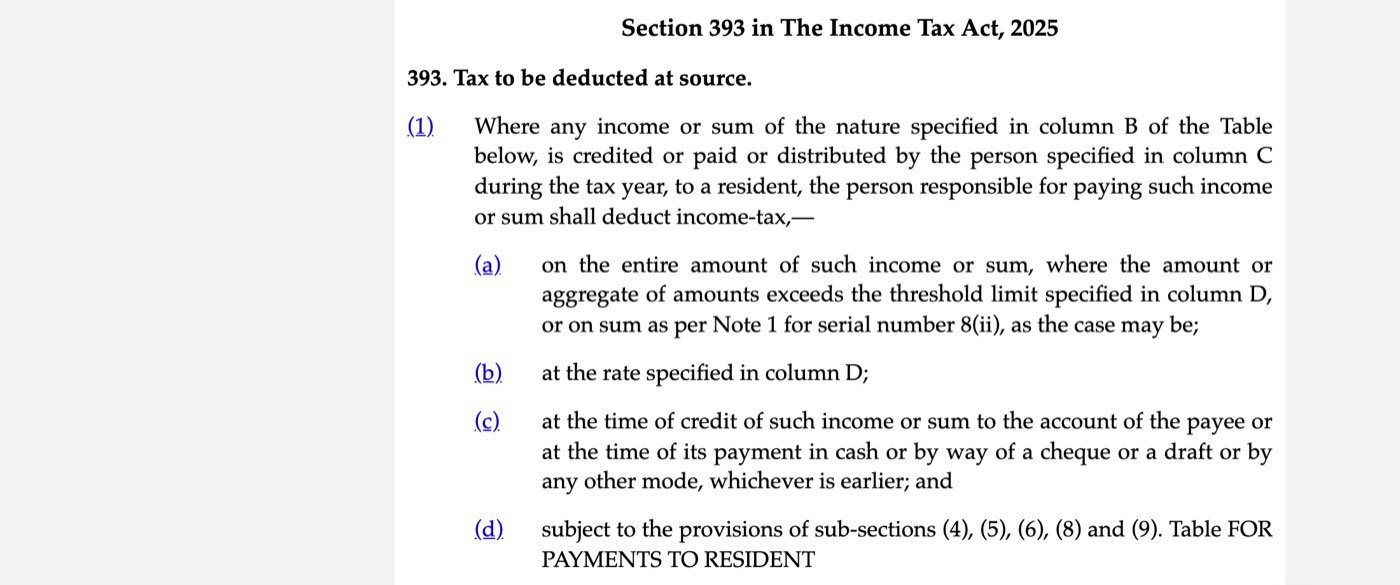
From 1 April 2026 the Income-tax Act, 1961 is replaced by the Income-tax Act, 2025. The rates and thresholds did not change, but the structure did: salary TDS is now Section 392, and almost every other payment sits in a single table under Section 393, one row per kind of payment with its payer, threshold and rate. The Act also drops the assessment-year label for the “tax year”, so the year in which a deduction is made and the year it is reported against are the same, 2026-27. The section numbers people search for — 194C, 194J, 194-I — survive as the row labels the portal and every accountant still use.
TDS क्या होता है? (TDS meaning in Hindi)
TDS का फुल फॉर्म Tax Deducted at Source है — हिंदी में स्रोत पर कर कटौती। जब कोई कंपनी, बैंक या क्लाइंट आपको सैलरी, ब्याज, किराया या फीस देता है, तो वह भुगतान करने से पहले तय दर से इनकम टैक्स काटकर सरकार के पास आपके PAN पर जमा करता है। यह कटी हुई रकम आपके Form 26AS में दिखती है और रिटर्न भरते समय आपके कुल टैक्स में से घट जाती है; अगर आपका टैक्स कम बनता है तो बाकी रकम रिफंड हो जाती है।
FY 2026-27 में बैंक ब्याज पर साल में ₹50,000 (वरिष्ठ नागरिक ₹1,00,000) से ऊपर 10%, ₹50,000 प्रति माह से ऊपर किराए पर 10%, प्रोफेशनल फीस पर ₹50,000 से ऊपर 10%, और ठेकेदार के भुगतान पर 1% या 2% TDS कटता है। सैलरी पर TDS स्लैब के हिसाब से कटता है — नई टैक्स रिजीम में ₹12 लाख तक की टैक्सेबल इनकम पर टैक्स शून्य है, इसलिए लगभग ₹1 लाख महीना तक की सैलरी पर आम तौर पर TDS नहीं कटता। PAN न देने पर 20% कटता है।
Other full forms of TDS: water and prescriptions
Two unrelated TDSs share the letters. On a water-purifier or a municipal report, TDS is total dissolved solids: the minerals and salts dissolved in water, measured in milligrams per litre. The Bureau of Indian Standards’ drinking-water standard IS 10500 sets 500 mg/L as the acceptable limit and 2,000 mg/L as the permissible limit where no better source exists, which is why RO purifiers advertise the number. On a prescription, t.d.s. is the Latin ter die sumendum, “to be taken three times a day”; doctors also write it as TID. Neither has anything to do with tax, and a search for “TDS full form” lands on all three.
Common questions
TDS stands for Tax Deducted at Source: income tax that the payer deducts from a payment such as salary, interest, rent or fees at a fixed rate, deposits with the government against the recipient's PAN, and reports so that it appears in the recipient's Form 26AS. In Hindi it is srot par kar katauti.
TDS on salary is the income tax your employer deducts from each month's pay under Section 192 (Section 392 of the Income-tax Act 2025). The employer estimates your tax for the whole year at slab rates under the regime you chose, after the standard deduction and any deductions you declare, and deducts one-twelfth every month. The total appears in Form 16 and Form 26AS.
Nil under the new tax regime for FY 2026-27. A salary of ₹50,000 a month is ₹6 lakh a year; after the ₹75,000 standard deduction the taxable income is ₹5.25 lakh, the tax on it is ₹6,250, and the rebate for taxable income up to ₹12 lakh cancels it. TDS on salary begins a little above ₹1 lakh a month under the new regime, assuming no other income.
Because the payment falls under a section with a 2 percent rate: payments to contractors that are companies or firms (194C), commission or brokerage (194H), fees for technical services (194J(a)), rent paid by an individual above ₹50,000 a month (194-IB), insurance commission (194D), rent of plant and machinery (194-I) or cash withdrawals above ₹1 crore (194N). Professional fees and rent of buildings carry 10 percent instead.
TDS is tax deducted at source, a way of collecting income tax at the moment income is paid rather than a year later when the recipient files a return. It gives the government a steady flow of tax through the year, creates a record of the payment against the recipient's PAN, and reduces evasion because the payer, not the recipient, does the deducting. The recipient sets the deducted amount off against the final tax.
Yes. If the TDS deducted during the year is more than your final tax liability, the excess is refunded after you file your income tax return, with interest at 0.5 percent a month from 1 April if the return is filed on time. The refund goes to the bank account validated on the e-filing portal. Not filing means the excess is never returned.
There is no difference in the tax itself. Income tax is the total tax on your income for the year; TDS is one way of paying part of it, deducted by the payer in advance. At the end of the year the TDS already deducted is subtracted from the income tax due, and you either pay the balance or receive a refund.
If your tax on total income is nil, submit Form 15G (under 60) or Form 15H (60 and above) to each bank at the start of the financial year; the bank then pays interest without deduction. Banks deduct 10 percent only when interest crosses ₹50,000 in a year (₹1,00,000 for senior citizens) from 1 April 2025. If tax was already deducted, it is refunded when you file your return.
TDS ka full form Tax Deducted at Source hai, Hindi mein srot par kar katauti. Jab bank, company ya client aapko salary, interest, rent ya fees deta hai to tay rate se income tax kaat kar sarkar ke paas aapke PAN par jama karta hai; yeh rakam Form 26AS mein dikhti hai aur return bharte samay aapke total tax se ghat jaati hai.
In water, TDS means total dissolved solids: the minerals and salts dissolved in the water, measured in milligrams per litre. The Bureau of Indian Standards' drinking-water standard IS 10500 gives 500 mg/L as the acceptable limit and 2,000 mg/L as the permissible limit where no alternative source is available. It is unrelated to tax deducted at source.
- Income-tax Act, 2025 — Section 393, tax to be deducted at source (Indian Kanoon)
- Income Tax Department — AIS FAQ: difference between AIS and Form 26AS
- Income Tax Department — TDS rates (incometaxindia.gov.in)
- Income Tax Department — Tax deducted at source, guide
- Finance Act 2025 — threshold changes and omission of Sections 206AB and 206CCA (India Code)
- TRACES (TDS-CPC) — Form 26AS, Form 16 and 16A
- Bureau of Indian Standards — IS 10500, drinking water specification
Thresholds and rates verified against the Income Tax Department's published TDS rates and the Finance Act 2025 on 28 September 2026; salary figures computed on the FY 2026-27 new-regime slabs used by the income tax calculator. Reviewed for technical accuracy by CA Amit Tripathi.