GST e-invoice: the ₹5 crore limit, who must comply, and the 30-day rule
Who has to generate an IRN, who is exempt, which documents are covered, the 30-day reporting limit and the 24-hour cancellation window, each checked against the notifications.
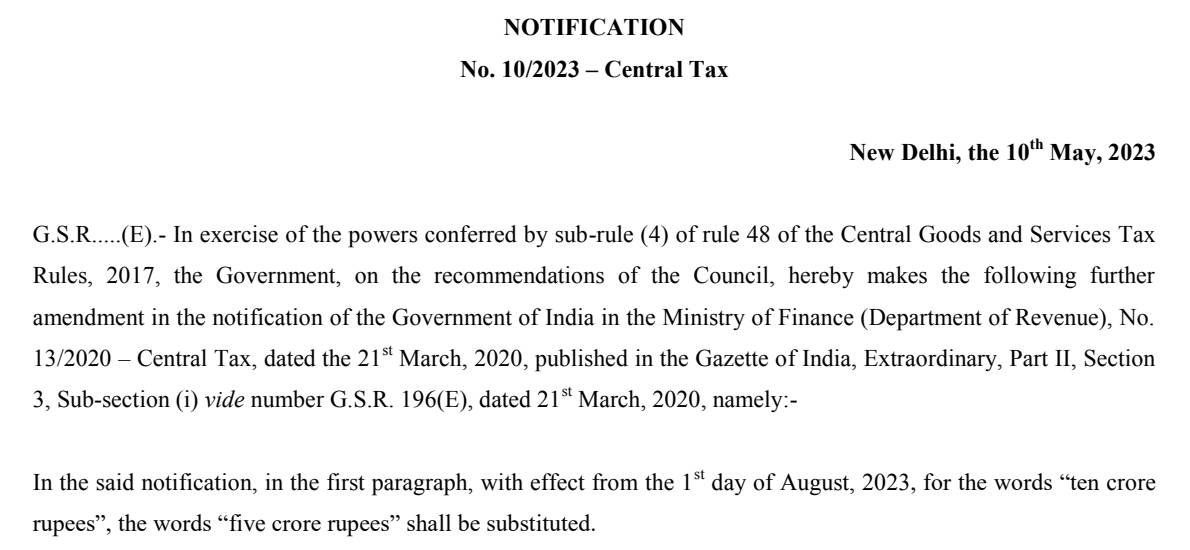
A GST e-invoice is a B2B invoice that has been reported to a government Invoice Registration Portal (IRP) and has got back a 64-character Invoice Reference Number (IRN) and a signed QR code before it is issued. Since 1 August 2023 it has been compulsory for every registered business whose aggregate turnover was more than ₹5 crore in any financial year from 2017-18 onwards (Notification 10/2023–Central Tax). Businesses with turnover of ₹10 crore or more must report each invoice within 30 days of its date (from 1 April 2025), and an invoice that should have an IRN but does not is not treated as an invoice at all (CGST Rule 48(5)). Banks, insurers, NBFCs, goods transport agencies, passenger transport operators, multiplexes, SEZ units and government departments are exempt.
- Limit: aggregate turnover above ₹5 crore in any year since 2017-18; once crossed, it applies for good.
- Covers: B2B invoices, credit and debit notes, exports. Not B2C.
- Time limit: 30 days from the invoice date if your turnover is ₹10 crore or more; the IRP rejects later uploads.
- Cancellation: on the IRP within 24 hours, whole invoice only; after that, a credit note.
- Without an IRN: not a valid invoice (Rule 48(5)); the buyer’s input tax credit is at risk.
- Portal: einvoice1.gst.gov.in (NIC) or another GSTN-authorised IRP; login needs multi-factor authentication.
What is an e-invoice under GST?
The name misleads: the government does not make your invoice, and a PDF emailed to a customer is not an e-invoice. You still create the invoice in your own billing or accounting software. E-invoicing adds one step before you issue it. The software sends the invoice data, in the standard schema of FORM GST INV-01, to an Invoice Registration Portal. The IRP checks it, rejects duplicates, and returns three things: the IRN, a unique 64-character reference built from your GSTIN, the financial year, the document type and the document number; the same data digitally signed; and a QR code that carries the key fields and the IRN. You print the QR code on the invoice and only then issue it.
The data then travels on its own. The IRP passes it to the GST system, where it fills in the B2B and export tables of your GSTR-1, and it can generate Part A of the e-way bill so that the same details are not typed twice.
E-invoice limit: who has to issue e-invoices
The test is in Notification 13/2020–Central Tax as amended. You must e-invoice if your aggregate turnover in any preceding financial year from 2017-18 onwards exceeded ₹5 crore. Three details in that sentence decide most real cases:
- “Any preceding financial year”. If you crossed ₹5 crore in 2019-20 and have been below it since, you are still covered. The obligation does not lapse when turnover falls.
- “Aggregate turnover” is PAN-wide: all taxable, exempt and export supplies and inter-state transfers of every GSTIN on the same PAN across India, excluding the taxes themselves (section 2(6) of the CGST Act). A business with three state registrations of ₹2 crore each is a ₹6 crore business.
- “Exceeded”. Exactly ₹5 crore is not enough; the turnover has to be more than that. Once you cross the line during a year, e-invoicing starts from the next financial year.
The threshold has been lowered six times since e-invoicing began. Each step was an amendment to the same notification:
| From | E-invoicing applies if turnover in any year since 2017-18 was | Notification (Central Tax) |
|---|---|---|
| 1 October 2020 | More than ₹500 crore | 13/2020 as amended by 61/2020 |
| 1 January 2021 | More than ₹100 crore | 88/2020 |
| 1 April 2021 | More than ₹50 crore | 5/2021 |
| 1 April 2022 | More than ₹20 crore | 1/2022 |
| 1 October 2022 | More than ₹10 crore | 17/2022 |
| 1 August 2023 (current) | More than ₹5 crore | 10/2023 |
No notification has lowered the limit below ₹5 crore as of 13 October 2026. The portal’s “e-invoice enablement status” search shows whether it has your GSTIN down as liable.
Check whether e-invoicing applies to you
Enter your highest turnover since 2017-18 and last year’s turnover. The checker applies the ₹5 crore test, the exempt categories and the ₹10 crore threshold for the 30-day rule.
Who is exempt from e-invoicing
Certain businesses never have to e-invoice, whatever their turnover. Most of them already issue documents in a special format under rule 54 of the CGST Rules, such as a bank statement or a passenger ticket:
| Exempt class | Where the exemption comes from |
|---|---|
| Insurers, banking companies and financial institutions, including NBFCs | Rule 54(2), via 13/2020 |
| Goods transport agencies carrying goods by road | Rule 54(3), via 13/2020 |
| Suppliers of passenger transportation services | Rule 54(4), via 13/2020 |
| Suppliers of admission to films in multiplex screens | Rule 54(4A), via 13/2020 |
| Special Economic Zone units (the exemption names units, not developers) | 61/2020 |
| Government departments and local authorities | 23/2021 |
The exemption is for the class of business, so a bank does not e-invoice even on its non-banking supplies. A supplier selling to one of these businesses is not exempt: an IT company billing a bank must still e-invoice if it crosses ₹5 crore.
E-invoice applicability: which documents are covered
| Document | IRN needed? |
|---|---|
| Tax invoices to registered buyers (B2B) | Yes |
| Credit notes and debit notes on those invoices | Yes |
| Export invoices | Yes (added by 70/2020) |
| Supplies to SEZ units and developers, deemed exports | Yes (they are B2B supplies) |
| Invoices to consumers and unregistered buyers (B2C) | No; very large suppliers print a dynamic QR code instead |
| Bills of supply, delivery challans, import bills of entry | No |
Two related rules sit next to e-invoicing and are often confused with it. Businesses above ₹500 crore must print a dynamic QR code on B2C invoices so that a customer can pay by scanning it; that is a separate notification and no IRN is involved. And e-invoicing businesses above ₹5 crore must show the 6-digit HSN code on their outward supplies (Notification 78/2020), which the IRP enforces by rejecting 4-digit codes.
How to generate an e-invoice: registration and IRN
- Check that your GSTIN is enabled. The portal enables businesses on the basis of their returns. If you are liable but not shown as enabled, the portal lets you request enablement.
- Register on an IRP. NIC runs einvoice1.gst.gov.in; GSTN has also authorised private IRPs, such as IRIS (einvoice6.gst.gov.in). Registration is with your GSTIN and the mobile number on your GST registration, and every login now needs a one-time password as a second factor.
- Pick the route that fits your volume. Small volumes: type the invoice into the IRP’s web form or the offline Excel utility. Larger volumes: let your ERP or billing software send JSON over the IRP’s API, directly or through a GST Suvidha Provider. Tally, Zoho, SAP and most Indian billing products have this built in.
- Upload and get the IRN. The IRP validates GSTINs, HSN codes, tax rates and totals and returns the IRN, signed invoice and QR code, usually in seconds. A failure comes back with an error code to fix and resubmit.
- Print the QR code on the invoice and issue it. Generate the e-way bill from the IRN if goods are moving.
Since GST 2.0 on 22 September 2025 the IRPs accept the new 40% rate in their tax-rate master, alongside the existing slabs; the GST 2.0 rate guide lists which goods moved where.
E-invoice time limit: the 30-day rule
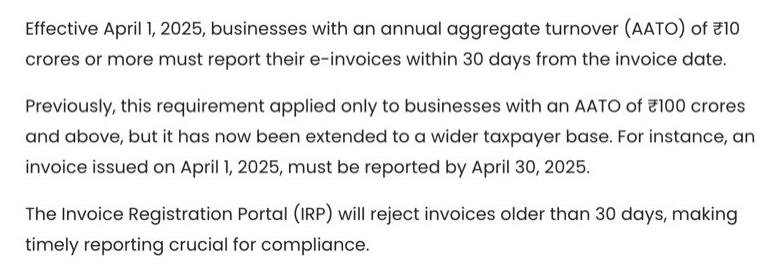
From 1 April 2025, a business with an annual aggregate turnover of ₹10 crore or more cannot report an invoice, credit note or debit note to the IRP more than 30 days after the date printed on it. The limit used to apply only above ₹100 crore. An invoice dated 1 April must be reported by 30 April; on 1 May the IRP rejects it, and without an IRN the invoice cannot be validly issued.
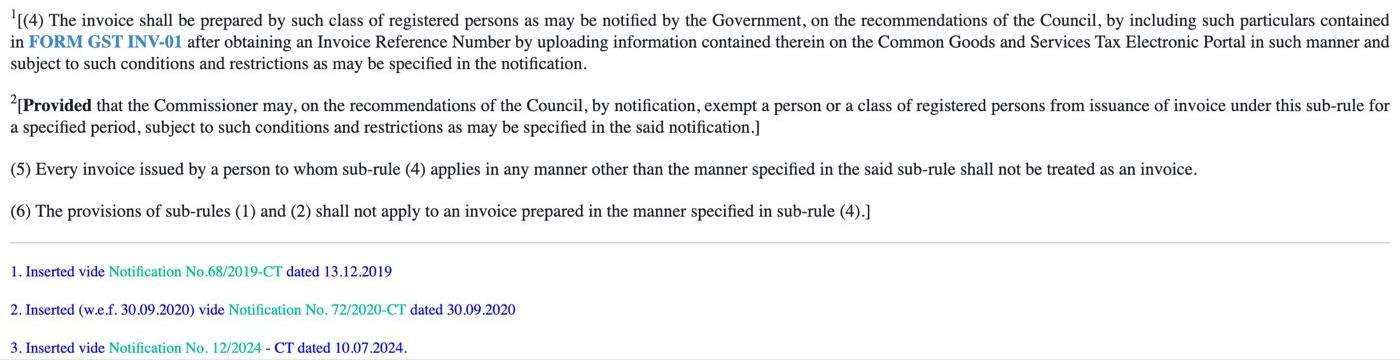
Below ₹10 crore the portal does not enforce a cut-off, but the law is the same for everyone: rule 48(4) requires the IRN before the invoice is issued, so reporting late means the invoice was issued without one. The practical answer is to have the IRN generated by the same click that saves the invoice.
Cancelling or changing an e-invoice
The IRPs allow an IRN to be cancelled only within 24 hours of generation, and only as a whole: there is no partial cancellation, and an IRN that already has an active e-way bill cannot be cancelled until the e-way bill is. A cancelled invoice number cannot be reused for a new IRN. After 24 hours, the correction is the ordinary GST one: issue a credit note (itself e-invoiced) against the original, or amend the details in GSTR-1. The IRP cannot edit an invoice; there is no “amend” on the portal.
What happens if you skip e-invoicing
- The invoice is not an invoice. Rule 48(5), shown above, is blunt. The supply has been made without a valid invoice.
- Your buyer loses out. Input tax credit needs a valid tax invoice, so a buyer holding an invoice without an IRN can have its credit disallowed. Large buyers therefore refuse to pay such invoices, which is the sanction most suppliers actually feel.
- Penalty. Issuing a supply without a valid invoice attracts the penalty in section 122 of the CGST Act: ₹10,000 or the tax involved, whichever is higher.
What changed in 2025 and 2026
- 1 April 2025: the 30-day reporting limit extended to businesses with turnover of ₹10 crore or more.
- July 2025: multi-factor authentication made mandatory for logging in to the IRPs (IRIS IRP release, 10 July 2025).
- 22 September 2025: the 40% GST rate added to the IRP rate master for GST 2.0.
- 1 February 2026: IRP validations on item totals relaxed for goods taxed on retail sale price under Notification 20/2025–Central Tax (IRIS IRP release, 1 February 2026).
- Unchanged: the ₹5 crore threshold, in force since 1 August 2023.
E-invoice portal and login
The NIC portal is einvoice1.gst.gov.in; einvoice2.gst.gov.in is its second instance, and the private IRPs have their own addresses under gst.gov.in. Logins are per GSTIN. The IRN, once generated on any IRP, can be verified on any other through the portal’s “verify signed invoice” and “verify QR code” tools. For the GST registration details the portal asks for, the GST state code list decodes the first two digits of any GSTIN.
Common questions
₹5 crore. Since 1 August 2023 a registered person whose aggregate turnover exceeded ₹5 crore in any financial year from 2017-18 onwards must generate an IRN for every B2B invoice, credit note, debit note and export invoice (Notification 13/2020-Central Tax as amended by 10/2023).
Yes. The test is turnover in any preceding financial year from 2017-18 onwards, so once you have crossed ₹5 crore in one year, e-invoicing continues even if turnover later falls.
Businesses with aggregate annual turnover of ₹10 crore or more must report an invoice, credit note or debit note to the IRP within 30 days of its date; the IRP rejects later uploads. The rule took effect on 1 April 2025. For everyone else, the IRN is still required before the invoice is issued.
No. E-invoicing covers supplies to registered persons and exports. Businesses with turnover above ₹500 crore print a dynamic QR code on B2C invoices instead, which does not need an IRN.
Insurers, banking companies and financial institutions including NBFCs, goods transport agencies, passenger transport service providers, multiplex cinemas for admission tickets, SEZ units, and government departments and local authorities.
Yes, on the IRP within 24 hours of generating the IRN, and only in full. After 24 hours, issue a credit note against the invoice or amend it in GSTR-1. An IRN with an active e-way bill cannot be cancelled until the e-way bill is cancelled.
Under CGST Rule 48(5) it is not treated as an invoice. The buyer's input tax credit can be denied, and the supplier is liable to a penalty under section 122 of ₹10,000 or the tax involved, whichever is higher.
The Invoice Reference Number, a unique 64-character hash that the Invoice Registration Portal generates from the supplier's GSTIN, the financial year, the document type and the document number. It is returned with the digitally signed invoice and a QR code.
Log in to the e-invoice portal (einvoice1.gst.gov.in or another GSTN-authorised IRP) with your GSTIN and the mobile number on your GST registration, complete multi-factor authentication, and choose web form, Excel utility or API access through your billing software.
Yes. Export invoices have been covered since Notification 70/2020-Central Tax, so a business above the ₹5 crore limit must generate an IRN for them too.
- CBIC — CGST Rules, rule 48: manner of issuing invoice
- Notification 13/2020–Central Tax (principal e-invoicing notification)
- Notification 61/2020–Central Tax (SEZ units)
- Notification 70/2020–Central Tax (any year from 2017-18; exports)
- Notification 23/2021–Central Tax (government departments, local authorities)
- Notification 10/2023–Central Tax (₹5 crore from 1 August 2023)
- IRIS IRP — revised time limit for e-invoice reporting, AATO ₹10 crore and above
- NIC e-invoice portal
Threshold, exemptions and coverage checked against the notification texts, and rule 48 against CBIC’s repository, on 13 October 2026. The 30-day rule and MFA were checked on a GSTN-authorised IRP; GSTN’s own advisory page could not be opened by our checker. The 24-hour cancellation window is how the IRPs operate rather than a rule in a notification. General information, not tax advice.