GoMyFinance.com review: what it is, and what it isn’t
We read the site instead of the articles about it. Here is what GoMyFinance.com actually publishes, what the searches for “invest”, “bills” and “credit score” get wrong, and whether it is safe to use.
GoMyFinance.com is a free personal-finance website, launched in 2024 and based in Sugar Land, Texas, that publishes beginner-level articles on budgeting, saving, credit, debt and investing. It is not a bank, broker, investing platform or app: there is no login, no account, no bill-pay or credit-score service, and no working calculator.
- What it is: a free personal-finance article site (WordPress), launched 2024
- What it is not: a bank, broker, investing platform, app or credit-score service — no login exists
- Calculators: none working found on Sept 25, 2026, despite a “Calculators & Tools” category
- Disclaimer: states it is not a registered investment advisor, broker-dealer or financial institution
- Contact listed: Sugar Land, TX; (281) 566-2500; info@gomyfinance.com
- Search noise: ~37,000 U.S. searches/month, many results are spam on hacked domains
- Lookalikes: gomyfinance.net, .org, .us and .co.uk are unrelated sites; only the .com is reviewed here
That gap between the name and the site is what this review is about. Most pages ranking for “gomyfinance.com” are machine-written filler promising apps and earnings, so we read the site itself — its About and Contact pages, its disclaimer, its category pages and its guides — on September 25, 2026, and report what is there.
What GoMyFinance.com is — and what it is not
The site describes itself, on its About page, as a “one-stop shop for mastering your financial future” whose mission is to help anyone “regardless of background or experience” make informed financial decisions. In practice that means a magazine-style blog: a homepage of recent stories, four content categories, and a set of foundational “101” guides that were all published on the same day, July 29, 2024, under the byline Joseph Campbell.
Its own disclaimer, shown in the footer of the homepage, is the clearest statement of what it is not: “The content on GoMyFinance.com is for informational and educational purposes only. We do not provide financial, investment, legal, or tax advice.” It goes on: “GoMyFinance is not a registered investment advisor, broker-dealer, or financial institution. We are not affiliated with or endorsed by the Securities and Exchange Commission (SEC) or Financial Industry Regulatory Authority (FINRA).” The standalone Disclaimer page linked from the header returned a 404 error when we visited, but the text itself is on the homepage.
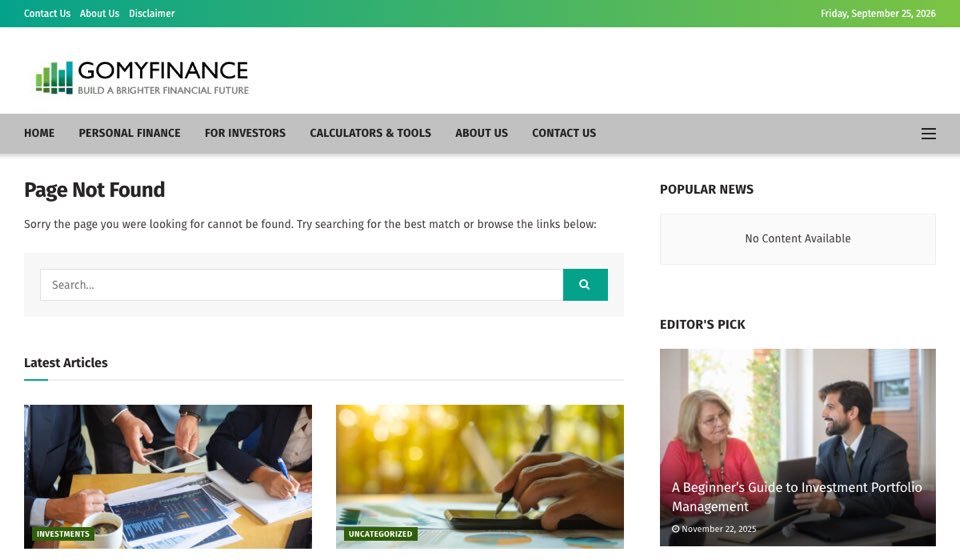
| Yes / No | Detail | |
|---|---|---|
| Free to read | Yes | No subscription, paywall or account is mentioned anywhere on the site |
| Requires a login | No | There is no sign-up, sign-in or member area |
| Mobile app | No | No iOS or Android app is offered or linked |
| Invest through it | No | It is not a brokerage; it cannot hold money or place trades |
| Bill payment or credit-score service | No | Nothing of the kind exists on the site |
| Working calculators | None found | The Calculators & Tools category holds articles, not tools (checked Sept 25, 2026) |
| Regulated financial firm | No | By its own disclaimer: not an RIA, broker-dealer or financial institution |
What is actually on the site
Navigation is built around four categories. The table lists what each one covers, drawn from the category pages and the guides linked from the homepage.
| Category | Sub-topics | Representative articles (with dates) |
|---|---|---|
| Personal Finance | Banking, credit & debt, budgeting & saving | Personal Finance 101, Banking 101, Debt 101, Effective Budgeting 101 (all July 29, 2024); a bad-credit-loans piece (June 2026) |
| Investments | Stocks, real estate, crypto, futures | Investments 101, How to Invest in Stocks, How to Start Real Estate Investment (Aug 21, 2024); “GoMyFinance Invest: The Complete Guide” (Sept 7, 2026) |
| Calculators & Tools | Explainers about financial calculators | Financial Calculators 101 (July 29, 2024); “GoMyFinance.com Calculators: The Complete Guide” (Aug 28, 2026) |
| Business Finance | Financial management, starting a business | Business Finance 101, Starting a Business, Financial Management 101 (2024) |
Two things stand out. First, the foundational content is a single batch from mid-2024, with occasional additions since. Second, the most recent posts — a run of “Gomyfinance.com Create Budget”, “Gomyfinance.com Invest”, “Gomyfinance.com Debt” and similar titles published August 28–30, 2026 — are written about the site itself, in the same phrasing people type into Google. That is the site responding to its own search demand, and it is a reasonable thing for a publisher to do; it is just worth knowing that those pages are about GoMyFinance rather than about budgeting or investing as such.

“GoMyFinance.com invest”: is there an investing platform?
No. “gomyfinance.com invest” is the most-searched phrase attached to the name, and the searches come from people who expect a product. What exists is an Investments category of articles: an Investments 101 primer, a how-to on stocks, one on real estate, and the September 2026 “GoMyFinance Invest” guide, whose opening line defines investing as “putting money to work so it can grow faster than inflation”. It is general education. You cannot open an account, deposit money, buy a stock or earn a return through GoMyFinance.com, and the site does not claim you can.
“GoMyFinance.com debt”: what the debt guides cover
Debt is the topic the site handles best. Debt 101 (July 2024) walks through secured versus unsecured debt, “good” versus “bad” debt, the common forms of consumer debt, how to work out a debt-to-income ratio, reading your credit report, identifying high-interest balances, and the two standard repayment methods — the snowball (smallest balance first) and the avalanche (highest rate first). The August 2026 “Gomyfinance.com Debt” guide repeats that ground with sections on credit-card, personal and emergency, and student debt, how interest accrues, and building a repayment timeline.
What it does not do is anything with your debt. Searches for “gomyfinance com debt relief” and “debt payment” are looking for a service; the site does not negotiate, consolidate, settle or pay debts, and it does not refer you to companies that do. For that, the Federal Trade Commission’s guide to getting out of debt covers credit counseling, debt settlement and consolidation, and the warning signs of a bad program.
Bills, credit score, budget templates: the apps people search for
The long tail of searches is revealing: “gomyfinance com bills app”, “bills payment login”, “credit score sign up”, “credit score login”, “create budget app”, “create budget template”, “saving money app”. Each assumes a service. Here is what the site has for each.
| What people search | What they seem to expect | What GoMyFinance.com actually has |
|---|---|---|
| gomyfinance com bills / bills app / bills payment | A bill-pay or bill-tracking service with a login | Nothing. No bill service, no login. The word appears only inside general budgeting and debt articles |
| gomyfinance com credit score / sign up / login | Free credit-score monitoring | Nothing. Articles that discuss credit; no score, no monitoring, no account |
| gomyfinance com create budget / template / app | A downloadable template or budgeting app | An Effective Budgeting 101 article and a 2026 “Create Budget” guide; we found no template file or app |
| gomyfinance com saving money | A savings product or tool | Articles on saving; no product |
| gomyfinance com calculator app | A calculator app | Articles about calculators; no app, no interactive calculator |
None of this is a mark against the site — it never claims to offer these things. The gap is between what the name sounds like and what the site is.
The calculators question
Because the category is called “Calculators & Tools”, we checked specifically for interactive tools. We loaded the category page, the July 2024 “Financial Calculators 101” article and the August 2026 “GoMyFinance.com Calculators” guide, and looked for input fields, sliders or embedded calculator widgets. There were none. The articles describe types of calculator — income and expense trackers, debt-to-income ratio, emergency fund, compound interest, retirement — and how to use them, but you cannot type a number anywhere and get a result.

For actual tools, use sources that are both free and accountable. The U.S. Securities and Exchange Commission’s compound interest calculator at Investor.gov is the standard, and MyMoney.gov collects the federal government’s budgeting and saving tools in one place. The Consumer Financial Protection Bureau publishes budgeting worksheets and debt tools, and AnnualCreditReport.com is the only source authorized by federal law for your free credit reports from all three bureaus, now available weekly. If you are in India, our own GST, income tax and in-hand salary calculators run in your browser and send nothing to a server.
Is GoMyFinance.com legit and safe?
As a website to read, yes. The risk profile of a site is set by what it asks of you, and GoMyFinance.com asks for nothing: no payment, no account, no personal data beyond a contact form and a live-chat widget you can ignore. It serves over HTTPS. It publishes a plain-language disclaimer that correctly describes its limits. Its contact page lists a street address (2245 Texas Dr #300, Sugar Land, TX 77479), a phone number ((281) 566-2500), an email (info@gomyfinance.com) and business hours, which is more than most anonymous finance blogs offer.
As a source of financial guidance, treat it as a starting point. Points to weigh:
- Thin authorship. Nearly everything carries one byline, Joseph Campbell, with no biography, credentials or contact. The About page describes a mission, not people.
- Self-referential recent content. The newest posts are guides to GoMyFinance.com itself. Read those as marketing.
- General, not personalized. The 101 guides are competent primers, but they are U.S.-generic and dated 2024; check any number — a contribution limit, a rate, a rule — against a primary source before acting on it.
- We could not verify the business behind it. The address and phone are listed, not confirmed; we did not find a registered company name on the site.
- A broken Disclaimer link is a small housekeeping failure, not a red flag, but it is the kind of detail a well-maintained site fixes.
Verdict: a legitimate, low-stakes educational blog. Not a scam, not a service, and not a substitute for a regulated advisor or an official calculator.
GoMyFinance.com contact details
As listed on the site’s contact page on September 25, 2026: email info@gomyfinance.com (the footer also shows hello@gomyfinance.com), phone (281) 566-2500, address 2245 Texas Dr #300, Sugar Land, TX 77479, business hours Monday to Friday, 9 am to 5 pm Eastern, plus a live-chat widget during those hours. We did not test the phone line or chat.
Why so many websites write about GoMyFinance.com
The name is searched roughly 37,000 times a month in the United States and almost nowhere else, with a keyword difficulty near zero. Search demand that large with competition that weak attracts automated content, and the results page shows it: alongside the site itself and a couple of genuine reviews sit pages on a Mexican municipal map portal, a Taiwanese university mail server and a Sierra Leone government subdomain, carrying titles like “Predictive GOMYFINANCE.COM INVEST Strategic Portfolio” and “Gomyfinance.com Invest App: How One User Earned…”. Those are hacked or neglected servers hosting machine-written text to catch the traffic. They are why a search for the site produces so much noise, and why an ordinary reader can come away believing an app or an investing product exists.
The tells are consistent: a government, university or unrelated business domain hosting a finance article; a title that promises earnings, a stock, an app or a login; no author; and text that never quotes anything the site actually says.
Lookalike domains: .net, .org, .us and .co.uk
There is a second source of confusion, and it is more deliberate. On September 25, 2026 we checked which other domains carry the name. Five resolve and serve a page; none shows any connection to GoMyFinance.com, and their titles are aimed squarely at the searches people make for the real site. We have not linked to them.
| Domain | Title served on September 25, 2026 | What it looks like |
|---|---|---|
| gomyfinance.net | “GoMyFinance.com Invest – Investment & Financial Insights” | Uses the .com name in its own title; targets “invest” searches |
| gomyfinance.org | “GoMyFinance: Check Credit Score, Save and Invest Smarter” | Promises a credit-score check the real site does not offer |
| gomyfinance.us | “GoMyFinance: Invest, Save and Improve Credit Score” | Same pitch, same keywords |
| gomyfinances.com | “Go My Finance: Learn to Manage Finances and invest wisely” | Plural-name lookalike |
| gomyfinance.co.uk | “1Win Aviator Game Bonuses: India’s Top Offers” | A gambling promotion page |
This is where the “gomyfinance.com credit score” and “invest” searches are being farmed: the imitators put those words in their titles because the real site’s name draws the traffic. The practical rule is simple. The site this review is about ends in .com. If a page on any other ending asks you to sign up, check a score, deposit money or download an app, it is not GoMyFinance.com, and nothing on the real site suggests those services exist.
The budgeting rules people ask alongside it
Google’s related questions for this search are not about the site at all — they are generic budgeting rules. Since the site’s guides mention them without defining them crisply, here are the short versions.
- The 50/30/20 rule splits after-tax income into 50% needs (rent, groceries, minimum debt payments), 30% wants, and 20% savings and extra debt repayment. It comes from Elizabeth Warren and Amelia Warren Tyagi’s 2005 book All Your Worth. It is a starting ratio, not a law; high-rent cities push needs past 50%.
- The 3-6-9 rule of money is an emergency-fund guideline: keep three months of essential expenses if you have a stable job and no dependents, six months for a typical household, and nine months if your income is variable or you are self-employed.
- “Where is all my money going?” has a mechanical answer: record every transaction for 30 days, sort them into a dozen categories, and compare the total with take-home pay. The leak is almost always many small recurring charges rather than one large one; a budget built on those real numbers, not estimated ones, closes it.
Pros and cons
| Pros | Cons |
|---|---|
| Free, no account, no upsell — nothing to lose by reading | No tools despite a “Calculators & Tools” category |
| Plain-language primers that cover the basics correctly | Single unnamed-credentials byline; no editorial team or review process disclosed |
| Honest disclaimer about what it is not | Core content dates from mid-2024; little has been updated |
| Physical address, phone and email listed | Recent posts are about the site itself rather than about money |
| Debt section is genuinely useful for beginners | U.S.-generic; no personalization, rates or product comparisons |
Verdict
GoMyFinance.com is a legitimate, low-stakes educational blog and nothing more. Read it for a first pass at a topic, ignore the pages about itself, take numbers from primary sources, and use official calculators for the arithmetic. Anything online that describes a GoMyFinance app, login, investment product or earnings is describing something the site does not offer.
Who should use it, and how
GoMyFinance.com suits someone who wants a jargon-free introduction to a topic — what a debt-to-income ratio is, how budgeting categories work, what a futures contract does — and who will then go to a primary source for the numbers and a regulated professional for decisions. It is less useful for anyone looking for tools, personalized planning, up-to-date rates or product comparisons; it has none of those. Read the 101 guides, skip the pages about the site itself, and use the official calculators linked above.
How we checked
On September 25, 2026 we visited the homepage, About, Contact and Calculators & Tools pages and the individual articles named above, read the disclaimer text, inspected the pages for interactive elements, and took the screenshots shown above. We also resolved twelve lookalike domain names and recorded what the five live ones served. Keyword volumes and the search-results composition are from Ahrefs, taken September 21–25, 2026. This review was researched and written by Rajat Chauhan. We have no relationship with GoMyFinance.com and received nothing for it; the links to it carry a nofollow attribute.
Common questions
A free personal-finance website, launched in 2024 and based in Sugar Land, Texas, that publishes beginner-level articles on budgeting, saving, credit, debt, investing and business finance. It is a publisher, not a bank, broker, app or advisory firm.
As a website to read, yes. It asks for no money or personal data, serves over HTTPS, lists a street address and phone number, and carries a disclaimer stating it is not a registered investment advisor, broker-dealer or financial institution. Treat its content as general education, not personalized advice.
Yes. There is no subscription, paywall, account or login.
No. There is no iOS or Android app, and no bill-pay, credit-score or budgeting app. Pages elsewhere that describe a GoMyFinance app are not describing anything the site offers.
No. It is not a brokerage and cannot hold money or place trades. The phrase 'gomyfinance.com invest' refers to its Investments category of educational articles.
When checked on September 25, 2026, its Calculators and Tools category contained articles about financial calculators but no working calculator. For free, accountable tools use Investor.gov, MyMoney.gov or the Consumer Financial Protection Bureau.
The site does not name a company or an editorial team. Most articles carry the byline Joseph Campbell, without a biography. The contact page lists 2245 Texas Dr #300, Sugar Land, TX 77479, phone (281) 566-2500 and info@gomyfinance.com.
The site's debt content: a Debt 101 guide covering secured and unsecured debt, debt-to-income ratio, credit reports, and the snowball and avalanche repayment methods, plus a 2026 guide on credit-card, personal and student debt. It offers no debt-relief, consolidation or settlement service.
A budgeting ratio: 50% of after-tax income to needs, 30% to wants, 20% to savings and extra debt repayment. It comes from the 2005 book All Your Worth and is a starting point, not a rule that fits every city or income.
An emergency-fund guideline: three months of essential expenses if your job is stable and you have no dependents, six months for a typical household, nine months if your income is variable or you are self-employed.
No. On September 25, 2026, gomyfinance.net, .org, .us and gomyfinances.com served unrelated pages titled around 'invest' and 'credit score', and gomyfinance.co.uk served a gambling promotion. None showed a connection to GoMyFinance.com. Only the .com is reviewed here.
The name draws about 37,000 U.S. searches a month with almost no competition, which attracts automated content. Many results are machine-written pages on hacked government and university domains promising apps, logins or earnings that do not exist.
- GoMyFinance.com — About Us
- GoMyFinance.com — Debt 101 (July 29, 2024)
- GoMyFinance.com — Contact Us
- GoMyFinance.com — Calculators & Tools category
- Investor.gov — compound interest calculator (U.S. SEC)
Site checked and quoted on September 25, 2026. TaxGamma has no affiliation with GoMyFinance.com and received nothing for this review.