Section 54F of Income Tax Act with example: capital gains exemption, calculator
Who can claim the 54F exemption, the formula, a calculator, worked examples for a plot, shares and a ₹10 crore sale, the difference from section 54, the Capital Gains Accounts Scheme, when the exemption is forfeited, the ITR-2 lines, and section 86 of the Income-tax Act, 2025.
Section 54F of the Income Tax Act exempts the long-term capital gain on selling any asset other than a house, such as land, a plot, shares, mutual funds or gold, when you put the sale proceeds into one residential house in India. You must buy the house within one year before or two years after the sale, or build it within three years. Invest the whole net sale consideration and the whole gain is tax-free; invest part of it and the same part of the gain is exempt. Only individuals and HUFs can claim it, and not if they already own more than one other house. For sales from 1 April 2026 the same rule is section 86 of the Income-tax Act, 2025; sales up to 31 March 2026 are still claimed under section 54F.
The cost of the new house counts only up to ₹10 crore, and the exemption reverses if you sell the new house within three years or buy another one within two. We read section 86 and the 2026-27 ITR-2 form on 2 November 2026. The calculator and the worked examples below use the formula in the Act.
- Who: individuals and HUFs, resident or non-resident
- Asset sold: any long-term capital asset except a residential house: land, plot, commercial property, shares, mutual funds, gold, bonds
- New asset: one residential house in India, bought 1 year before to 2 years after the sale, or built within 3 years
- Exempt gain: capital gain × cost of the new house ÷ net sale consideration; all of it if the house costs at least the net consideration
- Limits: house cost counted up to ₹10 crore, so the exemption never exceeds ₹10 crore; no more than one other house on the date of sale
- Not bought by the ITR due date: deposit the unspent amount in the Capital Gains Accounts Scheme, 1988
- Lock-in: selling the new house within 3 years, or buying another within 2, reverses the exemption
- New law: section 86 of the Income-tax Act, 2025 for sales from 1 April 2026; section 54 becomes section 82
- ITR: ITR-2 or ITR-3, Schedule CG, “Deduction under section 54F” plus item D
What is section 54F of the Income Tax Act?
Section 54F of the Income Tax Act, 1961 is a capital gains exemption for individuals and Hindu undivided families who sell a long-term asset that is not a residential house and buy or build a house with the money. It sits beside section 54, which covers the sale of a house, and section 54EC, which covers capital gains bonds. All three are rollover reliefs: the gain is not taxed as long as the money stays in the asset the law wants it in. The Income-tax Act, 2025, in force from 1 April 2026, keeps the rule and renumbers it as section 86, “Capital gains on transfer of certain capital assets not to be charged in case of investment in residential house”.
The exemption is worth the most to people selling land or a long-held share portfolio to buy a home, because the long-term gain on either is usually a large part of the sale price. It does nothing for a short-term gain, and nothing for a gain on selling a house: that is section 54.
What is exemption under section 54F?
The exemption under section 54F is the share of your long-term capital gain that escapes tax because you reinvested the sale money in a house: capital gain × cost of the new house ÷ net consideration. Net consideration is the full sale price minus the expenses of the sale, such as brokerage and legal fees (section 86(10)). It is not the gain. That is the trap in 54F: to exempt all of the gain you must invest all of the sale proceeds, not just the profit. The Act’s own words:
“(i) if the net consideration is more than the cost of the new asset, so much of the capital gains as bears to the whole of the capital gains, the same proportion as the cost of the new asset bears to the net consideration, shall not be charged under section 67; or (ii) if the net consideration is equal to or less than the cost of the new asset, no capital gains shall be charged under section 67.” — Income-tax Act, 2025, section 86(1)
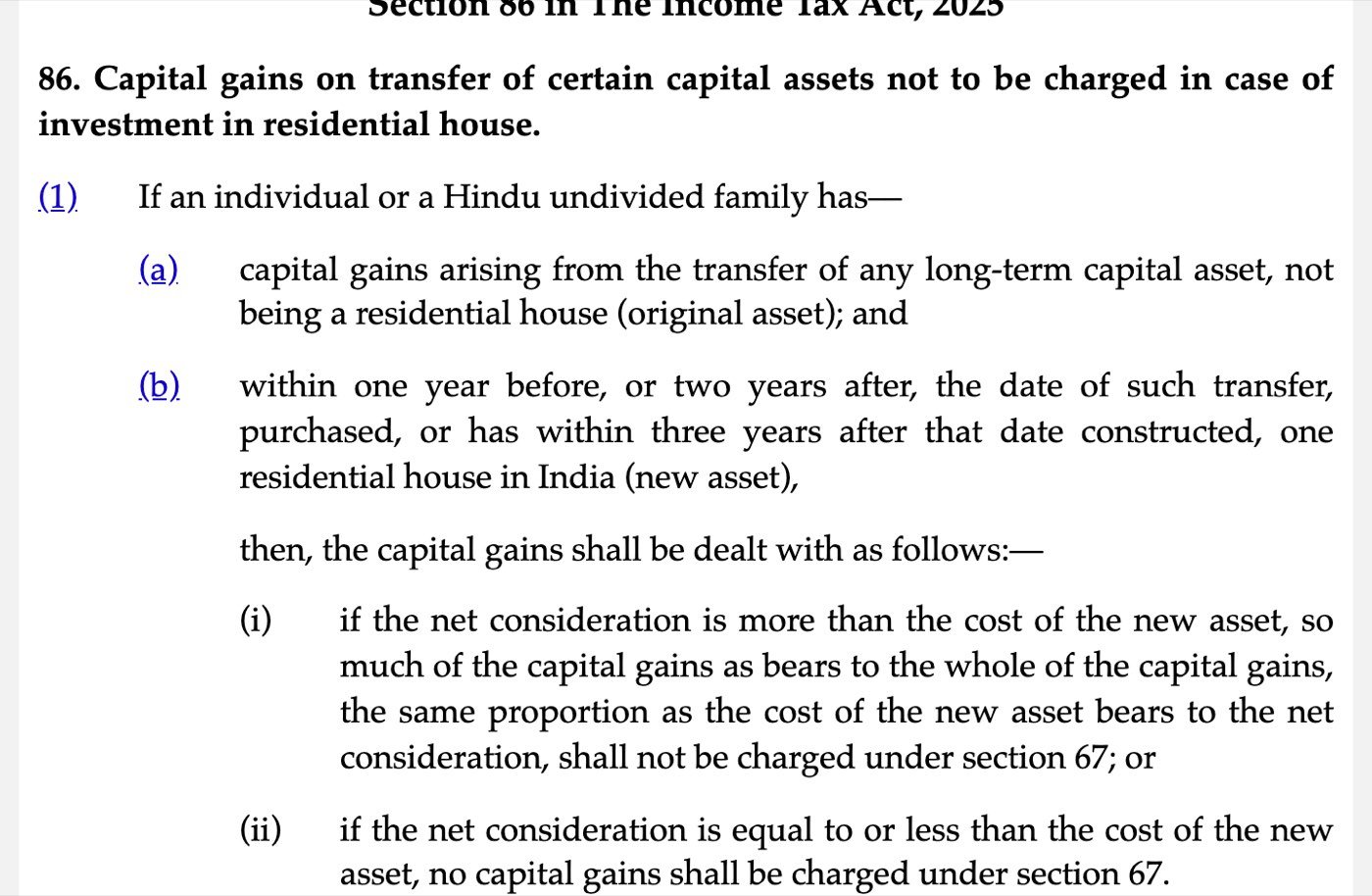
Two conditions sit outside the formula. The house must be one residential house in India, so a second flat or a villa abroad does not count. And on the date of the sale you must not own more than one residential house other than the new one (section 86(5)); owning one is fine, owning two shuts the exemption out completely.
How much does section 54F exempt? Calculator
The calculator below gives the exempt gain, the taxable gain and the tax from four figures. It applies the formula in section 86(1), the ₹10 crore cap in section 86(8) and the other-houses test in section 86(5). It opens with the plot in the first worked example.
Net sale consideration is the sale price minus brokerage, legal and other selling costs. Work out the gain itself in the LTCG calculator. Tax shown is before surcharge, and for listed equity it assumes this is your only section 112A gain of the year.
Section 54F of the Income Tax Act with example
Three examples show the formula at work: a plot sold with part of the money reinvested, listed shares reinvested in a flat, and a ₹15 crore sale that runs into the ₹10 crore cap.
Example 1: a plot, partly reinvested. Meera sells a plot she has held for eight years for ₹90 lakh and buys a flat for ₹60 lakh:
| Item | Amount |
|---|---|
| Sale price of the plot | ₹90,00,000 |
| Less brokerage and legal costs of the sale | ₹1,00,000 |
| Net consideration | ₹89,00,000 |
| Less cost of the plot (no indexation) | ₹35,00,000 |
| Long-term capital gain | ₹54,00,000 |
| Cost of the new flat | ₹60,00,000 |
| Exempt under section 54F: ₹54,00,000 × ₹60,00,000 ÷ ₹89,00,000 | ₹36,40,449 |
| Taxable long-term gain | ₹17,59,551 |
| Tax at 12.5% plus 4% cess | ₹2,28,742 |
To exempt the whole ₹54 lakh she would have to put ₹89 lakh into the flat, the full net consideration, not the gain. If the plot was bought before 23 July 2024 she may instead compute the gain with indexation and pay 20%; the LTCG calculator shows which is lower, and the same proportion of whichever gain she reports is exempt.
Example 2: listed shares. Arjun sells shares held for three years for ₹40 lakh, bought for ₹15 lakh, and buys a ₹30 lakh flat:
| Item | Amount |
|---|---|
| Sale value of the shares (net consideration) | ₹40,00,000 |
| Less cost of the shares | ₹15,00,000 |
| Long-term capital gain | ₹25,00,000 |
| Cost of the new flat | ₹30,00,000 |
| Exempt under section 54F: ₹25,00,000 × ₹30,00,000 ÷ ₹40,00,000 | ₹18,75,000 |
| Taxable long-term gain | ₹6,25,000 |
| Tax: 12.5% on the gain above ₹1.25 lakh, plus 4% cess | ₹65,000 |
| Tax without section 54F | ₹3,08,750 |
| Tax saved | ₹2,43,750 |
Example 3: the ₹10 crore cap. A family sells land for a net ₹15 crore with a gain of ₹12 crore and buys a ₹14 crore house:
| Item | Amount |
|---|---|
| Net consideration on the land | ₹15 crore |
| Long-term capital gain | ₹12 crore |
| Cost of the new house | ₹14 crore |
| Cost that counts (section 86(8)) | ₹10 crore |
| Exempt: ₹12 crore × ₹10 crore ÷ ₹15 crore | ₹8 crore |
| Taxable long-term gain | ₹4 crore |
Without the cap the whole gain would have been nearly exempt. With it, only ₹10 crore of the house counts, and only ₹10 crore of the sale money could have gone into a Capital Gains Accounts Scheme deposit either (section 86(9)).
What are the conditions for claiming section 54F?
Section 54F has seven conditions, and missing any one of them loses the exemption:
| Condition | What the law requires | Section 86 |
|---|---|---|
| Who can claim | An individual or a Hindu undivided family, resident or non-resident. Companies, firms and LLPs cannot. | 86(1) |
| What you sell | A long-term capital asset that is not a residential house: land, a plot, a shop or office, shares, mutual fund units, gold, bonds. Listed shares and equity funds are long-term after 12 months, other assets after 24 months. | 86(1)(a) |
| What you buy | One residential house in India. Not two houses, not a bare plot, not a house abroad. | 86(1)(b) |
| When | Bought within one year before or two years after the date of sale, or constructed within three years after it. | 86(1)(b) |
| Other houses | On the date of sale you own no more than one residential house apart from the new one, and you do not buy another within one year or build another within three years. | 86(5) |
| Money not yet spent | Deposited in the Capital Gains Accounts Scheme before the due date of your return, with proof filed with the return. | 86(2) |
| Lock-in | Keep the new house for three years, and do not buy another house within two years of the sale or build one within three. | 86(6), 86(7) |
Two kinds of investment never qualify. Debt mutual fund units bought on or after 1 April 2023 and market-linked debentures are taxed as short-term whatever the holding period (section 76, formerly 50AA), and section 54F applies only to long-term gains.
What is the maximum amount of exemption allowed under section 54F?
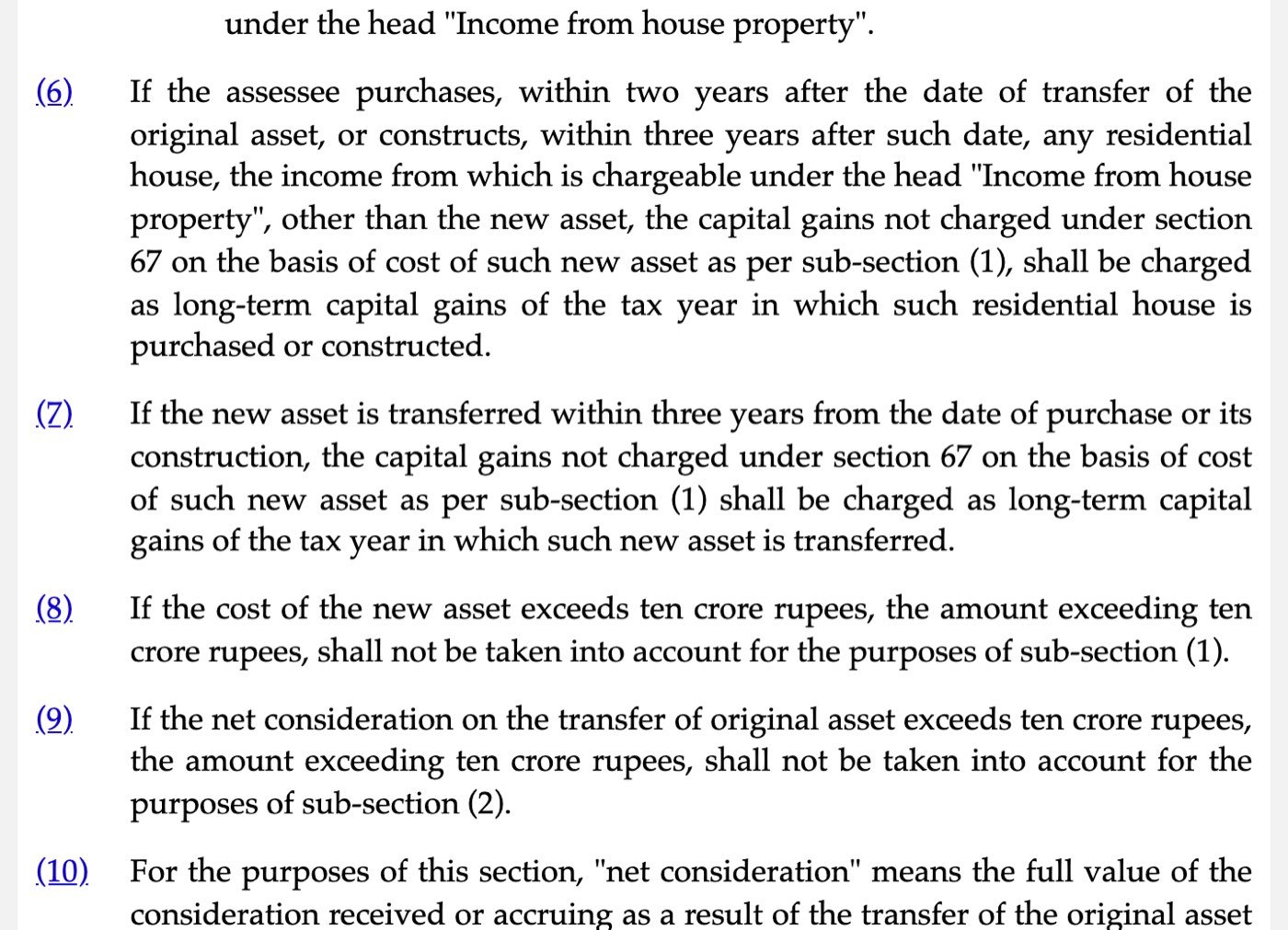
The exemption under section 54F can never exceed ₹10 crore, because the cost of the new house counts only up to ₹10 crore (section 86(8), and section 54F from assessment year 2024-25 after the Finance Act, 2023). The gain is always smaller than the net consideration, so gain × ₹10 crore ÷ net consideration always stays below ₹10 crore. For any sale with a net consideration of ₹10 crore or less, the cap changes nothing: a house costing at least the net consideration still exempts the whole gain. The 2026-27 ITR-2 schema enforces the same ceiling, allowing at most 10,00,00,000 in the “amount of deduction claimed” field for sections 54 and 54F.
What is the major difference between section 54 and 54F?
Section 54 is for the gain on selling a residential house and asks you to reinvest only the gain; section 54F is for the gain on selling anything else and asks you to reinvest the whole net sale proceeds. The rest follows from that:
| Section 54 (now section 82) | Section 54F (now section 86) | |
|---|---|---|
| Asset you sell | A residential house (long-term) | Any long-term asset except a residential house: land, plot, commercial property, shares, mutual funds, gold, bonds |
| What you must reinvest | The capital gain | The whole net consideration (sale price minus selling costs) |
| Exemption | Gain up to the cost of the new house | Gain × cost of new house ÷ net consideration |
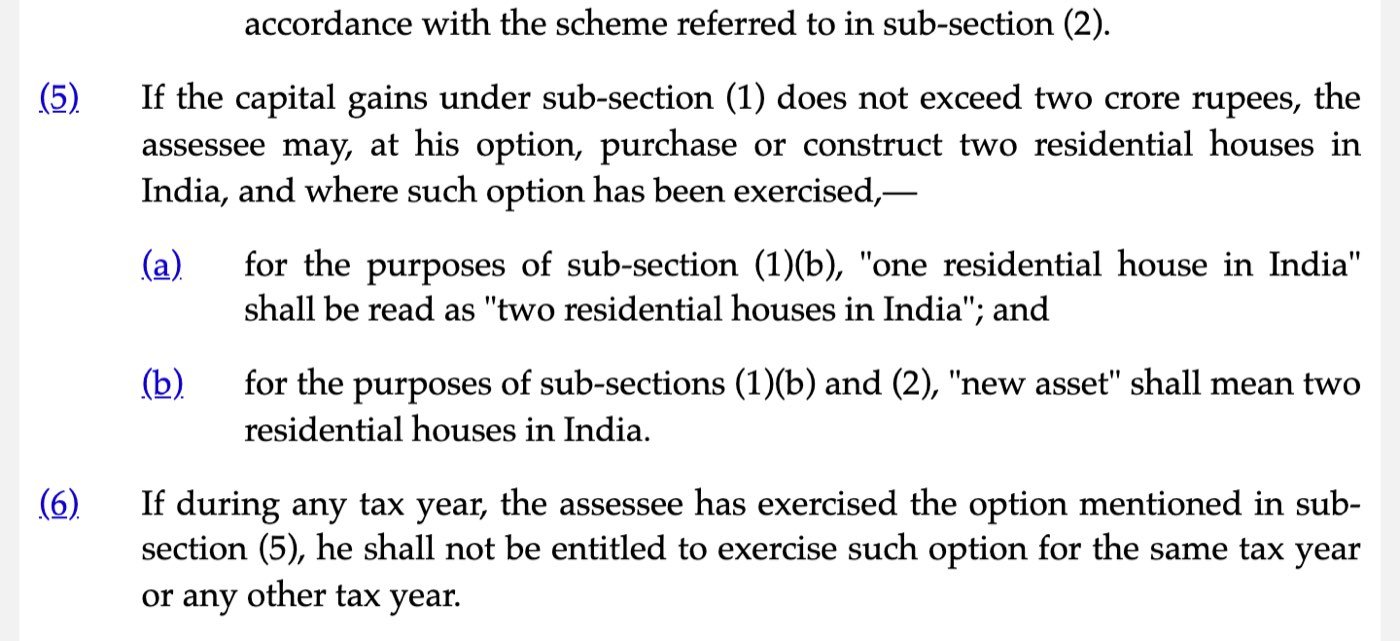
| New house | One house in India; two houses once in a lifetime if the gain is ₹2 crore or less | One house in India only |
| Houses you already own | No limit | At most one other house on the date of sale |
| ₹10 crore cap | Cost of the new house above ₹10 crore ignored | The same, and the scheme deposit counts only on up to ₹10 crore of net consideration |
| Time to buy or build | 1 year before or 2 years after; build within 3 years | The same |
| If the new house is sold within 3 years | Its cost is reduced by the exempt gain, so the gain shows up on that sale | The exempt gain is taxed as long-term gain of that year |
| Buying another house later | No effect | Exemption withdrawn if another house is bought within 2 years or built within 3 |
| 2025 Act section | Section 82 | Section 86 |
The two-house option is the one benefit section 54 has that section 54F lacks. The 2025 Act keeps it in section 82:
Section 54EC, now section 85, is the other alternative for land or buildings only: invest up to ₹50 lakh of the gain in specified bonds within six months of the sale, and keep them five years. For shares, gold or mutual funds, section 54F is the only one of the three that applies.
Can 54F be claimed on sale of shares?
Yes. Section 54F covers any long-term capital asset that is not a residential house, so long-term gains on listed shares, equity mutual funds, unlisted shares, ESOP shares and bonds all qualify, as long as the sale proceeds go into a house. The ITR-2 for 2026-27 has its own 54F line inside the section 112A rows for listed equity. Example 2 above shows the arithmetic. Four points matter for shares:
- Holding period. Listed shares and equity funds are long-term after 12 months; unlisted shares after 24. A short-term gain never qualifies.
- Reinvest the sale value, not the gain. On a portfolio held for years the gain may be a small part of the sale value, so a full exemption needs a house costing as much as everything you sold.
- The ₹1.25 lakh exemption still applies to the listed-equity gain left over after section 54F, so a small taxable remainder can end up tax-free.
- Several sales, one house. Selling shares in instalments is fine; each sale’s net consideration counts towards the same house if the dates fit the one-year-before and two-years-after window for each sale.
What if you have not bought the house by the ITR due date?
Deposit the unspent part of the net consideration in a Capital Gains Accounts Scheme account at an authorised bank branch before the due date of your return, and file the proof with the return; the deposit then counts as cost of the new house (section 86(2) and (3)). The due date is 31 July after the end of the year for most individuals whose accounts are not audited. The scheme dates from 1988 and runs through public-sector bank branches. Bank of Baroda’s description of it on 2 November 2026 gives the working rules:
- Two accounts: Account A is a savings account, Account B a term deposit. Joint accounts cannot be opened.
- Withdrawals: the first on Form C with the passbook, later ones on Form D showing how the previous withdrawal was spent; money withdrawn must be used within 60 days.
- Closing the account needs Form G approved by the Assessing Officer.
Whatever is not spent on the house within the period in section 86(1) is taxed in the tax year in which three years from the sale end (section 86(4)). The tax is on X − Y: the gain exempted on the strength of the deposit, minus the gain that would have been exempt on what you actually spent. Continuing Example 1, suppose Meera sold the plot on 10 August 2026, paid ₹20 lakh to the builder before filing and deposited ₹69 lakh in the scheme. Her return shows the whole ₹54 lakh as exempt. If the flat finally costs ₹60 lakh, then ₹17,59,551 is taxed as long-term gain in tax year 2029-30, the same amount she would have paid tax on had she bought the cheaper flat outright.
Under what circumstances can the exemption under section 54F be forfeited?
The section 54F exemption is reversed, and the exempted gain is taxed as long-term capital gain in a later year, in three situations:
- You sell the new house within three years of buying or building it. The exempted gain is taxed in the year of that sale (section 86(7)), on top of any gain on the house itself.
- You buy another residential house within two years of the original sale, or build one within three. The exempted gain is taxed in the year you buy or finish it (section 86(6)).
- Scheme money is not used within three years. The unused share is taxed in the year the three years end (section 86(4)), as in the example above.
One more rule stops the exemption from applying at all: owning more than one house other than the new one on the date of sale, or buying another within one year of it (section 86(5)).
How to show 54F exemption in ITR?
Show the 54F exemption in ITR-2 (or ITR-3), Schedule CG: enter the sale in the long-term part, claim the exemption on the “Deduction under section 54F” line for that asset, and give the new house’s details in item D. The labels below are from the income tax department’s own ITR-2 utility for assessment year 2026-27 (version 1.4), which covers sales between 1 April 2025 and 31 March 2026:
- Pick ITR-2, or ITR-3 if you also have business or professional income. ITR-1 and ITR-4 have no place for a 54F claim.
- Open Schedule CG, part B (long-term capital gains), and enter the sale in the row for that asset: land or building, listed equity under section 112A, unlisted shares, or other assets. Give the sale value, the cost and the selling expenses.
- Claim the exemption in the same row, on the line “Deduction under section 54F (Specify details in item D below)”.
- Fill item D, “Information about deduction claimed against Capital Gains”, under “In case of deduction u/s 54/54B/54EC/54F/115F give following details”: date of transfer of original asset, cost of new residential house, date of purchase/construction of new residential house, amount deposited in Capital Gains Accounts Scheme before due date, date of deposit, account number and IFSC, and amount of deduction claimed.
- In a later year, if a scheme deposit from an earlier sale went unused, report the reversal on the line “Amount deemed to be LTCG under sections 54F”.
The return schema behind the utility asks for the same eight fields in its 54F block, and it caps the amount of deduction at ₹10 crore. For a sale on or after 1 April 2026 the claim goes under section 86 in the return for tax year 2026-27, filed in 2027. That return form had not been published on the e-filing portal’s downloads page on 2 November 2026.
What is section 54F in the Income-tax Act, 2025?
Section 54F becomes section 86 of the Income-tax Act, 2025 for any sale on or after 1 April 2026, with the same formula, time limits, ₹10 crore caps and lock-in. The 2025 Act restates the conditions in plainer numbered sub-sections. The changes are in the references: “tax year” for “previous year”, section 67 for section 45, and section 263 for section 139. The neighbouring sections move too:
| Provision | Income-tax Act, 1961 | Income-tax Act, 2025 |
|---|---|---|
| Exemption on reinvesting in a house (assets other than a house) | Section 54F | Section 86 |
| Exemption on selling a house and buying another | Section 54 | Section 82 |
| Capital gains bonds, up to ₹50 lakh, for land or building | Section 54EC | Section 85 |
| Charge on capital gains | Section 45 | Section 67 |
| Debt funds and market-linked debentures always short-term | Section 50AA | Section 76 |
| Long-term gains tax rate (12.5%; 20% with indexation option) | Section 112 | Section 197 |
| Listed equity: 12.5% above ₹1.25 lakh | Section 112A | Section 198 |
| Return of income and its due date | Section 139 | Section 263 |
| Period | “Previous year”, sales up to 31 March 2026 | “Tax year”, sales from 1 April 2026 |
Which section applies depends on the date of the sale, not the date of the new house. A plot sold in March 2026 is claimed under section 54F even if the flat is bought in 2027; a plot sold in April 2026 is claimed under section 86.
धारा 54F क्या है? (Section 54F kya hai)
इनकम टैक्स एक्ट की धारा 54F के तहत, अगर कोई व्यक्ति या HUF मकान के अलावा कोई लंबी अवधि की संपत्ति (जैसे ज़मीन, प्लॉट, शेयर, म्यूचुअल फंड या सोना) बेचकर उसकी पूरी शुद्ध बिक्री राशि से भारत में एक रिहायशी मकान खरीदता है, तो पूँजीगत लाभ पर टैक्स नहीं लगता। मकान बिक्री से एक साल पहले या दो साल बाद तक खरीदा जा सकता है, या तीन साल के भीतर बनवाया जा सकता है। अगर पूरी राशि नहीं लगाई, तो उसी अनुपात में छूट मिलती है: छूट = पूँजीगत लाभ × नए मकान की लागत ÷ शुद्ध बिक्री राशि। बिक्री की तारीख पर नए मकान के अलावा एक से ज़्यादा मकान नहीं होना चाहिए, और नए मकान की लागत ₹10 करोड़ तक ही गिनी जाती है। 1 अप्रैल 2026 से यही नियम इनकम-टैक्स एक्ट, 2025 की धारा 86 में है।
Common questions
A capital gains exemption for individuals and HUFs who sell a long-term asset other than a residential house, such as land, shares, mutual funds or gold, and invest the net sale proceeds in one residential house in India within the time limits. From 1 April 2026 it is section 86 of the Income-tax Act, 2025.
The part of the long-term capital gain that is not taxed: capital gain multiplied by the cost of the new house and divided by the net sale consideration. If the house costs at least the net consideration, the whole gain is exempt. House cost above ₹10 crore is ignored.
Section 54 applies when you sell a residential house and requires you to reinvest only the capital gain; it also allows two houses once if the gain is ₹2 crore or less. Section 54F applies when you sell any other long-term asset and requires you to reinvest the whole net sale consideration, with no two-house option and a limit of one other house owned on the date of sale.
Yes. Long-term gains on listed shares, equity mutual funds, unlisted shares and bonds qualify, because section 54F covers any long-term asset other than a residential house. You must invest the sale value, not just the gain, in one house in India. The ₹1.25 lakh listed-equity exemption then applies to any gain left over.
In ITR-2 or ITR-3, Schedule CG: enter the sale in the long-term part, claim the amount on the line Deduction under section 54F (Specify details in item D below) for that asset, and fill item D with the date of transfer, cost of the new house, date of purchase or construction, any Capital Gains Accounts Scheme deposit with its date, account number and IFSC, and the amount claimed.
The cost of the new house counts only up to ₹10 crore, so the exemption can never exceed ₹10 crore. Below a net consideration of ₹10 crore the cap makes no difference: a house costing at least the net consideration exempts the whole gain.
Purchase within one year before or two years after the date of sale, or complete construction within three years after it. Money not spent by the due date of the return must be deposited in the Capital Gains Accounts Scheme by that date.
Yes, if you own only one residential house besides the new one on the date of sale. Owning two or more other houses on that date, or buying another within one year, rules the exemption out.
The whole net sale consideration, meaning the sale price minus selling expenses, for a full exemption. Invest less and only the same proportion of the gain is exempt. Reinvesting only the gain is the rule for section 54, not 54F.
If you sell the new house within three years, if you buy another house within two years of the sale or build one within three, or if money deposited in the Capital Gains Accounts Scheme is not used within three years. The exempted gain is then taxed as long-term gain in that later year.
Section 86, titled Capital gains on transfer of certain capital assets not to be charged in case of investment in residential house. It applies to sales from 1 April 2026; section 54 is now section 82 and section 54EC is section 85.
Yes. Section 54F, and section 86 of the 2025 Act, apply to any individual or HUF, resident or not, provided the new house is in India.
Only to debt fund units bought before 1 April 2023 and held long enough to be long-term. Units bought on or after that date, and market-linked debentures, are always taxed as short-term gains, and section 54F covers only long-term gains.
No. Since 2014 the law has required one residential house in India, and section 86 of the 2025 Act keeps the words one residential house in India.
- Income-tax Act, 2025, section 86 (Indian Kanoon)
- Income-tax Act, 2025, section 82 (Indian Kanoon)
- Income-tax Act, 2025, full text: sections 67, 76, 85 and 263 (Indian Kanoon)
- Income-tax Act, 1961, section 54F (Income Tax Department)
- Income Tax Department e-filing portal — ITR-2 utility V1.4 and schema V1.2 for AY 2026-27
- Bank of Baroda — Capital Gains Accounts Scheme, 1988
Section 86 and section 82 were read on Indian Kanoon on 2 November 2026; Indian Kanoon’s copy of the 1961 section 54F predates the 2014 “in India” and 2023 ₹10 crore amendments, so the screenshots are of the 2025 Act. The ITR labels are quoted from the official ITR-2 utility for assessment year 2026-27. The calculator and examples apply the Act’s formula; tax is shown before surcharge and does not adjust for a resident’s unused basic exemption. This is an explainer, not tax advice.